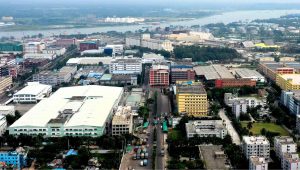
An initiative to build a hi-tech park in the Dadamatch Factory area of Rupsha was taken with the aim of boosting employment opportunities and technology-based skills among young people in Khulna in the age of modern information technology.
However, nine years after approval, the project is yet to see the light of day. Complications have led to repeated extensions of the project timeline, and despite two extensions, overall progress stands at only 45 per cent.
Approved by the Ecnec on 25 April 2017, the project was estimated to cost Tk170 crore. The implementation period was set from 1 July 2017 to 30 June 2024.
The park is being constructed on around four acres of land under the Hi-Tech Park Authority of the Information and Communication Technology Division, with funding from the Government of India.
In 2022, the then ICT Minister Mostafa Jabbar laid its foundation stone.

Indian construction firm Larsen & Toubro (L&T) completed 36 per cent of the work by July 2024. However, following the fall of the Awami League government on 5 August that year, the contractor left the site, bringing construction to a halt. This created uncertainty over the future of the project.
Later in November 2024, a 12-member delegation from Larsen & Toubro visited Khulna, inspected the site and expressed its intention to resume work.
So far, 65 per cent of the main building has been completed. Officials said it would take another year to resume full progress, and the project deadline may be extended once again.




Project-in-charge (Confidence Group) BM Hedayetul Islam told TIMES of Bangladesh that the project was awarded to Larsen & Toubro, with Confidence Group working as a subcontractor under them.
A source involved with the project said the work is expected to be completed by December 2027. “Our deadline was until June 2026, but the process of extension is now underway,” he said.
Due to delays beyond the stipulated timeframe, locals will have to wait at least another year to see the expected benefits of the project.
Once operational, the park is expected to train around 1,000 young men and women annually and generate about 3,000 employment opportunities.
Shamim, CEO of Airtech IT in Khulna, said, “Our office is only 500 square feet, where six to seven people work together. Our workload is increasing and new projects are coming in, but due to space constraints we are unable to recruit new staff, despite having the intention. There are many talented freelancers and IT experts in Khulna. If institutions like ours can rent office space in the IT park, we will be able to work with larger teams.”
He added that many other similar organisations are also waiting for the park to become operational.
“This will create new employment opportunities, increase job prospects for local youth, and encourage many entrepreneurs to establish new businesses. It will also strengthen Khulna’s economy. With the right facilities, young people here will be able to deliver international-standard work,” Shamim said.
Companies also hope the IT park will include office space, startup opportunities, training centres, high-speed internet, seminar and networking facilities, and links with investors. They believed that if these facilities are ensured, the Khulna IT Park could emerge as a strong IT hub in the southwestern region.
Md Nasir Uddin, assistant maintenance engineer and regional director of Bangladesh Computer Council, said that participation of young people in various freelancing training courses under BCC Khulna was significant in the 2025–26 fiscal year. Around 100 participants completed different freelancing and digital marketing courses under year-long training programmes. These skilled youths are now preparing to contribute to the country’s digital economy through technology-based employment.
Md Babul Hossain, member secretary of Khulna Citizens’ Society, said, “The Khulna Hi-Tech Park project was a timely initiative. For competing in the international market and advancing as a nation, this project was essential. But unfortunately, due to time constraints or other reasons, it has not yet been implemented.”