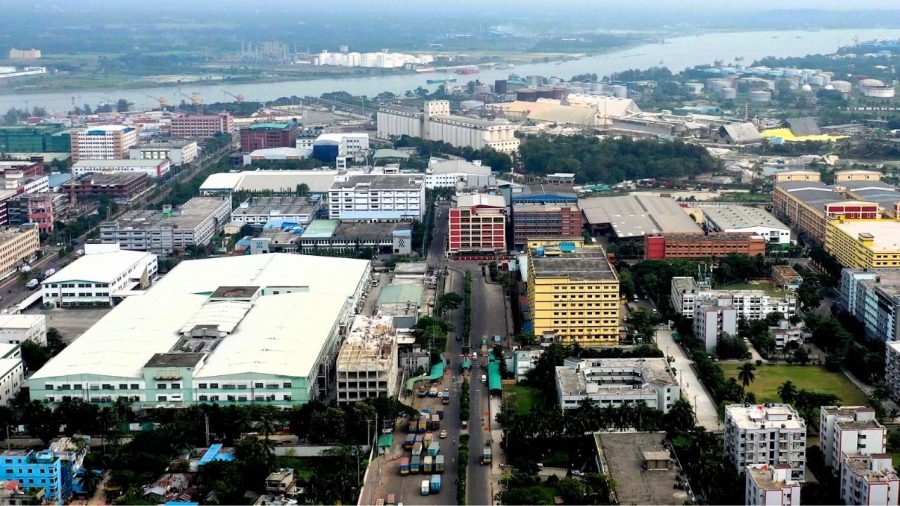

Twenty years ago, the site of Karnaphuli Export Processing Zone (EPZ) was part of a shuttered steel mill. Today, the 209-acre industrial estate has generated more than $14.15 billion in exports, offering a striking example of how a small industrial footprint can produce an outsized economic return.
The zone, which began operations on 12 September 2006, has attracted $787.33 million in investment and now directly employs about 80,000 people. Another 1 lakh livelihoods are estimated to be linked indirectly to its factories and related economic activities.
Its performance is also central to the broader case made by the Bangladesh Export Processing Zones Authority (Bepza)- the contribution of EPZs cannot be measured simply by the customs duties collected on imported raw materials.
“Once a factory is established in an EPZ, its economic activities spread across multiple dimensions,” Md Tanvir Hossain, Bepza member for Investment Promotion, said at a press briefing at Karnaphuli EPZ on Saturday.
He said EPZ factories generate economic activity through workers’ wages, corporate taxes, transport, clearing and forwarding services, local suppliers, catering, logistics and other businesses connected to industrial production.
The numbers illustrate the scale of that contribution.

Bepza’s eight EPZs and two economic zones occupy a combined 3,550 acres, or about 0.01 per cent of Bangladesh’s total land area. Yet they generated $8.41 billion in exports in the 2025-26 fiscal year, accounting for 17.51 per cent of the country’s total export earnings.
The zones had attracted $7.41 billion in investment by August 2026 and employed about 5.6 lakh Bangladeshi workers as of July.
Karnaphuli EPZ alone accounted for about 2.5 per cent of the country’s total exports despite occupying only about 209 acres.
Tanvir said the duty-free regime is primarily designed to allow manufacturers to import raw materials and export finished goods competitively. But the wider economic return extends beyond customs revenue.




Workers’ wages circulate through the domestic economy, while factories begin paying corporate taxes after their tax-holiday periods. Corporate tax rates generally range from 24 per cent to 35 per cent, he said.
EPZ factories also create demand for transport operators, clearing and forwarding agents, restaurants, logistics providers, stationery suppliers and industries that supply manufacturers.
Karnaphuli EPZ’s own history illustrates that transformation.
The land beside the Karnaphuli River, about 10 kilometres from Chattogram city, was once part of Chittagong Steel Mills. The mill was placed under lay-off in 1998 and permanently closed through a government notification on 7 July 1999.
In 2004, Bepza received 222.42 acres of land from the defunct mill in two phases. Two years later, on 12 September 2006, Karnaphuli EPZ was formally inaugurated.
The former industrial site has since attracted investors from China, Taiwan, Hong Kong, South Korea, India, Sri Lanka, Japan, the UK, the US, the Netherlands, Malaysia, Canada and Bangladesh.
The zone now has 258 industrial plots across about 209 acres. Forty enterprises are in production, including 29 fully foreign-owned companies, three joint ventures and eight locally owned companies. Five more projects are under implementation.
The investor mix has turned the zone into a manufacturing base for companies seeking to integrate Bangladesh into wider global production networks.
Lee Hong Woo, chief executive of Campvalley Global, said Bangladesh had become an important part of the company’s international expansion.
“We really believe Bangladesh is the future of our company and an important part of our overall growth,” he said at the briefing.
He said Bepza’s support had helped the company expand and that it planned further investment in Bangladesh.
Campvalley is also building a project in Mirsarai and aims to begin bulk production before the end of the year. Continued support from Bepza will be important to completing the project, he said.
Bepza Executive Director for Public Relations Abu Syeed Md Anwar Parvez and Karnaphuli EPZ Executive Director Mahbub Ahmed Siddiq attended the briefing, along with investors, representatives of different organisations and journalists.
A documentary on the zone’s development was screened at the event, followed by visits to four factories producing footwear, bicycles, ready-made garments and bags.
For Bepza, Karnaphuli’s transformation is more than the story of one industrial estate. It shows how converting underused industrial land into export-oriented manufacturing can generate employment, investment and business activity well beyond the zone itself.
As Bangladesh seeks to expand its industrial base, the experience also highlights the value of concentrating infrastructure and manufacturing activity on limited, well-connected land.