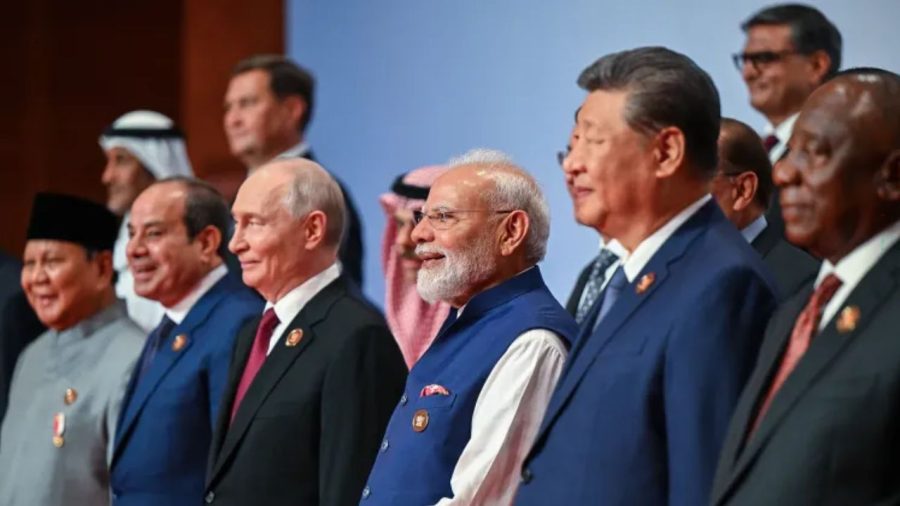

BRICS leaders unanimously adopted a joint declaration on the opening day of their two-day summit in New Delhi, overcoming divisions within the 11-member bloc over the wars in Iran and Ukraine.
The New Delhi Declaration, adopted on Saturday, called for restraint in the Middle East but stopped short of condemning US-Israeli strikes or Iranian attacks on Gulf countries. It also criticised the global trade war without directly naming the United States.
Chinese President Xi Jinping and Russian President Vladimir Putin joined other leaders at the summit amid heightened geopolitical tensions following the US-Israeli war on Iran, US President Donald Trump’s tariff measures and Washington’s unilateral foreign policy decisions.
Reporting from New Delhi, Al Jazeera’s Um-e-Kulsoom Shariff said BRICS leaders had “steered clear” of naming individual countries, including over the issue of sweeping US tariffs.
“We’ve seen BRICS countries who have been targeted, be it India, Russia, China, or any other, but they have stayed clear,” she reported.
“While they said unilateral tariffs are condemned and they work against international law, they have not named the US. So India had to keep in mind that it has bilateral trade relations with other countries, and so do others.”
Indian Prime Minister Narendra Modi described the bloc as reaching a “coming of age” moment and called on the Global South to become a “rule-shaper” rather than simply follow rules set elsewhere.
Here are the key takeaways from the summit declaration:
What is BRICS?
BRICS was formed in 2006 as BRIC, comprising Brazil, Russia, India and China. South Africa joined the grouping four years later, giving it the name BRICS.
The bloc has since expanded to include Egypt, Ethiopia, Iran, the United Arab Emirates, Saudi Arabia and Indonesia.
BRICS members represent nearly half of the world’s population and around 40 per cent of global GDP.
The grouping has sought a greater voice for developing economies in global institutions traditionally dominated by Western powers. It has also called for reforms to institutions such as the World Bank, International Monetary Fund and World Trade Organization.

Modi stressed that BRICS should not be seen simply as an anti-Western alliance.
“BRICS is not against anyone,” he said, while calling for a stronger role for the Global South in shaping global governance.
US-Israel war on Iran
The conflict in Iran posed one of the biggest challenges to the expanded BRICS’ ability to reach a common position.
In the declaration, leaders expressed “deep concern over the continued escalation of tensions” in the Middle East and called for “maximum restraint”. They also urged countries to avoid actions that could further worsen the situation.
However, the statement did not explicitly name the US, Israel, Iran or the Gulf states.
That was a softer position than the one adopted at last year’s BRICS summit in Rio de Janeiro, where leaders condemned the US and Israeli war on Iran as a “blatant breach of international law”.
In a separate statement, Xi said the war “does not serve the common interests of the international community” and called for a political settlement and a permanent, comprehensive ceasefire.
BRICS foreign ministers failed to agree on a joint statement in May because of differences over the conflict. Iran and the UAE are both BRICS members, but the UAE has faced Iranian attacks during the war.




Former Indian Foreign Secretary Nirupama Menon Rao described New Delhi’s success in securing the declaration as a “significant diplomatic success” despite “sharp differences between Iran and the UAE”.
“Consensus was preserved, but only through carefully generalised language. In this, BRICS’s value and its limitation was exposed: it can keep difficult conversations alive and affirm broad principles, but it struggles to assign responsibility or organise collective action when there is the occasional collision of the interests of its members,” she posted on X.
The declaration also expressed concern over deliberate attacks on civilian infrastructure and peaceful nuclear facilities operating under International Atomic Energy Agency (IAEA) safeguards.
The wording could be seen as an indirect criticism of US and Israeli attacks on Iranian nuclear facilities.
During the 12-day war in 2025, the US struck three major Iranian nuclear facilities in Natanz, Isfahan and Fordow.
Praveen Donthi, a senior analyst at the International Crisis Group, said expectations for the summit had been low because of geopolitical instability and conflicting strategic interests among members.
“The members, invested in the success of this non-Western grouping, would be reasonably satisfied with the modest outcome,” he said.
Donthi said India had drawn on its strong ties with all BRICS members and worked behind the scenes to secure the declaration. The main challenge, he said, was persuading Iran and the UAE, which are on opposing sides of the conflict.
Russia-Ukraine war
The war in Ukraine remains another major source of division within BRICS, particularly because Russia is one of the group’s founding members.
The declaration avoided directly mentioning Ukraine, instead calling for international disputes to be resolved through “dialogue, consultation, and diplomacy”.
However, BRICS leaders criticised unilateral sanctions imposed without authorisation from the UN Security Council.
“We call for the elimination of such unlawful measures, which undermine international law and the principles and purposes of the UN Charter,” the declaration said.
The position is particularly significant for Russia, which has faced extensive Western sanctions since launching its full-scale invasion of Ukraine in 2022.
India has maintained close ties with Moscow and continued importing Russian oil amid disruptions to global energy supplies following the US-Israel war on Iran.
Kremlin spokesman Dmitry Peskov said on Sunday that Xi and Modi had offered to help facilitate peace talks on Ukraine, while Putin welcomed their readiness, Russian state news agency TASS reported.
Trump last year imposed a 25 per cent tariff on Indian goods over New Delhi’s purchase of Russian crude. India has since reduced its imports of Russian oil.
Support for Palestinian statehood
BRICS adopted considerably stronger language on Palestine.
The declaration voiced “firm opposition” to the forced displacement of Palestinians and efforts to alter the geography or demography of the occupied Palestinian territory.
It called for an end to Israel’s genocidal war in Gaza, unhindered humanitarian access, continued support for the UN Relief and Works Agency for Palestine Refugees (UNRWA), and full UN membership for Palestine.
The bloc also reaffirmed support for a two-state solution and the creation of a sovereign Palestinian state along the 1967 borders, with occupied East Jerusalem as its capital.
US tariffs
The declaration criticised “unilateral tariff and non-tariff measures” that distort global trade and reiterated opposition to sanctions imposed without UN Security Council authorisation.
The US has imposed tariffs on several BRICS members, including China, Russia and India. Trump has previously described the bloc as “anti-American” and threatened further tariffs against countries that align themselves with BRICS.
Putin, speaking at the summit, accused countries “accustomed to thinking in colonial categories” of using tariffs, sanctions and “brute force” to contain emerging competitors.
At the same time, BRICS called for greater cooperation to safeguard global trade, supply chains, energy flows and maritime security as conflicts continue to disrupt international commerce.
Push for a multipolar world
BRICS reaffirmed its “commitment to strengthening multilateralism and multipolarity”, arguing that a multipolar international system could create greater opportunities for Emerging Markets and Developing Countries (EMDCs).
The declaration said such a system could help EMDCs realise their “constructive potential” while promoting “universally beneficial, inclusive, sustainable and equitable economic globalisation and cooperation”.
Putin called for stronger representation of Asia, Africa and Latin America on the UN Security Council, saying established powers were resisting the shift towards a multipolar world.
Xi urged BRICS members to help steer the international order towards greater “equity and justice”.
Modi similarly called on the Global South to move from being a rule-taker to a “rule-shaper”.
“We have to transform this pyramid of privilege into a platform of partnership,” Modi told the summit.
At the same time, India has sought to distance BRICS from the perception that the bloc exists primarily to challenge the West.
“We are not against anyone; rather, we strive to move forward with the approach of taking everyone along,” he asserted.