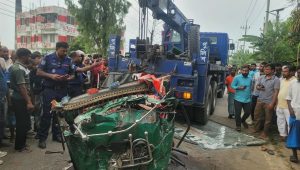
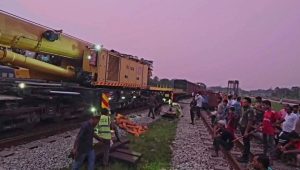
At least 281 people were killed and 837 others injured in 292 road accidents across the country in 13 days surrounding Eid-ul-Adha, according to a report released by Road Safety Foundation (RSF).
The report, which covers the period from 21 May to 2 June, reveals a grim daily average of approximately 22 fatalities. Motorcycle accidents remained the deadliest factor, accounting for 124 deaths in 141 incidents, which represents over 44 per cent of the total fatalities. The victims included 34 women, 48 children, and 37 pedestrians.
Divisional statistics
Dhaka Division recorded the highest number of accidents and casualties, with 101 people killed in 95 incidents.
In contrast, Sylhet Division saw the lowest number of fatalities. Further statistics show that accidents in the Rajshahi Division accounted for 18.50 per cent of deaths, followed by Chittagong at 12.09 per cent, Khulna at 10.32 per cent, and Barisal at 8.90 per cent.

Nature of accidents and vehicles involved
The analysis of the accidents shows that 127 cases (43.49 per cent) occurred after drivers lost control of their vehicles, while 73 (25 per cent) were head-on collisions. Additionally, 38 incidents (13 per cent) involved pedestrians being run over, and 42 (14.38 per cent) were rear-end collisions.
A total of 507 vehicles were involved in these accidents. Motorcycles comprised the largest share at 30.96 per cent, followed by heavy vehicles such as trucks, covered vans, and lorries at 22.09 per cent.


Three-wheelers (including easy-bikes and CNG auto-rickshaws) accounted for 18.34 per cent, while buses made up 15.58 per cent of the vehicles involved.
The report further noted that most accidents occurred in the morning (23.63 per cent) and afternoon (21.23 per cent), followed by night-time incidents (19.52 per cent).
Primary causes
The RSF identified several key reasons for the high toll, including –
- Reckless speeding and faulty vehicles.
- Driver incompetence and physical or mental exhaustion.
- Lack of fixed pay and working hours for transport workers.
- Risky motorcycle riding by teenagers and youths.
- Weak traffic management and the presence of slow-moving vehicles on highways.
- Extortion within the public transport sector and a lack of public awareness regarding traffic laws.
Recommendations for safer transit
The foundation observed that the country lacks enough safe, high-quality public transport options to accommodate the massive surge of passengers during the 4 to 5 days of Eid celebrations. To address this, RSF urged government to adopt a three-year sustainable and integrated transport plan.
Key recommendations include –
- Reforming and expanding the railway network and improving water transport to reduce pressure on roads.
- Increasing the BRTC bus fleet and utilising buses owned by the Police, BGB, and Ansar during the Eid rush.
- Opening toll plazas for free movement during the Eid journey to prevent traffic congestion.
- Constructing service roads on all highways for slow-moving small vehicles.
- Restructuring the National Road Safety Council (NRSC) to oversee BRTA, BRTC, and DTCA with greater accountability and transparency.
The RSF concluded that while fatalities have decreased slightly, there has been no significant improvement in road transport management.
The organisation stressed that political will is essential to implement modern safety technologies, remove expired vehicles from the roads, and ensure the safety of all commuters.