


The Bangladesh Energy Regulatory Commission (BERC) on Wednesday raised electricity tariffs without conducting a financial impact assessment, despite acknowledging it had the opportunity to do so.
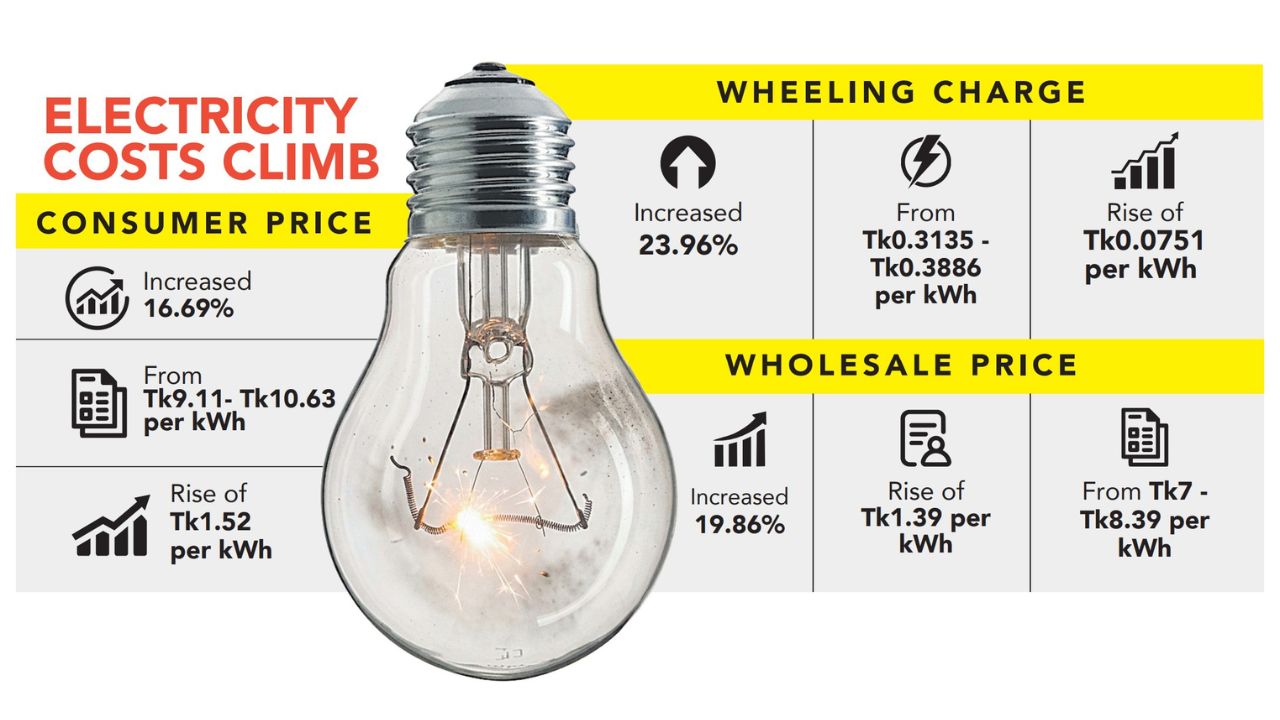
Effective from 1 June, consumer prices will rise by 16.69%, wholesale rates by 19.86%, and wheeling charges by 23.96%.
While BERC denied facing external pressure, it argued that implementing the hike before the 11 June national budget announcement was preferable.
According to the BERC circular, the average retail tariff increases by Tk1.52 per kilowatt-hour (kWh), from Tk9.11 to Tk10.63.
At the wholesale level, the average tariff jumps by Tk1.39 to Tk8.39 per kWh.
Meanwhile, transmission (wheeling) charges rise by Tk0.0751 to Tk0.3886 per kWh. Demand charges across all consumer categories remain unchanged.

Announcing the decision at the Institution of Engineers, Bangladesh, the commission stated the new rates follow public hearings held on 20-21 May. The adjustment factors in power generation, import costs, transmission expenses, and government subsidies.
BERC noted that even with these hikes, the government must still provide Tk41,000 crore in subsidies to the Bangladesh Power Development Board (PDB).
Under the new retail structure, the lifeline rate for residential consumers using up to 50 units increases from Tk4.63 to Tk5.32 per unit.
For general households, the 0-75 unit slab rises to Tk 6.18 (up from Tk 5.26), and the 76-200 unit slab increases to Tk 8.50 (up from Tk 7.20). Consumers using 201-300 units and 301-400 units will now pay Tk 9.10 and Tk 9.62 per unit, respectively.




For high-consumption households, the rate rises sharply to Tk 15.01 per unit for usage between 401 and 600 units, and tops out at Tk 17.35 per unit for consumption exceeding 600 units.
Meanwhile, low-voltage tariffs for irrigation and agricultural pumps have been set at Tk 6.04 per unit.
Non-profit and institutional consumers, including educational, religious, medical, and charitable organisations, under the flat low-tension category will see their rates rise from Tk 7.55 to Tk 9.05 per unit.
For commercial and office spaces, flat low-tension rates increase by Tk 2.35 to Tk 15.36 per unit, while flat mid-tension rates jump from Tk 11.63 to Tk 13.93.
BERC also introduced time-of-use tariffs for low-tension users, fixing off-peak rates at Tk 13.82 and peak-hour rates at Tk 18.43 per unit. In the industrial sector, flat mid-tension consumers will pay Tk 12.85 per unit, up from Tk 10.88.
During the public hearings, BERC’s Technical Evaluation Committee (TEC) reported that the country’s six power distribution utilities require an additional Tk 11,925 crore to operate under current conditions compared to the 2024 tariff structure.
The committee estimated that covering this gap would require a 13.9% increase in retail tariffs, excluding any adjustments for higher wholesale rates and transmission charges. According to the TEC, distribution charges alone needed to rise by Tk 1.25 per kWh to bridge the deficit. This latest tariff revision comes amid mounting pressure on the global energy sector following the outbreak of the Iran war.
The tariff revision follows consecutive government fuel price hikes on 18 April and 31 May, which triggered widespread speculation over an impending electricity adjustment, though diesel prices remained unchanged in the latest round.
The last wholesale electricity revision occurred in February 2024, when the average tariff rose from Tk 6.70 to Tk 7.04 per unit.
During the press briefing, journalists questioned whether public hearings hold any practical significance, pointing out that final tariff revisions often closely mirror the government’s initial proposals.
Reporters also pressed for details on how the commission plans to tackle rising costs, heavy subsidies, and systemic inefficiencies within power companies.
In response, BERC Chairman Jalal Ahmed announced that a detailed order would be issued soon, containing specific directives for power companies to slash operating expenses and curb Bangladesh Power Development Board (PDB) capacity payments.
He noted that critical issues, including merit-order dispatch, capacity charges, and availability factors, would be thoroughly reviewed and adjusted.
To ensure compliance and enforce cost control, the commission will mandate monthly progress reports from all power utilities, Jalal Ahmed added.