Ukraine and Germany have commenced planning for the joint manufacture of sophisticated unmanned aerial vehicles (UAVs) and other combat-proven defence systems, President Volodymyr Zelenskyy announced on Tuesday.
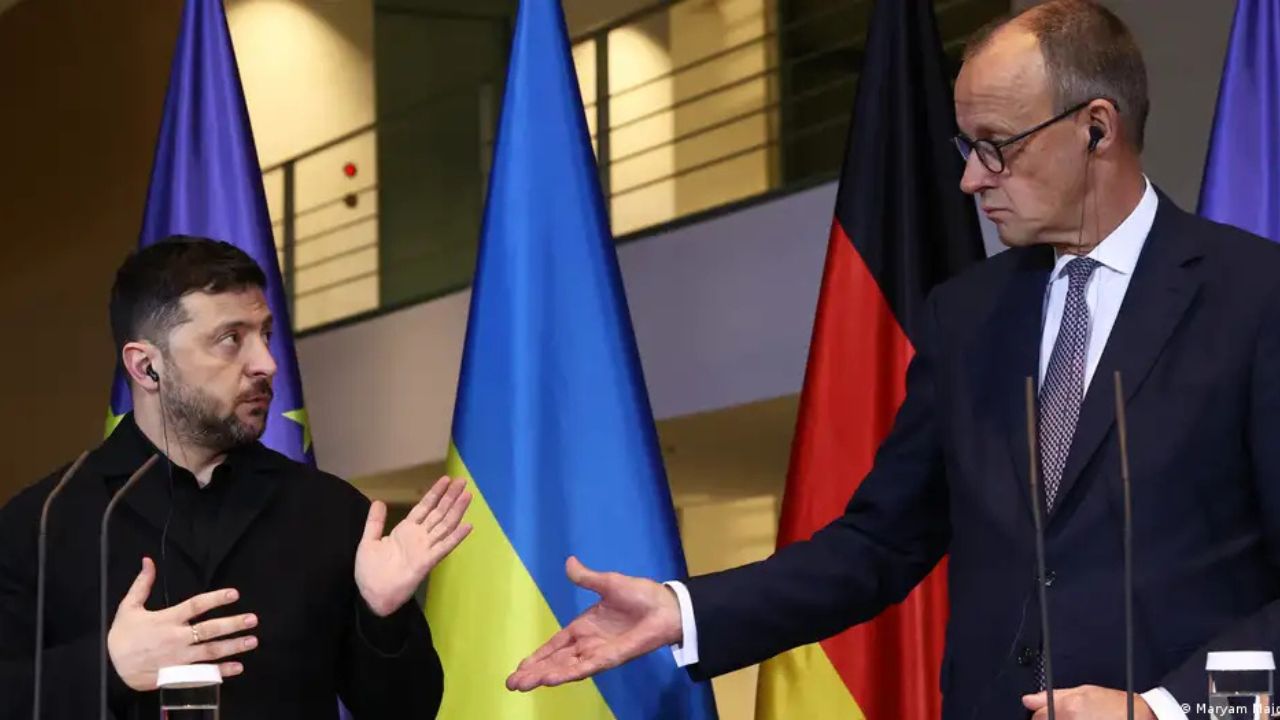
The announcement came during a high-level visit to Berlin for government consultations, where President Zelenskyy met with German Chancellor Friedrich Merz, reports AFP.
At a joint press conference, the Ukrainian leader confirmed that his administration has proposed a bilateral agreement to Germany encompassing various drone types, missiles, software, and modern defence technology.
“Our teams are starting concrete work,” President Zelenskyy said, as Kyiv seeks to bolster its capabilities in the fifth year of the conflict following Russia’s full-scale invasion.

Chancellor Merz emphasised that Germany’s commitment remains unwavering, describing the support as “a very clear signal” to Moscow.
He further noted that Germany would assist Kyiv in facilitating the return of Ukrainian men of military age, asserting that “rapid, tangible progress” is required on the matter.
Funding and troop shortages
While Ukraine possesses the industrial capacity to double its current military output, President Zelenskyy highlighted a critical lack of financial resources. “We simply don’t have enough money,” he remarked.



The potential for increased production hinges on a promised 90 billion-euro (£77 billion) loan from the European Union.
The funds had been delayed by now outgoing Hungarian Prime Minister Viktor Orbán; however, his expected exit from office following recent elections may expedite the process. Chancellor Merz described the release of these funds as “urgent.”
The Ukrainian military is also contending with a significant personnel deficit. In January, Defence Minister Mykhailo Fedorov reported approximately 200,000 desertions and an estimated 2 million people dodging the draft.
Geopolitical shifts and battlefield status
The initiative arrives as US-led diplomatic efforts have slowed, with the Trump administration’s focus shifting toward the war in Iran. Despite this, Tammy Bruce, the deputy US ambassador to the United Nations, informed the Security Council on Monday that Washington would continue advocating for a “durable end” to the war.
On the ground, Russia currently occupies roughly 20 per cent of Ukrainian territory, including the Crimean Peninsula seized in 2014. Nevertheless, Western analysts suggest Kyiv has recently seen successes, disrupting a Russian spring offensive.
Finnish President Alexander Stubb noted on Monday that Ukraine is “on top from a military perspective,” having launched more drones and missiles at Russia last month than it received.
Kyiv’s domestically developed long-range drones and missiles have reportedly struck manufacturing and oil facilities up to 1,750 kilometres (1,000 miles) inside Russian territory.
Civilian casualties
The conflict continues to take a heavy toll on non-combatants. On Tuesday, a Russian missile strike on the city of Dnipro killed four civilians and injured 21 others. Separately, a 52-year-old woman was killed during a Russian drone attack in the southern city of Kherson.
Following his visit to Berlin, President Zelenskyy is scheduled to travel to Norway. Meanwhile, defence leaders from over 50 partner nations are set to hold a virtual meeting on Wednesday to coordinate further military assistance.