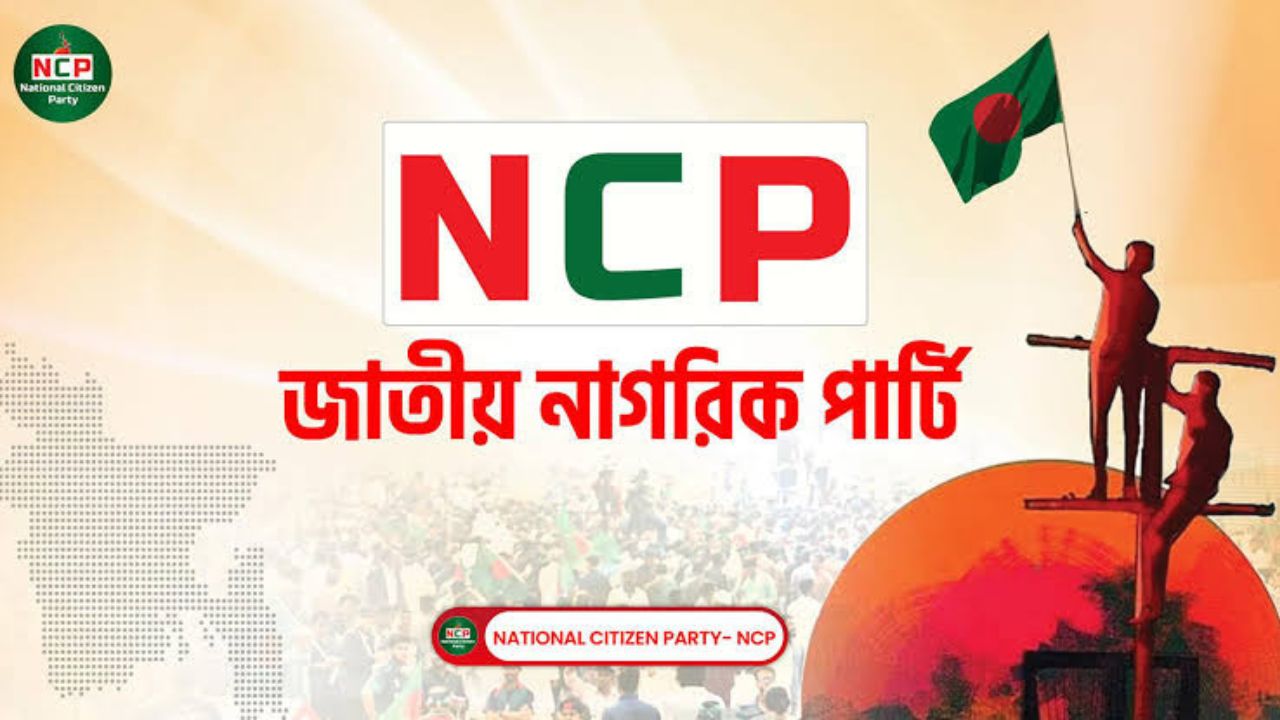



The student-led National Citizen Party (NCP), established following the July Uprising and a prominent member of the 11-party bloc, has released its electoral manifesto in anticipation of Bangladesh’s 13th parliamentary election.
The document, titled “Manifesto of Youth and Dignity,” was officially launched on Friday afternoon at city hotel in Gulshan, Dhaka. The party has put forward 36 pledges, which it describes as a strategic roadmap for the creation of a “Second Republic.”
Presenting the document, NCP convener Nahid Islam stated that the party seeks to establish a “new political settlement” rooted in the aspirations of the 2024 mass uprising.
“For a long time, the people of Bangladesh have been deprived of democracy and voting rights. A new opportunity to restore those rights has now emerged,” he remarked.
NCP spokesperson Asif Mahmud emphasised that sustainable democratic transformation requires profound structural reforms. He asserted that the “Second Republic” is not merely a slogan but a genuine commitment to developing an accountable, inclusive, and humane state.

Mahmud further noted that the manifesto is grounded in realism, focusing on promises that can be implemented within a five-year timeframe. The document is the culmination of extensive public consultations conducted during the party’s nationwide July march last year.
Justice and accountability
Central to the NCP’s platform is a focus on accountability and institutional reform. The party has pledged to establish an independent commission to oversee the implementation of the July Charter’s provisions through legislation and executive orders.
The NCP committed to prosecuting crimes against humanity committed under previous administrations – specifically citing alleged killings, enforced disappearances, and extrajudicial executions – and proposed the formation of a Truth and Reconciliation Commission.


To ensure transparency in governance, the party proposed the “Hishab Dao” online portal, where the annual income and asset statements of ministers, lawmakers, and senior officials would be made available to the public.
Economic reform
On the economic front, the NCP aims to reduce the tax burden on the poor and middle class while raising the tax-to-GDP ratio to 12 percent by expanded investment in education and healthcare and combating tax evasion.
The party has set a target to lower inflation to 6% and restore discipline in the financial sector. Strict measures are proposed for willful loan defaulters, including the seizure of assets and the withdrawal of political rights.
Labour and welfare
The NCP’s labour policy includes setting a national minimum wage of Tk100 per hour, alongside mandatory workplace safety insurance and pensions.
The party also plans to reform the Trading Corporation of Bangladesh (TCB) family card system, allowing subsidised goods to be collected from registered grocery stores instead of trucks.
To address unemployment, the manifesto promises to create 10 million “decent jobs” over five years, with targeted support for SMEs, women, and young entrepreneurs. Additionally, the party aims to send 1.5 million skilled migrant workers abroad annually through government-led training and placement programmes.
Education and Healthcare
The NCP proposes a comprehensive education reform commission, the nationalisation of 75% of MPO-listed institutions within five years, and mandatory six-month internships or research projects for undergraduate students.
In healthcare, the party pledges to establish specialised medical zones, launch a GPS-tracked national ambulance service, and implement digital health records. A long-term goal includes bringing all citizens under a national health insurance scheme.
Social policy and foreign affairs
To promote gender equality, the NCP has proposed directly elected reserved seats for women in parliament. Other welfare measures include extended maternity and paternity leave, period leave in government offices, and mandatory daycare facilities.
Regarding foreign policy, the party pledged a firm stance with India on water-sharing and border killings. It is also committed to resolving the Rohingya crisis and seeking closer engagement with Southeast Asia via ASEAN.
On national security, the NCP plans to expand reserve military forces and enhance air defence and drone capabilities. The party concluded that if the NCP and the 11-party alliance are elected to power, they will play a “responsible role” in fulfilling these commitments.
NCP’s 36 pledges
- An independent commission shall be established to formulate a time-bound and accountable framework for the implementation of those clauses of the July Charter that are contingent upon laws and orders.
- Exemplary justice will be ensured for all crimes against humanity committed during the period of Awami fascism, including the July genocide, the Shapla genocide, the BDR killings, enforced disappearances, and extrajudicial killings; additionally, a Truth and Reconciliation Commission will be formed.
- A special cell of the Human Rights Commission with independent investigative authority will be established to prevent religious hatred, sectarianism, the persecution of minorities, and any form of discriminatory treatment or oppression based on ethnic identity.
- Annual income and asset declarations of all public representatives, including Ministers and MPs, as well as high-ranking government officials, will be clearly published and updated on a detailed ‘Hisab Dao’ (Give Accounts) portal, alongside details of government expenditure and allocations.
- Lateral entry into the bureaucracy will be increased, and 100 per cent of promotions in government service will be performance-based through an independent promotion commission; furthermore, the pay scale will be updated every three years in alignment with inflation, ensuring the inclusion of Imams, Muazzins, and Khadems.
- The NID card will be utilised as the sole document for accessing all services to eliminate the complexities and hassles associated with various different cards.
- The National Minimum Wage will be set at Tk 100 per hour, and labour laws will be strictly implemented to ensure mandatory work-protection insurance and pensions.
- The existing one crore TCB Smart Family Card system will be transitioned from truck-based queues to being usable at registered grocery shops.
- A specific house-rent framework will be developed, and social housing projects will be established through Public-Private Partnerships (PPP) or Waqf Sukuk foundations.
- The tax burden on the poor and middle class will be reduced, tax evasion will be halted, and the tax-to-GDP ratio will be raised to 12 per cent to facilitate investment in education and health and the development of a cashless economy.
- To facilitate a planned LDC graduation, advance FTAs and CEPAs will be signed; export diversification and new industries will be promoted for employment generation, and discipline will be restored in the financial sector (banking, insurance, and capital markets), while strict laws, asset seizures, and the withdrawal of political rights will be ensured for wilful loan defaulters.
- Political costs of business for local and foreign investors will be reduced to zero by completely stopping extortion, launching a 999-style hotline, and strictly implementing a zero-tolerance policy.
- Inflation will be reduced to 6 per cent; the publication of fake and misleading economic data will be stopped, the full independence of regulatory institutions will be ensured, and the savings and future of the public will be secured through school-based financial education.
- The voting age will be lowered to 16, and a Youth Civic Council will be formed to institutionalise and empower the voices of the youth.
- One crore (10 million) honourable jobs will be created in the country over the next five years; a fund of Tk 10,000 crore will be established for women and youth entrepreneurs in the SME sector, alongside reduced registration costs and a tax exemption for the first five years.
- Through government-controlled placement, language, and skill training, 1.5 million safe and skilled migrant workers will be developed annually.
- An Education Reform Commission will be formed to rationally coordinate all existing educational mediums and methods; a separate pay scale for teachers will be implemented, and 75 per cent of MPO-listed educational institutions will be nationalised within five years.
- To bridge the gap between higher education and the workplace, a six-month full-time internship or thesis research will be made mandatory at the undergraduate level.
- A ‘Reverse Brain Drain’ will be initiated by providing expatriate researchers with seniority and one-time funding for laboratories; a National Computing Server will be created to place special emphasis on computational research.
- Alternatives to overseas medical tourism will be created by establishing specialised healthcare zones in the northern and southern regions of the country for the treatment of complex and incurable diseases, including heart disease, cancer, trauma, infertility, and complex surgeries.
- To ensure universal emergency medical services in remote and inaccessible areas, a GPS-tracked national ambulance and pre-hospital emergency system will be formed, integrated with emergency paramedic response teams; advanced emergency departments will be developed in all divisional and district hospitals, ensuring at least one modern ICU and CCU in every district hospital.
- An NID-based digital health record and an effective referral system will be developed for every citizen, and all citizens will gradually be brought under National Health Insurance.
- To increase women’s empowerment, a provision for the direct election of women representatives to 100 reserved seats in the lower house will be introduced, the number of which will decrease as women’s general participation in politics increases.
- Six months of fully paid maternity leave and one month of paternity leave will be mandatory in all institutions; optional period leave will be introduced in government service, and day-care facilities will be made mandatory.
- The supply of women-friendly health products, including sanitary items, will be ensured through a decentralised upazila-based structure, with direct allocations provided to upazila health centres and government schools and colleges.
- A ‘Diaspora Digital Portal’ (One-Stop Service) will be developed where passports, NIDs, birth registrations, consular services, and investments can all be managed online; strict monitoring against harassment and misconduct at airports and embassies will also be introduced.
- Investment and pension benefits will be provided against the amount of remittances sent by expatriates, and travel miles titled ‘RemitMiles’ will be provided for air travel.
- The education, health, employment, voting rights, skill development, and social protection of persons with disabilities and marginalised communities will be ensured.
- An integrated public transport system under a single authority will be established in Dhaka and Chittagong, and the pressure of trucks on roads will be reduced by increasing freight trains.
- Polluting brick kilns will be closed, and clean vehicles and green technology will be ensured; at least 25 per cent of electricity will be produced from renewable sources within five years, and 40 per cent electric vehicles will be introduced in government procurement.
- The installation of ETPs (Effluent Treatment Plants) will be mandatory in all industrial factories, with tax and financial incentives provided to reduce costs; strict laws will be applied with a zero-tolerance policy against industrial pollution, the encroachment of rivers and canals, and environmental destruction.
- Subsidies on fertilisers, seeds, and machinery will be provided directly to farmers through NID-based cashback verification; the direct purchase of products from farmers will be ensured by establishing agricultural collection and sales centres, multipurpose cold storages, and warehouses.
- Not only food security but food sovereignty will be ensured by increasing domestic seed research, preservation, and distribution capabilities; anti-adulteration drives will be intensified with strict punishments ensured.
- A firm role will be taken at the highest diplomatic and political levels regarding all existing issues with India, including border killings, fair shares of international river waters, the extradition of Sheikh Hasina and Awami terrorists, and unequal treaties, seeking recourse in international organisations and courts if necessary.
- A humanitarian solution to the Rohingya crisis will be sought through bilateral and multilateral diplomacy, and relations with Southeast Asian countries will be improved by joining ASEAN.
- A reserve force twice the size of the regular forces will be created for the armed forces; an UAV brigade will be formed in the Army within five years, and at least eight medium-range surface-to-air missile (SAM) batteries will be acquired.