Veteran journalist Mark Tully, whose reporting during the 1971 Liberation War helped draw global attention to the plight of the Bangladeshi people, passed away on Sunday at a hospital in New Delhi. He was 90.
Born in Kolkata, Tully served as the BBC’s South Asia correspondent during one of the most turbulent periods in the region’s history. Throughout the Liberation War, he filed regular and vivid reports on the humanitarian crisis in Bangladesh, documenting atrocities committed by the Pakistan Army and the suffering of millions of Bengalis.
Tully travelled extensively to refugee camps along the border and to districts inside Bangladesh, sending back first-hand accounts that portrayed the realities of the war at a time when access for foreign journalists was limited.
His reporting played a crucial role in shaping international public opinion in support of Bangladesh’s independence during the 1971 war.
Mark Tully is remembered not only as a journalist of exceptional courage and integrity, but also as a rare foreign correspondent whose work left an enduring imprint on Bangladesh’s history.
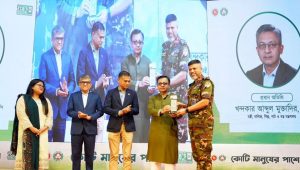
In recognition of his contribution, the government of Bangladesh later honoured him with the Muktijuddho Maitree Sammanona, acknowledging his role in projecting the country’s cause to the world.
Early life and education
Mark Tully was born on 24 October 1935, in Tollygunge, Kolkata, then part of the Bengal Presidency under British India. His father was a British businessman associated with one of the leading managing agencies of the colonial era.

At the age of four, he was sent to a British boarding school in Darjeeling, and by the age of nine, he moved to England for further education. He studied at Twyford School in Hampshire, Marlborough College, and later Trinity Hall, Cambridge, where he read Theology.
Journalistic career
Tully joined the BBC in 1964 and returned to India the following year as the broadcaster’s India Correspondent. Over nearly three decades, he reported on many of South Asia’s defining moments, including Bangladesh’s Liberation War, the Bhopal gas tragedy, Operation Blue Star and its aftermath, the assassination of Indira Gandhi, the anti-Sikh riots, the killing of Rajiv Gandhi, and the demolition of the Babri Masjid.
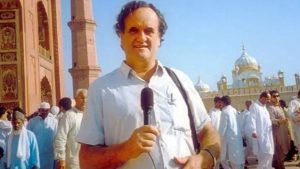
While covering the Babri Masjid demolition in 1992, Tully faced hostility from Hindu extremists, with some chanting threats against him. He was briefly detained before being rescued with the help of local officials. He later described the Babri Masjid demolition as independent India’s “greatest setback” to secularism.
Tully resigned from the BBC in July 1994, ending a career widely regarded for its depth, independence and moral clarity.
Mark Tully in Dhaka to report on the Liberation War
About a month after the Liberation War began, Mark Tully came to Dhaka to gather news.


Pakistan’s military government allowed foreign journalists into Bangladesh only once, granting permission to Tully and one other reporter, according to a report of BBC Bangla.
During that 1971 trip, Tully stayed in Bangladesh (then East Pakistan) for nearly two weeks. He even travelled by road from Dhaka to Rajshahi.
In March 2016, Tully recalled an interview with BBC Bangla. He said, “In those days I was accompanied by Clare Hollingworth, the war correspondent of Britain’s Telegraph. Since we were able to move around freely and observe the situation firsthand, our reports carried special weight.”
He published on-the-ground reports for the BBC describing the devastation he witnessed in different areas in 1971.
“We realized there had been mass killings. On the road from Dhaka to Rajshahi, I saw village after village burned down,” he told BBC Bangla.
How did he gather news?
During the 1971 Liberation War, almost all newspapers coming out of Dhaka were under the control of the Pakistani military. There was no press freedom. Only statements issued by the military regime and news dictated by them were printed.
As a result, reports of killings and atrocities by the Pakistani forces, or the resistance of the freedom fighters, were absent from the local media.
War affairs researcher Afsan Chowdhury told BBC Bangla that even reports from Swadhin Bangla Betar Kendra or Indian media were not always accurate or impartial.
She said, “Therefore, for many people, Western outlets like the BBC became a trusted source of reliable and neutral news.”
Throughout the Independence War, the BBC regularly broadcast reports and analyses on the situation inside blockaded Bangladesh.
“As a BBC journalist, Mark Tully reported on the Liberation War with neutrality, and his style of presenting the news was excellent. That is why his name spread widely among the people,” she said.
Although Tully was allowed into Dhaka in April 1971, the Pakistani military did not permit him to stay longer than two weeks.
In his BBC Bangla interview, Tully said, “When the Pakistani army advanced to the border areas and felt they had control of the situation, that’s when they allowed us to come.”
Later, from London, he reported to the world on the mass killings by the Pakistani forces and other aspects of the Liberation War. “For most of the war I was based in London. From there I wrote and broadcast analyses and commentaries. Much of the information I relied on came from Kolkata,” he said.
“When the refugee crisis began, we received all kinds of reports. We had a very good correspondent named Nizamuddin who was inside the country. He also sent news. Toward the end of the war, he was killed,” he added.
Tully also gathered information from relatives and acquaintances of colleagues who were in Bangladesh at the time.
“I received a lot of help from my colleagues at BBC Bangla in London. Many of them had relatives and friends in the country. They tried to contact them in various ways, and that information was useful for my work,” Tully said in the interview, given about ten years before his death.
His books
Beyond journalism, Tully was a prolific author. His first book, Amritsar: Mrs Gandhi’s Last Battle (1985), co-written with fellow BBC journalist Satish Jacob, examined the political crisis surrounding Operation Blue Star. This was followed by No Full Stops in India (1988), a collection of essays later published in the US as The Defeat of a Congress-man.
In 2002, he co-authored India in Slow Motion with Gillian Wright, offering insights into India’s social and political transformations. His final book, Upcountry Tales: Once Upon a Time in the Heart of India (2017), presented fictionalised narratives rooted in rural north India.