Doughty Street Chambers, legal counsel representing deposed prime minister Sheikh Hasina, has formally petitioned the United Nations High Commissioner for Human Rights to issue an immediate public retraction regarding a February 2025 Fact-Finding Report.
The demand follows claims that suggest the United Nations’ reported casualty figures of 1,400 people from the 2024 civil unrest were “highly inaccurate” and used to “legitimise the violent overthrow” of Awami League government.
Muhammad Habibe Millat, who looks after AL’s international affairs, confirmed the matter to TIMES of Bangladesh.
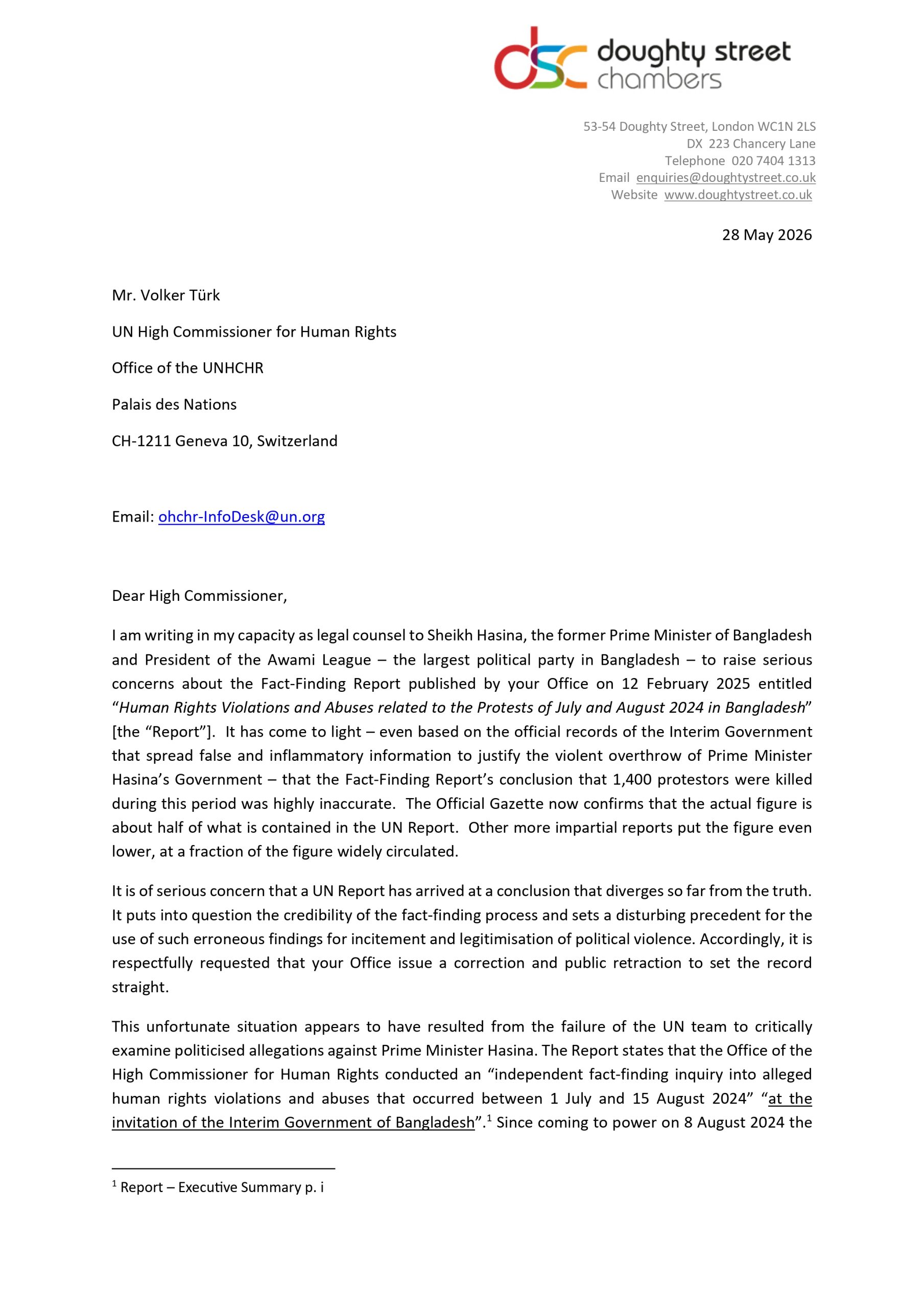
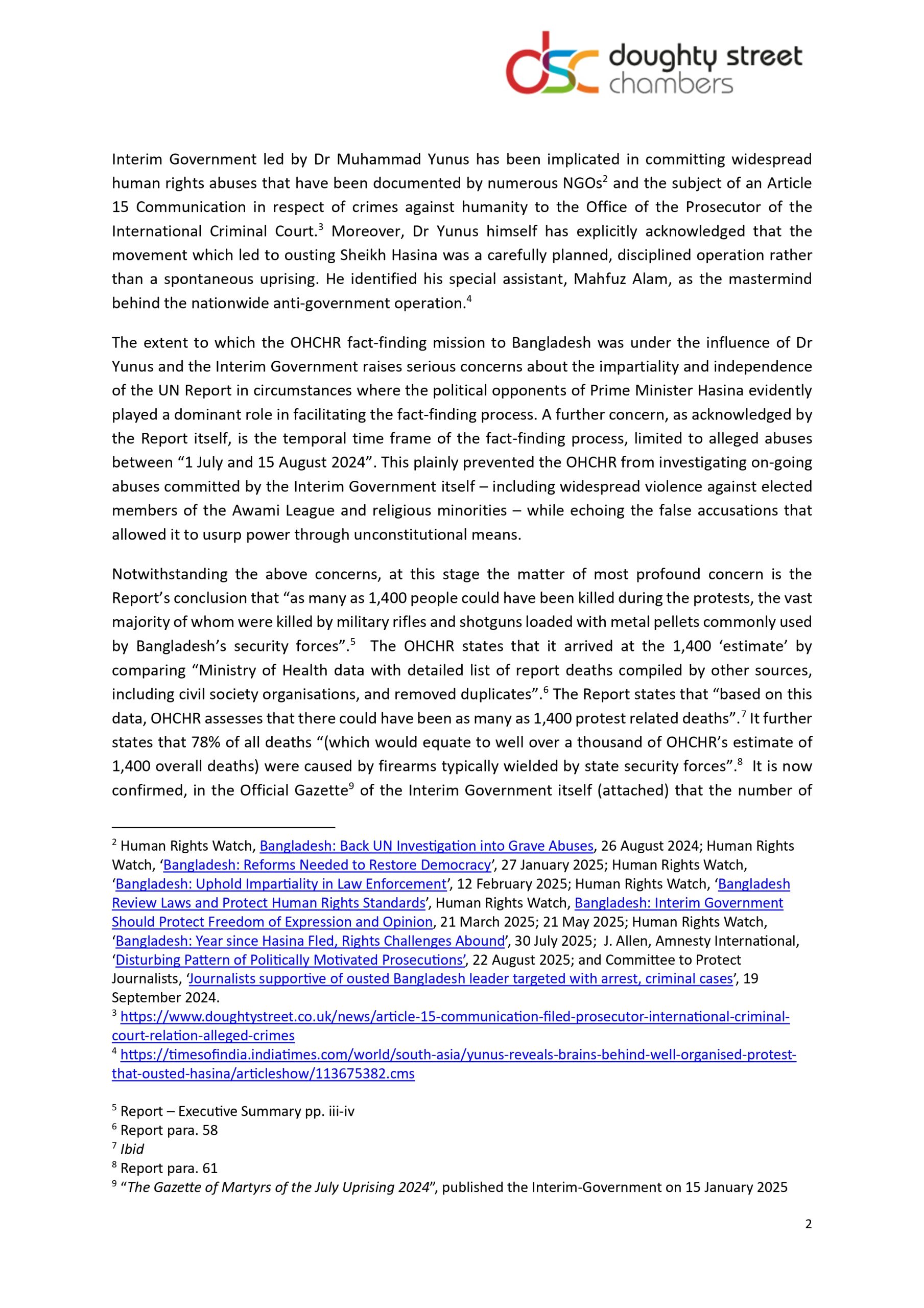
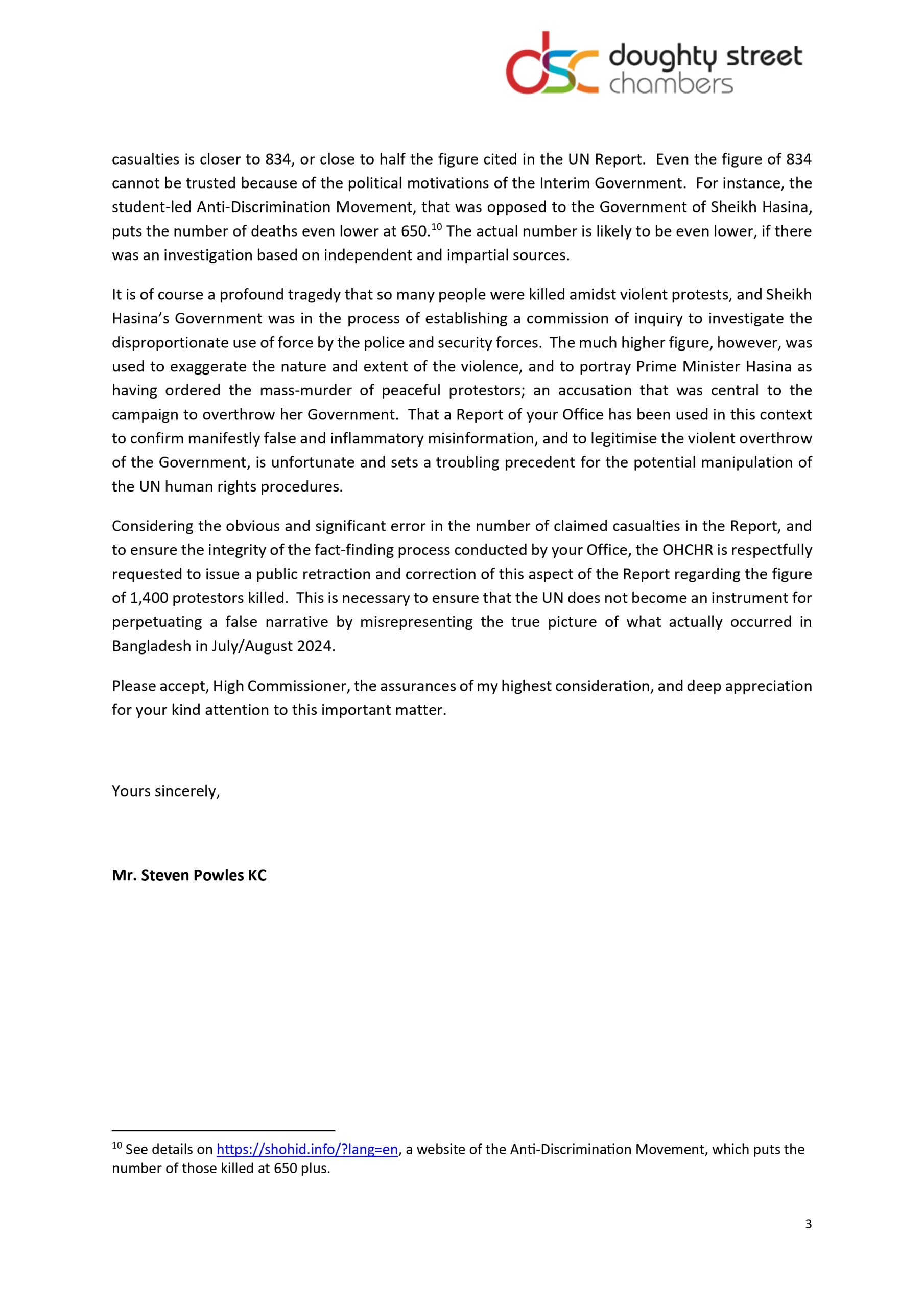
In a comprehensive legal correspondence dated 28 May 2026, Steven Powles KC of Doughty Street Chambers addressed High Commissioner Volker Türk, raising “serious concerns” about the report titled “Human Rights Violations and Abuses related to the Protests of July and August 2024 in Bangladesh.”
The letter claims that the UN’s conclusion that 1,400 people were killed during the protests is “manifestly false” and nearly double the actual figures confirmed by the current administration’s own official records.
‘Discrepancies’ in the death toll
Central to the legal challenge is a significant divergence in data regarding the loss of life during the July and August 2024 protests.
The UN report estimated that “as many as 1,400 people could have been killed,” claiming that 78 per cent of these deaths – equivalent to well over 1,000 individuals – were caused by firearms, specifically “military rifles and shotguns loaded with metal pellets,” which the report attributed to state security forces.
However, Powles pointed to the Official Gazette published by the Interim Government itself on 15 January 2025, titled “Gazette of Martyrs of July Uprising 2024.”

This official state document confirmed a casualty figure of 834, which is close to half of the estimate circulated by the United Nations.
The legal counsel further claimed that even the student-led Anti-Discrimination Movement, which was fundamentally opposed to the Sheikh Hasina administration, maintains a figure lower than the UN’s, placing the death toll at “650 plus” on its dedicated website, shohid.info.
“The much higher figure… was used to exaggerate the nature and extent of the violence, and to portray Hasina as having ordered the mass-murder of peaceful protestors,” the letter read, arguing that such “inflammatory misinformation was pivotal in the campaign to oust the elected government.”
Former state minister for information Mohammad A Arafat told TIMES that all 834 deaths must be investigated “thoroughly and impartially” to determine the actual causes.
“Using the entire number indiscriminately to vilify the Awami League or pursue politically motivated and false cases against leaders does not serve justice,” he said.
Arafat said justice could not be built on “a false or unverified narrative” and that the families of those killed deserved the truth.



He said only a “credible and transparent investigation” could ensure accountability, adding that proper investigation — not political misuse — was the only path towards justice.
Allegations of bias, political influence
The correspondence raised sharp questions regarding the impartiality and independence of the Office of the High Commissioner for Human Rights (OHCHR) fact-finding mission.
Powles alleged that the UN team was under the significant influence of the Interim Government led by Muhammad Yunus, noting that the mission was conducted “at the invitation” of the very administration that seized power following the protests.
The counsel argued that the UN failed to critically examine “politicised allegations” and effectively allowed political opponents of Sheikh Hasina to play a “dominant role” in facilitating the fact-finding process.
The letter suggested that the UN’s findings were used to “echo the false accusations” that allowed the current administration to “usurp power through unconstitutional means.”
‘Mastermind’ and temporal limitations
A key point raised in the letter concerns the nature of the protests. While the UN report framed the unrest as a spontaneous uprising, the counsel cited admissions by Muhammad Yunus himself, who described the movement as a “carefully planned, disciplined operation.”
Yunus reportedly identified his special assistant, Mahfuz Alam, as the “mastermind” behind the nationwide operation.
The legal challenge criticised the temporal timeframe of the UN’s investigation, which was limited strictly to abuses occurring between 1 July and 15 August 2024.
Powles argued this restriction “plainly prevented” the OHCHR from investigating the “on-going abuses committed by the Interim Government itself” following its installation on 8 August 2024.
These alleged abuses include widespread violence against elected members of the Awami League and religious minorities in Bangladesh.
Widespread human rights concerns
The letter noted that since coming to power, the Interim Government has been implicated in human rights abuses documented by a litany of international organisations.
References were made to reports from Human Rights Watch throughout 2024 and 2025, which called for the protection of freedom of expression and an end to politically motivated law enforcement.
Additionally, the counsel cited Amnesty International’s findings regarding a “disturbing pattern of politically motivated prosecutions” and reports from the Committee to Protect Journalists concerning the targeting of journalists supportive of the ousted leader.
The legal challenge also referenced an Article 15 Communication filed with the International Criminal Court (ICC) regarding alleged crimes against humanity committed by the current administration.
Request for ‘integrity’
AL leader and former minister of Hasina cabinet Mohibul Hassan Chowdhoury Nowfel told TIMES of Bangladesh that the OHCHR report on Bangladesh raises “serious questions” over the neutrality and conduct of the UN rights office and warrants impartial scrutiny by the UN secretary-general.
He said any unlawful use of force during the July-August 2024 unrest should be independently investigated, but accountability must be based on verified facts, objective methodology and political neutrality.
Nowfel also criticised what he described as the report’s narrow scope, saying it excluded allegations and widely reported attacks on Awami League supporters, as well as religious and ethnic minorities, following the ouster of the Hasina government.
He said Bangladesh deserves a “transparent, balanced and genuinely independent” investigation reflecting the full reality of the 2024 events, rather than what he called “a partial narrative shaped by political circumstances and pressure from supporters of Mohammad Yunus and extremist religious and political groups who have risen to prominence after August 2024.”
Prior to her ousting, the letter noted, Sheikh Hasina’s government was in the process of establishing its own commission of inquiry to investigate the “disproportionate use of force” by security forces.
Powles emphasised that while the loss of life is a “profound tragedy,” the integrity of the UN’s fact-finding process is at stake when erroneous figures are used for “incitement and legitimisation of political violence.”
The legal counsel concluded by urging the OHCHR to issue a correction to ensure the United Nations does not become an “instrument for perpetuating a false narrative.”
The high commissioner was requested to “set the record straight” regarding the casualty figures to protect the credibility of the international human rights framework.