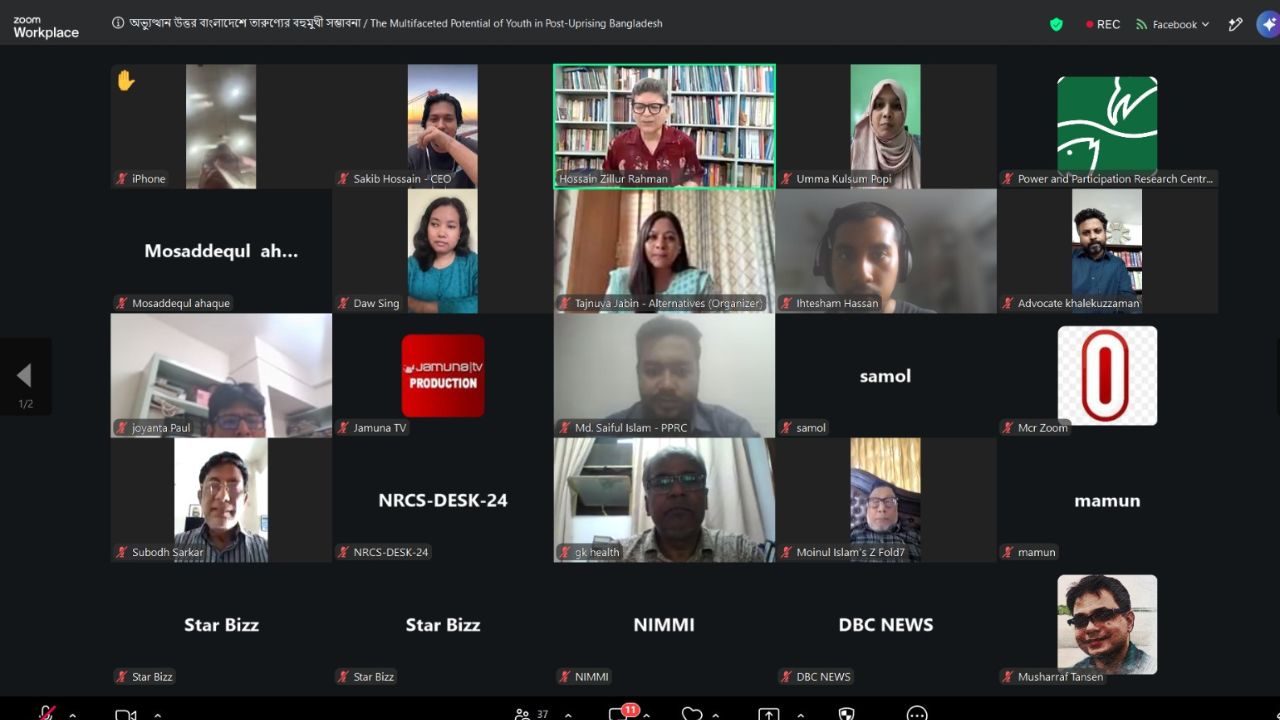

Bangladesh’s youth are seeking to turn the energy unleashed by the July uprising into lasting political, economic and social change, with speakers at a webinar highlighting the need for greater youth participation in politics, entrepreneurship, education and institutional reform.
The discussion at the Power and Participation Research Centre’s “Ajker Agenda” webinar on Saturday focused on how young people’s aspirations and capabilities can be translated into sustained participation and productive opportunities at a time when expectations for political renewal, economic opportunity and social transformation remain high.
Tajnuva Jabeen, organiser of the National Organising Committee at Alternatives, said renewed political interest among young people was an important outcome of the July uprising. She called for an end to the stigma that keeps capable professionals such as doctors, engineers and bankers away from politics, arguing that a genuinely decentralised political system could help build a better Bangladesh over the next 10 to 15 years.
For Sakib Hossain, chief executive officer of Fashol, the opportunity for young people lies partly in using technology to address longstanding weaknesses in agriculture. Drawing on his experience since founding Fashol in 2019, he pointed to farmers’ dependence on intermediaries and uncertainty over whether their produce will ultimately reach markets.
“As a young entrepreneur, I saw technology transforming every industry except the one that feeds our nation, so we built Fashol ourselves,” he said, describing youth-led innovation as a way to close gaps that previous generations had been unable to resolve.

Agriculture could itself offer a new path for young people, said Umma Kulsum Popi, an agri-entrepreneur and agriculture-focused content creator. She said 90 per cent of young people avoid farming in pursuit of careers offering greater income and social status, despite Bangladesh’s fertile soil and the sector’s potential to support livelihoods.
She urged young people to see agriculture as a sector around which they could build a future and a family.




In the Chittagong Hill Tracts, Daw Sing Nue Marma, team lead of TONGDAINGNEY, highlighted the role of young people’s networks in overcoming language barriers and bringing education closer to communities.
Her initiative focuses on non-formal, technology-supported and nature-based education. She said education needs to be reoriented towards creativity and values while exposing young people to real-life issues.
Institutional reform, meanwhile, requires changes to the foundations of the legal system, said Advocate Khalequzzaman. He identified the continued presence of colonial-era laws as a major barrier to change and described the abolition of the independent judicial secretariat initiative as a step backwards.
“Law reform has to be built from the ground up,” he said, arguing that a new generation of political leaders would be needed to carry that process forward.
The gap between young people’s contribution to the July uprising and their subsequent participation in rebuilding the country was highlighted by Munim Mubashshir.
“So many young people who bled for July had the vision and the ability to help rebuild this nation, but were never given a seat at the table,” he said. The responsibility now, he added, is to ensure that the next generation is not remembered only for its sacrifices but is included in shaping the future it fought for.
Hossain Zillur Rahman, chairman of the Power and Participation Research Centre and moderator of the session, said the desire for change was Bangladesh’s greatest strength after July. Harnessing it, however, requires work across institutional spaces, from grassroots reform to the structural forces that resist change.
Such an effort must extend beyond Dhaka and elite circles, he said.
“Young people are wide awake to this desire for change.”
“The real question is whether we’re giving them the right environment and right opportunities to contribute,” Hossain Zillur said.