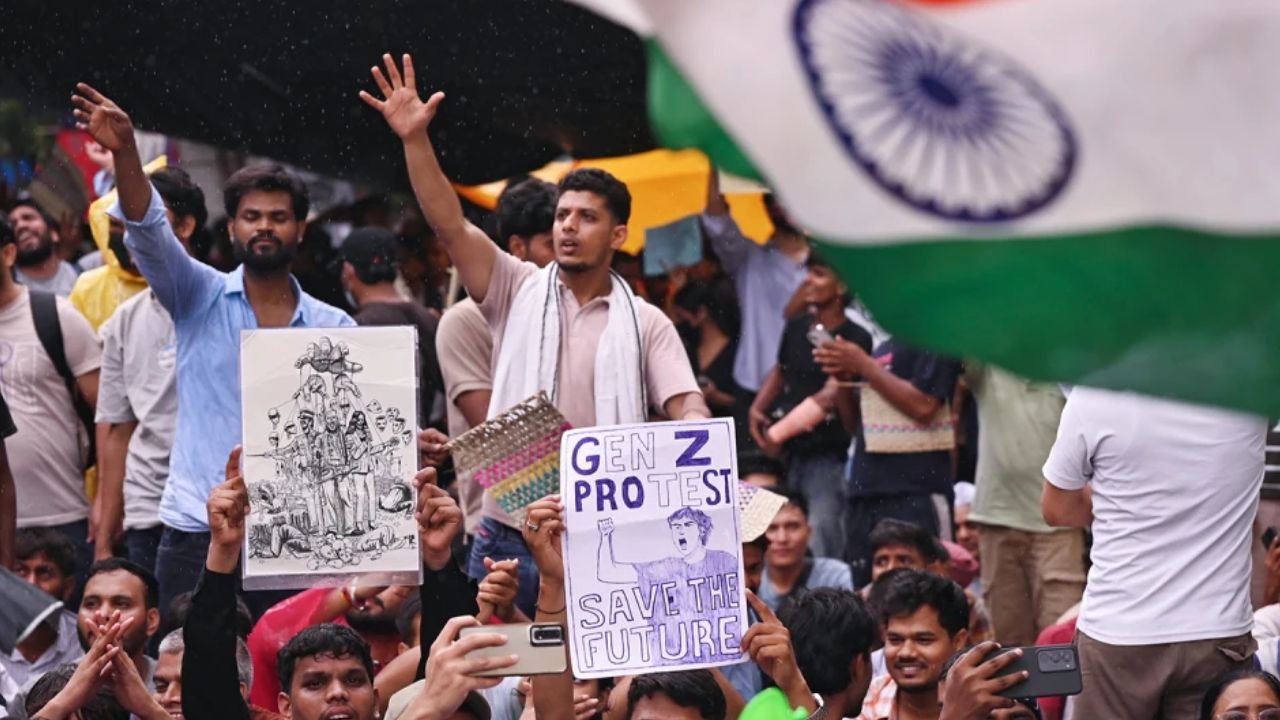



A quietude returned to Jantar Mantar and adjacent Parliament Street in central New Delhi at midnight on Saturday, marking the suspension of a week-long agitation by Cockroach Janta Party (CJP).
The pause in Gen Z-led demonstrations followed the resignation of education minister Dharmendra Pradhan, a development that political commentators describe as a notable setback for Bharatiya Janata Party (BJP)-led administration and a blow to the “strongman” persona of Prime Minister Narendra Modi, reports Al Jazeera.
As municipal workers moved in to erase the protest’s visual legacy from the capital’s walls, CJP founder Abhijeet Dipke warned that the movement was merely entering a new phase.
Unpacking settlement, outstanding demands
The cessation of the protest followed a high-level dialogue between BJP government and youth leaders. The CJP’s campaign had been anchored to two non-negotiable demands: the removal of Pradhan and financial restitution for the families of approximately 20 students who died by suicide following systemic exam paper leaks and cancellations.
During a joint press conference on Saturday, federal ministers Jitendra Singh and JP Nadda appeared alongside CJP representatives Saurav Das and Ashutosh Ranka to confirm that the government would provide the “maximum possible” compensation within existing frameworks.

The activists have specifically sought 10 million rupees (roughly $105,000) for each bereaved family.
However, the resolution of legal and safety concerns remains precarious. While the government pledged that no criminal proceedings would be initiated in BJP-governed states and that existing charges would be retracted, reports of ongoing enforcement actions persist.



In West Bengal, 11 individuals including 10 from Muslim community were reportedly arrested in connection with seven criminal cases. Similar detentions were noted in Assam, where six people were held for solidarity demonstrations.
In Bihar, tensions escalated on Saturday as police reportedly opened fire on protesters, leaving three injured. The government has yet to offer the public apology demanded by CJP regarding a 20 July crackdown by Delhi Police and Rapid Action Force, which resulted in over 100 injuries.
From digital spark to grassroots mobilisation
The movement’s nomenclature and identity stem from a May incident in which a judge reportedly compared unemployed youth to “cockroaches” and “parasites”. In response, Dipke, a Dalit activist, used the social media platform X to ask, “What if all cockroaches come together?”.
This rhetorical question galvanised a digital generation, leading to a physical occupation of the areas surrounding Parliament of India. Analysts suggest that Dipke’s Dalit background, a community historically subjected to caste-based persecution, is a vital element in the movement’s broader sociopolitical significance.
Looking ahead, CJP appears to be transitioning from a single-issue protest group into a broader social entity. Spokeswoman Vaishnavi Gaur indicated that the organisation plans to move beyond educational reforms to address wider societal grievances through “townhall-like” engagements with civil society.
While member Sudhir Sangwan said the group is currently “resting and regrouping” to take their message to the grassroots, the leadership remains cautious about entering formal electoral politics, opting instead to focus on organisational capability.
Opposition pressure and accountability
The political fallout continues to reverberate in Parliament. Rahul Gandhi, leader of Indian National Congress, has signalled his intent to demand a formal government apology for the violence against students.
In a letter to Home Minister Amit Shah, Gandhi condemned the use of “indiscriminate force” and lethal weaponry against youth seeking a transparent education system.
Akhilesh Yadav of Samajwadi Party characterised the minister’s resignation as a “major victory” for India’s youth, urging all political factions to ensure the integrity of future examinations.
Meanwhile, Neha Bora, president of All India Students Association (AISA), emphasised that the reshuffling of ministers does not equate to justice, calling for direct accountability from both Amit Shah and Delhi Commissioner of Police Shri Anurag Kumar for the events of 20 July.