


It was a perfectly normal Friday morning—until a 5.7-magnitude earthquake shook Dhaka University along with places across the country as the clock read 10:38 am.
Students rushed to safer areas in panic. Among them, residents of the university’s old and vulnerable halls of residence were the most anxious. Amid the chaos, some tripped and sprained their ankles, while others—fearing imminent collapse—jumped from multi-storey buildings and were injured.
At least 15 injured students received treatment in both inpatient and outpatient units of the Shaheed Buddhijibi Dr Murtaza Medical Centre, said officials at the centre.
Several critically injured students were transferred to Dhaka Medical College Hospital.
“As soon as I felt the tremor, I tried to get out. But our hall is in such a terrible state that I thought something from the ceiling would fall on me before I reached the ground floor. I felt I had no option but to jump,” said a student, who jumped from the fourth floor of Mohsin Hall.

At the centre of this fear lies the fragile and dilapidated condition of Dhaka University’s residential halls. Students allege that most students do not receive proper accommodation, and those who do are housed in old and high-risk buildings.
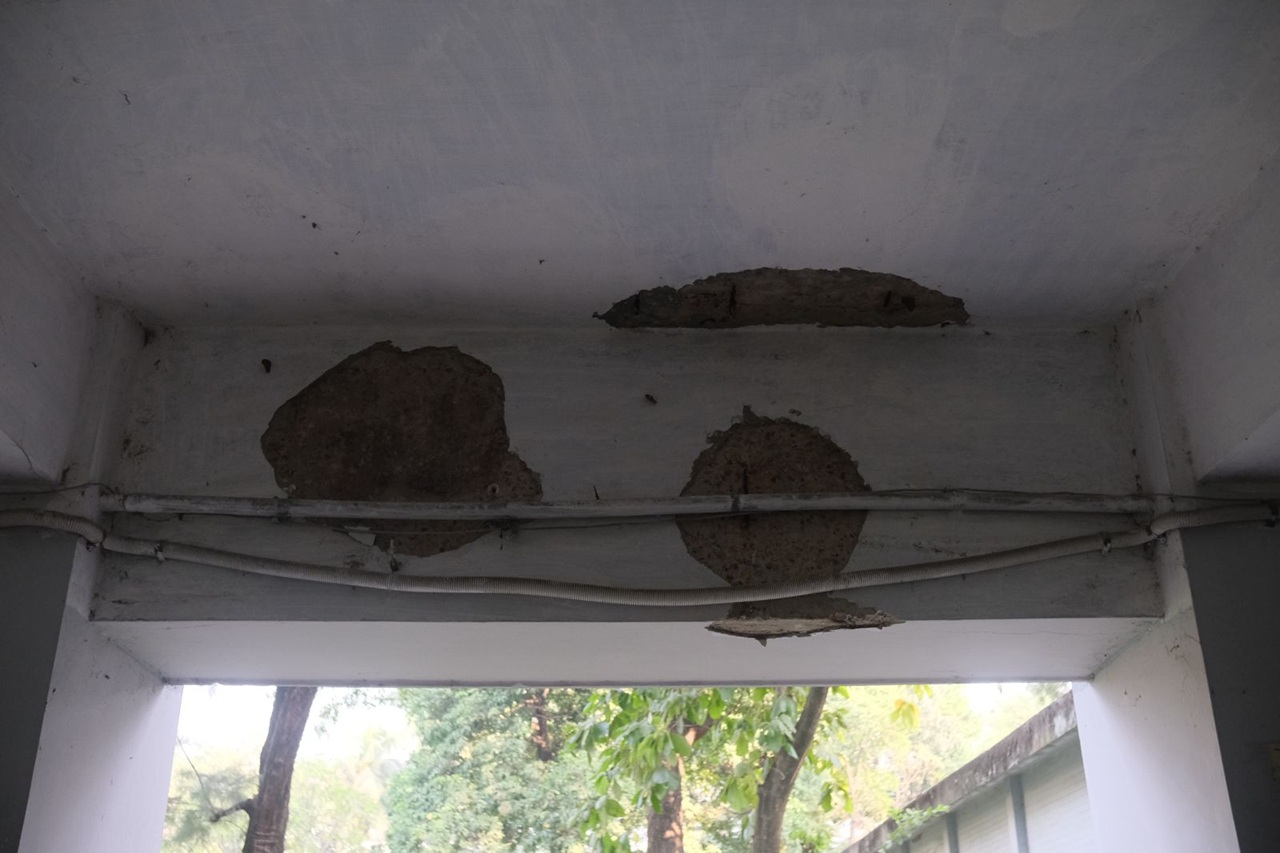
Most of DU’s halls were built before the independence. Decades without significant renovation have led to cracks in walls and ceilings, plaster falling off, and exposed reinforcement rods. Students say that while thin layers of paint or cement are often used to mask the damage temporarily, the structural weaknesses remain.
Amid the situation, students of Salimullah Muslim Hall, Mohsin Hall, Shahid Sergeant Zahurul Haq Hall, Jasimuddin Hall, Surja Sen Hall, and several others have to live in hazardous conditions.




Meanwhile, cracks developed in at least ten of the dorms of Dhaka University due to Friday’s tremor.
Another alarming incident occurred on Wednesday in Room 349 of Shahid Sergeant Zahurul Haq Hall when a large chunk of ceiling plaster suddenly collapsed. Resident student Syed Zahed Iqbal said, “I survived by sheer luck. Two seconds before it fell, I was standing exactly where the plaster landed.”
A similar incident occurred two months earlier in Room 201 of the same hall. Despite informing the hall authorities, little progress has been made beyond assurances of renovation, according to students.
Meanwhile, after a student was injured in Room 204 of Haji Muhammad Mohsin Hall on 7 January when plaster fell from the ceiling, emergency renovation work began. However, the work has been progressing slowly, allegedly due to staff negligence.
A month ago, a chunk of plaster from the ceiling of Room 142 in Salimullah Muslim Hall fell directly onto a student’s pillow. Fortunately, the student was not in the room at the time. The hall union’s general secretary, Sadman Abdullah, said, “Most rooms in this hall are in the same risky condition.”
Hall Provost Abdullah Al Mamun said they have been unable to begin repair work as sufficient funds were not allocated for hall renovation in this year’s budget.
“My students are at risk of death,” he said. “I urge the university administration to allocate funds immediately, at least enough to begin essential work.”
Regarding hall renovations, the university’s acting chief engineer, Kazi Md Akram Hossain, said that significant funds are required for major repairs to the older halls. Although several project proposals have been submitted, work cannot begin until government budget approval is received.
He added that initial repair work has already begun in buildings classified as “extremely high-risk.”
Dhaka University has experienced the devastating consequences of administrative negligence before. On the night of 15 October 1985, the ceiling of Jagannath Hall collapsed, killing 39 students and staff. The university still observes the day as a “Day of Mourning.”
Despite the tragic history, many halls still remain unsafe due to lack of renovation.