
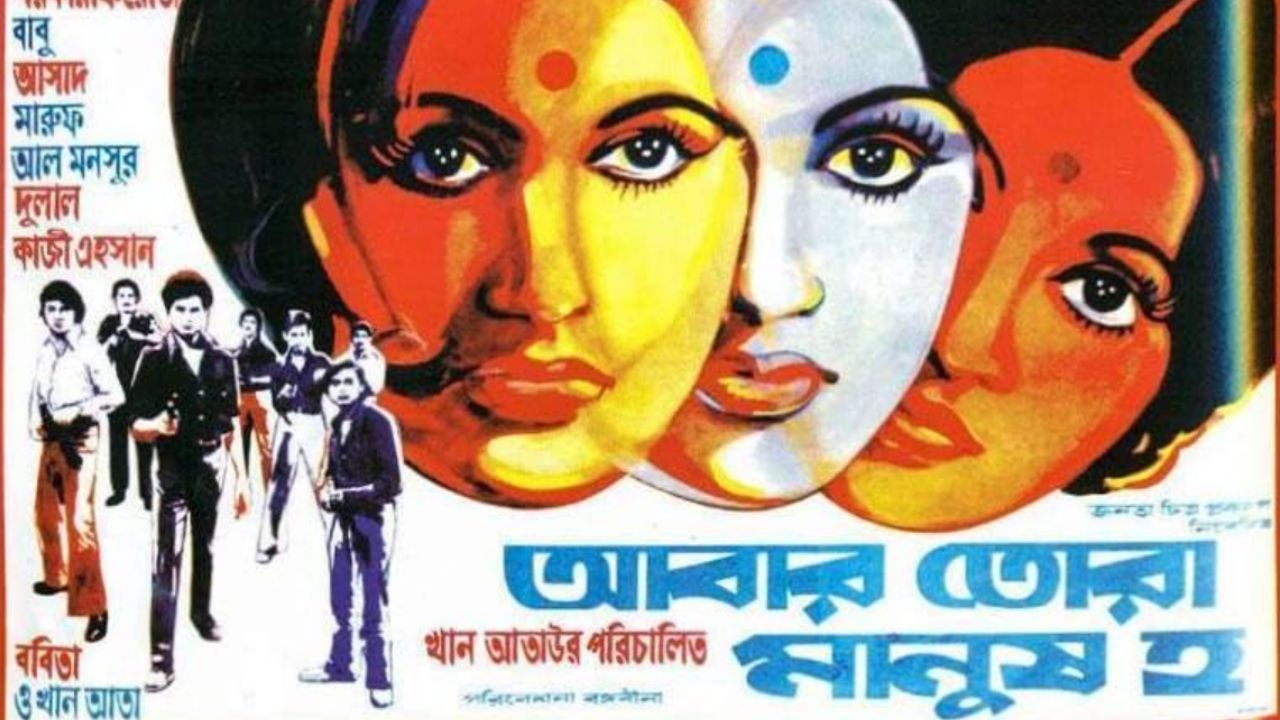



Post independence Dhaka!
The jubilation of liberation has paved way to hardcore reality where ideals appear vacuous, and profiteering becomes the key driving force.
The divide between the privileged and the common person is stark, the rich get richer by brazenly bending the rules, the wheeler dealer makes quick profit, the ordinary person without a job, living in a war ravaged system, is desperate for medicine, food while the freedom fighter, once filled with glittering hope, now stands disillusioned.
Without the gun, which has not been surrendered as yet, he is helpless in a mercenary post-independence dystopia.
That is how Abar Tora Manush Ho, the 1973 celluloid tour de force by Khan Ataur Rahman opens.
The early 70s was the fertile period for movies about the Liberation War but while most productions use the period leading up to the struggle and the War of Independence as the premise, this movie, unlike any other of the time, showcases the battle for survival in a different conflict.
Abar Tora Manush Ho (ATMH from now), is not just a film about seven valiant fighters trying to make sense of it all in post-independence society where values are swiftly sidelined for instant profit.
It’s a piercing cinematic document depicting the grim years following the emergence of the country – a damning portrayal of ruthless opportunists exploiting the vulnerabilities of the masses languishing in post-independence malaise.

The film was shown on 10 August 2026 at the Shilpakala Academy as part of a three-day festival called ‘Cholochitro Utshob; Ekal Shekal’ celebrating movies that are socially, culturally and aesthetically significant.
Glory only a thin veneer:
The recurring theme all throughout ATMH is a feeling of disenchantment.
It was made in 1973, portraying the period just after victory when freedom fighters had not surrendered their weapons and society in general was grappling with acute shortage in all areas of life from medicine, to cooking oil to food.
Interestingly, a whole generation growing up in the last fifteen years from 2009 till 2024, was not allowed to see this unsavoury cinematic portrayal of post-independence life.
In fact, in the period prior to 2009, You Tube was not widely watched in Bangladesh and, therefore, ATMH, unquestionably a crucial historical document, was lost to at least two to three generation of Bangladeshis.




The film, which I saw in 1982 on Bangladesh Television, BTV, left a lasting impression on my teenage mind because unlike most other liberation war related drama or films of the time, this showed a society consumed by greed and mercenary tendencies while the essence of 1971 struggled to make sense of it all.
The plot involves seven Freedom Fighters who come back from the front and, as they try to blend into society, are faced with some harsh lessons.
When the medicine shop owner demands extra payment for medicine, the once fighter who resisted an invading army has to pick up the Sterling SMG to ensure rights of the common person, when the hoarder says there’s no cooking oil (Kerosine) but is seen secretly selling barrels at higher rates, the young war returnee smiles in resignation, buttons his shirt and casually picks up the SMG.
After promising to refrain from flaunting the gun, the Freedom Fighters fall from their social standing and are treated like rags even by relatives who had been reverent so far.
As they barely manage to buy a pack of filter less cigarettes, someone comes in a sleek car, buys a whole carton of State Express and drives off – an indication as to how profiteers were leading a life of luxury in post war scenario of privation.
The message is clear – while the angst riddled Freedom Fighter was caught in no man’s land, the country was being plundered by unscrupulous people.
Why this film was hushed up:
ATMH was hushed up, erased from all forms of media and those who knew about it could not find it anywhere.
Only a song from the film, where the seven freedom fighters are garlanded at their college, is available but not even a celluloid clip can be found.
This was done deliberately, says Shahnoor Karim, a social observer and a film enthusiast.
The movie depicts rightly the anarchy in the first few years after independence when depravity was rife while powerful links were exploited right and left.
As a result, a class of people quickly became abnormally wealthy in a devastated nation where austerity became the only living mantra of millions, added Karim.
However, the party in power back then came back to rule Bangladesh later, presenting an airbrushed picture of the years after liberation.
Since their fabricated narratives were contradictory to what the film shows, ATMH was carefully but firmly cut out from all media channels.
No CD or DVD copy of the film is available, it was never showcased in any film festival and, the original print was left in neglect.
Heartfelt gratitude to the relevant department for restoring the original print using digital technology.
If it’s any consolation, it’s a general trend all over the world to hush up records of unpleasant past.
Most colonial crimes were suppressed until Internet came along and, even today, nations that were colonial powers and had subjugated/ exploited other nations, feel uncomfortable talking about the genesis of their progress and prosperity.
Just like most former colonial powers never want to openly discuss slave trade, the imposition of opium on another nation to force her to open sea-ports or the usage of gunboats to compel others to sign commercial treaties.
In addition to showing social decadence, ATMH goes deeper into the early 70s moral decay, depicting the plight of young women who lost parents during the War of Liberation.
In the end, ATMH has a story line plus an ending exuding hope.
However, this will always be more than a movie – a biting, thought provoking social narrative of a fledgling nation.