Economists have warned that weak revenue collection may pose a major challenge for the next government in implementing the national budget inherited from the current interim administration as well as when framing a new one.
They said introducing meaningful changes to the current budget would also be difficult as the incoming government would be required to place its first budget within four months of its election, scheduled for 12 February.
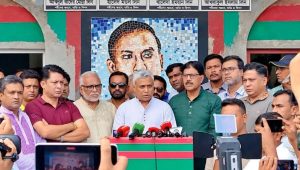
“If we fail to accelerate domestic resource mobilisation, the next government will face extreme difficulty, which could hinder future development,” said MA Razzaque, chairman of the Research and Policy Integration for Development (RAPID).
He made this remark while delivering the keynote at a seminar, styled “Socioeconomic Priorities for the Next Government”, jointly organised by RAPID and the UK’s Foreign, Commonwealth and Development Office (FCDO) in Dhaka on Monday.
Razzaque said the current revenue trend represents a significant risk for the incoming administration as it severely limits the scope for any major fiscal reform.
“The country’s tax-to-GDP ratio is currently below 7 per cent, one of the lowest among its peer countries,” he said.

However, studies by the International Monetary Fund and the World Bank suggest that a tax-to-GDP ratio of at least 15 per cent is required to sustain economic growth and achieve Sustainable Development Goals.
Citing an upcoming RAPID study, Razzaque said 54 per cent of the country’s wealth is concentrated in the hands of just 1 percent of its population, posing a serious threat to social stability.
He urged the government to take immediate steps to raise the tax-to-GDP ratio, noting that achieving the desired level within the next three to five years would be unrealistic.


Failure to increase the ratio, strengthen domestic resource mobilisation, and sustain reform initiatives would place severe pressure on fiscal sustainability, he added.
Speaking as chief guest, National Board of Revenue (NBR) Chairman Abdur Rahman Khan said that NBR officials were deeply concerned about the low tax-to-GDP ratio.
“They say they collect around 15 per cent in taxes, yet the tax-to-GDP ratio remains low,” he said. “In many countries, 5 per cent of the GDP is spent on health alone, whereas our total tax-to-GDP ratio is only about 6.5 per cent.”
He also noted that of around 1.2 crore tax identification number holders, only 35 lakh actually pay taxes.
Stabilising the economy without increasing revenue—particularly from direct taxes such as income tax—would be extremely difficult, he said, adding that the NBR is working to automate tax collection and move towards eliminating tax exemptions.
In his presentation, Razzaque outlined 12 priority areas for the next elected government, including extending the LDC graduation timeline, controlling inflation, reforming the banking sector, creating employment, strengthening foreign exchange reserves, stabilising the exchange rate, and ensuring fiscal sustainability.
Other priority sectors include investment in health, education and social protection, energy security, women’s economic participation, data integrity, and managing geopolitical risks.
He also said that despite inequality being a key issue behind the movement that led to the fall of the previous government, Bangladesh has failed to adopt credible policies to address the problem.
On employment, Razzaque noted that labour force participation declined from 73.5 million in 2023 to 71.7 million in 2024, largely due to a fall in female labour force participation. Graduate unemployment stood at 13.5 percent in 2024, with around 0.9 million graduates currently unemployed.
On LDC graduation, Bangladesh Chamber of Industries President Anwar Ul Alam Chowdhury said the previous government’s decision was based on inconsistent data.
He warned that Bangladesh could lose preferential trade benefits after graduating from LDC status, while the economy remains fragile and lacks sufficient product diversification and trade agreements.
He urged the government to defer LDC graduation to give businesses time to prepare.
Razzaque concluded by stressing that the next government must act swiftly to address the ongoing crises, as developing a long-term vision would be difficult without short-term stability, particularly in areas such as inflation, banking, reserves and LDC graduation.
“Failure to act early would narrow policy space,” he said, adding that structural reforms can only succeed when short-term economic stability is ensured.