


In my editorial analysis titled Art, Politics, and Journalism on the TIMES Front Page: The Aesthetic Spectacle of Crisis, published in Times of Bangladesh on November 3, 2025, I made several predictions about the newspaper’s evolving editorial language. Nearly a year later, those observations are proving to be remarkably accurate. At the time, I wrote: “In just two months, TIMES of Bangladesh (TOB) has introduced ten remarkable front-page layouts – each a bold departure from the norms of Bangladeshi journalism. Such transformations demand not only creative courage but also editorial clarity and strategic vision.”
With time, that assessment has gained even greater significance. In the history of newspaper page design and news presentation in Bangladesh, TIMES of Bangladesh has established a distinctive, original, and remarkably bold editorial tradition.
Journalism persuades audiences that certain people, events, and issues are worth knowing about. It creates awareness of people, problems, and perspectives, encouraging society to recognise what deserves its attention. Most importantly, it accomplishes this through stories. Stories take different forms, but they generally share two essential qualities: they establish why something is newsworthy, and they shape what that something means – what it should make us think about, and how it connects with what we already know. It does not merely report reality; it constructs meaning and expands public consciousness. The most revealing place to witness this process is the newspaper’s front page. Even before readers begin the first article, the front page has already told a story about what is happening in society and, equally importantly, how society is invited to understand and feel about those events. The placement of individual articles within the front page – the use of colour, photography, headlines – all serve to frame them, to give them additional meaning. In short, the front page of the newspaper does not simply deliver news to the reader – it comments on it.
Bangladesh has a proud tradition of quality English newspapers, which have consistently delivered both high-quality articles and solid front pages that balanced gravitas and accessibility. For the most part, the papers’ front pages reflected a certain aesthetic, one which drew lines from across the South Asian print-journalism tradition. However, what happens when the front page starts telling its own story – one that has little in common with the traditions of South Asian print journalism?

Such questions lie at the heart of this thesis, which examines the English-daily front-page design of the new Bangladeshi paper TOB. With its motto ‘A New Perspective’, TOB promises to deliver news, written and presented in a new way. It uses colour, collage, photography, cartoons, and other media to tell stories and frame events in novel ways, drawing attention to them as much with pictorial and typographic means as textual ones. In many ways, TOB’s front page design breaks away from the constraints of traditional newspaper journalism. It presents us with collages and photos with captions that seek to convey certain ideas and emotions; it frames events with specific colours or fonts; it draws attention to particular news items by placing them prominently on the page; it presents them in such ways as to suggest a certain point of view.
But what exactly does it say? How does TOB’s front page present news, both and viscerally? What messages does it communicate to its readers, and how does it do it? These are the questions that this study seeks to answer by examining 100 front pages of TOB, published between September 2025 and August 2026, as well as the events they depict. To put it another way: how exactly does a newspaper’s front page tell a story through its design? How does it frame events, draw attention to them, and make them more memorable and meaningful?



In the Bangladeshi context, 2025 and 2026 were politically charged years, which resulted in a complex social, state and democratic reality being experienced by the media. Following the political transition in 2024, the debate on human rights, election-related tensions, political violence, freedom of the press and state accountability has rejuvenated the relevance of the role of the media. In this context, the media were not merely channels for transmitting information; they also became important spaces for shaping public opinion, interpreting crises, representing political power, and reconstructing state– citizen relations.
The front page is the most easily seen place of this function in print journalism, where it acts as the first visual portal between the reader and the newspaper. It not only tells, but it also catches; it marks, it makes meaning, it evokes emotions, and it sets the context for events. Traditionally, the pages of English-language newspapers in Bangladesh have followed a strict grid-based layout, with a fixed column layout, information-oriented headlines, and limited use of visual experimentation. But TOB is not limited to that concept and has turned the front page into an interpretative visual canvas. Each front page has a different mood, a different political atmosphere, a different visual story of social crisis with symbols, colour, collage, illustration, political cartoons, large typography and dramatic layout. This is important for research purposes because news is not simply information; it is a process of meaning-making.
The process of choosing images, how they are used in colour, the portrayal of political figures, the use of symbols and the emphasis given to typography all impact the meaning. In times of turmoil, the images can bridge the gap between words and convey fear, uncertainty, opposition, sadness, anger or political messaging. The theoretical basis of this research is based on three approaches: visual journalism, semiotics and framing theory. Visual journalism is the ability to tell a story with pictures, colour, layout and typography.
TOB showcases the efforts of newspapers to use visual language to capture the attention of digitally influenced readers, making news visual with the use of colour, typography and graphic storytelling. Political communication is important because the visual construction of crisis, power, elections and civic suffering has the potential to have an immediate impact on public perception and opinion, far more than written communication. The study demonstrates that visual elements are not decorative but rather have political, social and cultural significance, using such theories as semiotics and framing theory. The fire, barbed wire, broken buildings, dark backgrounds and bold typographic and human faces function at a deeper level of interpretation.
The study also has implications for journalism education and professional training, such as understanding how to create visual hierarchy and the principles of editorial decision-making and ethical use of images and colour in news reporting. More specifically, it looks at the messages conveyed by TOB’s front pages – examining the events they depict, how they are depicted, and what those messages say about TOB’s journalistic outlook. By engaging with the front-page design of TOB, this study hopes to demonstrate how visual media can shape and inform journalism, framing events in novel ways and making us see them – and therefore think about them – differently.
Essentially, this work is concerned with one overarching question: ‘What else does the newspaper want me to see?’ And so, instead of looking merely at what the front page says, we are going to look at what else it wants us to see.
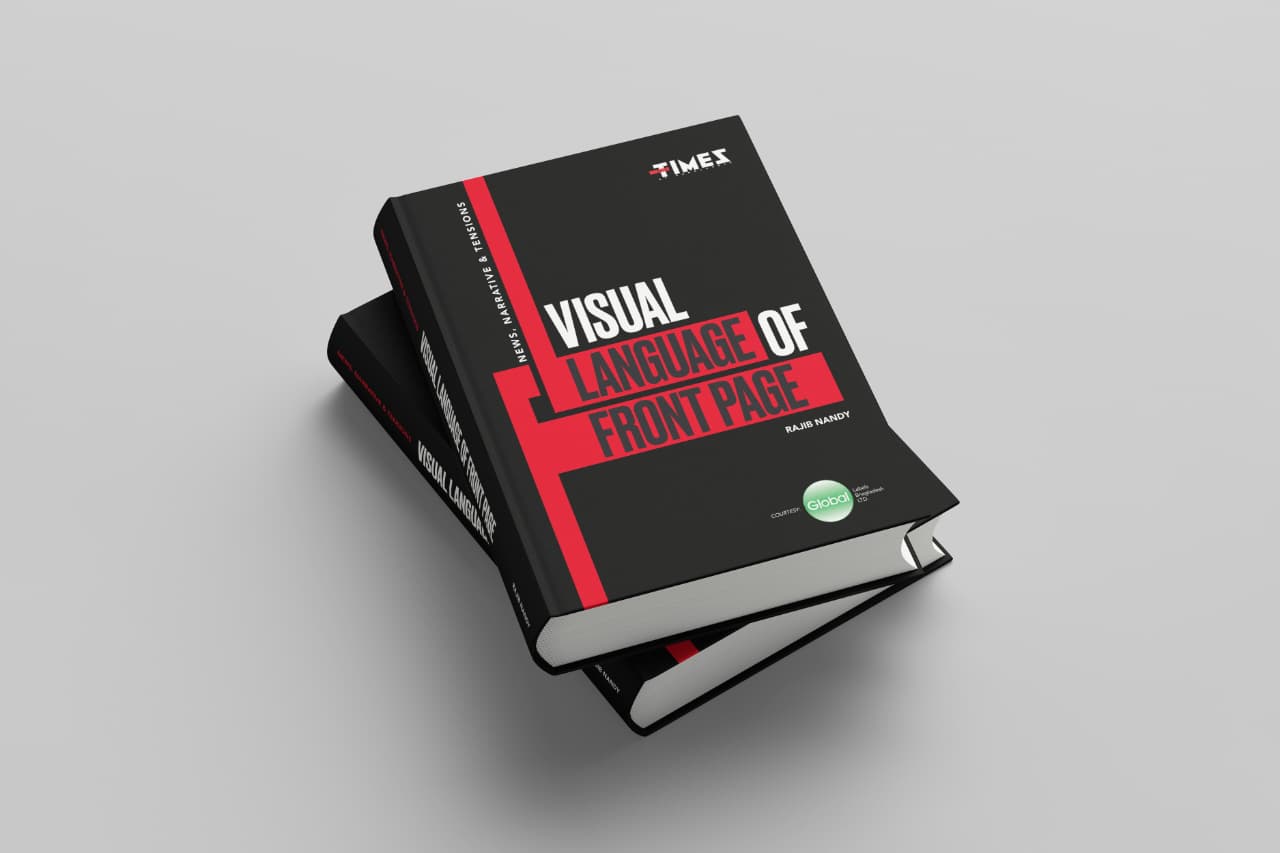
This write up is an excerpt from ‘News, Narratives & Tensions: Visual Language of the Front Page’, an analytical and research-based book on the front pages of Times of Bangladesh, published on the 1st anniversary today.