The United States has stepped up its military footprint in the Middle East, expanding both naval and air operations close to Iran.
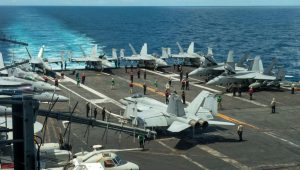
Recent satellite images confirm that the aircraft carrier USS Abraham Lincoln is operating in waters near Iran, as Washington intensifies pressure linked to Tehran’s military activities and its handling of domestic unrest.
According to BBC Verify, satellite data places the carrier in the Arabian Sea, roughly 700 kilometres from the coast of Oman.
The Abraham Lincoln commands a strike group that includes three guided-missile destroyers and supports nearly 90 aircraft, among them F-35 fighter jets.

The vessel carries a crew of about 5,700 personnel. Although it was deployed to the region in late January, its position had not previously been clearly identified.
Diplomatic engagement is also continuing. Officials from the US and Iran are due to hold a second round of talks in Switzerland on Tuesday.
Tehran has indicated that discussions will centre on its nuclear programme and the potential easing of US sanctions, while Washington has suggested it wants to address a wider range of concerns.


Meanwhile, reports indicate that the US has dispatched its largest warship, the USS Gerald R Ford, toward the Middle East, with expectations that it could arrive in the area within the coming weeks.
BBC Verify says the deployment of the Abraham Lincoln forms part of a broader military expansion underway for several weeks. Satellite tracking has identified at least a dozen US naval vessels across key waterways, including the Gulf, the eastern Mediterranean and the Red Sea.
Some ships are based at a US naval facility in Bahrain, while others have been observed near the American base at Souda Bay.
US air operations have also increased. Analysts report a higher concentration of F-15 and EA-18 fighter jets at a military base in Jordan, along with increased movement of US transport, refuelling and communications aircraft arriving from both the US and Europe.
Iran has answered the build-up with its own military manoeuvres. The Islamic Revolutionary Guard Corps recently conducted naval exercises in the Strait of Hormuz, a crucial route for global energy shipments that carries about one-fifth of the world’s oil and gas.
State media footage showed missiles being fired from Iranian naval vessels during the drills.
Defence analysts say the scope and duration of the current US deployments appear more extensive than earlier operations, pointing to a strategy aimed at sustained deterrence as well as readiness for potential conflict.
They argue that the combination of naval forces, air power and established regional bases would enable Washington to maintain high-intensity operations while managing possible Iranian actions across the region.