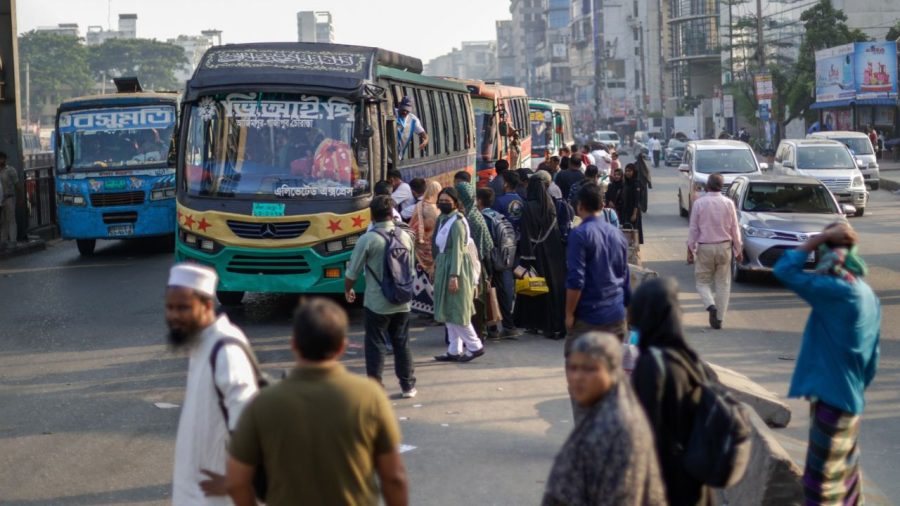

New names, new colours, but little change on Dhaka’s roads. Four weeks after the launch of a franchise-based bus service on six routes, commuters are still grappling with overcrowding, reckless competition among operators, indiscriminate stops, and fares far above approved rates.
Introduced on 1 November under the slogan “one route, one company”, the service was meant to bring discipline to the capital’s chaotic public transport system. But old minibuses, narrow doors, missing fare charts and operators competing for passengers suggest that the latest reform has so far changed the appearance of buses more than the experience of commuters.
Midline Paribahan buses operating on the Jatrabari–Ghatarchar route charge Tk50 for the 10-kilometre journey from Kamalapur to Mohammadpur and Tk20 for the journey from Banglamotor to Asad Gate. The fares prescribed by the Bangladesh Road Transport Authority (BRTA) are Tk26 and Tk11, respectively.
Nasrin Akter, a commuter on the Jatrabari–Sayedabad route, complained about excessive fares. “There are no fare charts inside the buses. Passengers are charged excessive fares even for short distances,” she said.
There are no designated passenger stops along the route. Buses stop whenever someone raises a hand, while passengers alight wherever they wish.
Tanvir Ahmed, a university student travelling on the Uttara–Motijheel route, echoed his concerns. “Even buses belonging to the same company compete with one another and stop indiscriminately to pick up passengers,” he said.
Bangladesh Road Transport Owners’ Association Secretary General Md Saiful Alam was reluctant to acknowledge the irregularities. However, if anyone dishonestly or unlawfully collects excessive fares, action will be taken, he said.
Old buses, narrow doors
For 61-year-old Farid Islam, boarding a bus at Shahbagh proved impossible despite two attempts. He could not physically compete with other passengers jostling to get aboard.

Suffering from calcium deficiency, Farid cannot stand for long periods. Bus assistants often refuse to let him board.
Another commuter, Yusra Khandakar, called for wider doors like those on buses operated by the state-owned Bangladesh Road Transport Corporation (BRTC).
Concerns were raised from the outset about the use of old minibuses that had previously operated under different names for the franchise service.
Their doors are only 2.5 to 3 feet wide, with a driver’s assistant often occupying part of the entrance. Passengers must squeeze past one another while boarding and alighting. The problem is even worse on buses with doors positioned in front of the engine.
Despite repeated government announcements that minibuses would be removed from Dhaka’s roads, plans for circular routes under the franchise system propose the introduction of 27-seat minibuses.


Transport experts, however, have long advocated the use of larger buses in the densely populated capital.
Buet Professor and transport expert Md Shamsul Hoque said, “Although minibuses are supposed to have 31 seats, owners increase the number to 40. As a result, the ideal distance between seats is reduced from around 26 inches to between 14 and 16 inches.”
Large buses that previously operated in Dhaka had two doors, making boarding and alighting relatively easier.
Md Shihab, a bus assistant on the Gabtoli–Demra route, acknowledged that passengers struggled to get on and off during busy periods and that a second door would benefit both passengers and bus staff.
Dhaka Transport Coordination Authority (DTCA) and BRTA have made it mandatory for buses to keep their doors closed while moving and to pick up and drop off passengers only at designated stops. These are conditions for issuing route permits under the “one route, one company” arrangement.


Operating a vehicle with its doors open while in motion is punishable by up to three months’ imprisonment or a fine of Tk10,000, along with the deduction of one point from the driver’s licence.
Two decades of failed reforms
Plans to introduce franchise-based bus services in Dhaka date back more than two decades.
The Strategic Transport Plan 2005 envisaged a comprehensive overhaul of the capital’s public transport network to establish an economically and environmentally sustainable system.
Five successive governments, however, have done little beyond making promises.

In 2015, an initiative was taken to consolidate more than 400 unorganised bus routes into 42. Six years later, in 2021, a franchise-based bus service was introduced under the name “Dhaka Nagar Paribahan”.
The service began with 50 buses on the Ghatarchar–Kanchpur route, running from Keraniganj, with the participation of BRTC and 22 private operators. The fleet was subsequently expanded to around 100 buses, with two additional routes introduced in 2022.
However, private operators withdrew their buses, citing financial losses, eventually causing the initiative to collapse.
The interim government attempted to revive the project by reorganising the 42 routes into nine clusters, but that initiative also failed to materialise.
Over the years, the authorities have failed even to finalise designated passenger stops across the capital.
Road Safety Foundation Executive Director Saidur Rahman believes the franchise service is bound to fail under the government’s current approach. “Relying solely on private transport without strengthening the government’s own bus services will not provide a lasting solution to the problem,” he told TIMES.
The government’s inability to operate enough buses has allowed private operators to gain greater influence and monopolise the market, he said, adding that they were exploiting the situation to charge excessive fares and perpetuate disorder.
Buet Professor and transport expert Moazzem Hossain believes the franchise model is bound to fail unless the state assumes full control. He recommended adding at least 2,000 new buses to BRTC’s fleet and making the state-owned company the principal operator of Dhaka’s public transport system.
Sharmin Akter, a bank official commuting on the Mohammadpur–Motijheel route, said, “A new system has been introduced, but bus frequency has not improved. Sometimes several buses arrive together, while at other times there are no buses for a long period.”
Another Buet Professor and transport expert, Md Hadiuzzaman, advocated the introduction of double-decker buses. “The single-door buses currently in operation are more suitable for long-distance travel than for rapidly transporting passengers within the limited road capacity of a densely populated city like Dhaka. Double-decker buses could be an effective solution in this regard,” he said.