
Over the past 20 years, garment workers’ minimum wages have been revised six times, more frequently than those of workers in any other of the 45 occupations covered by the Minimum Wage Board.
Yet few sectors have seen as much anger and protest over wages as the garment industry. With more than four million workers employed in the sector, any unrest can lead to road blockades, clashes and disruption to the lives of millions of other people.
A familiar pattern has emerged every time the wage revision process begins. Workers take to the streets demanding a particular amount, but the final wage usually falls only a little above half of what they initially sought. Even after the Minimum Wage Board announces its decision, protests over the unmet demand often continue for days.
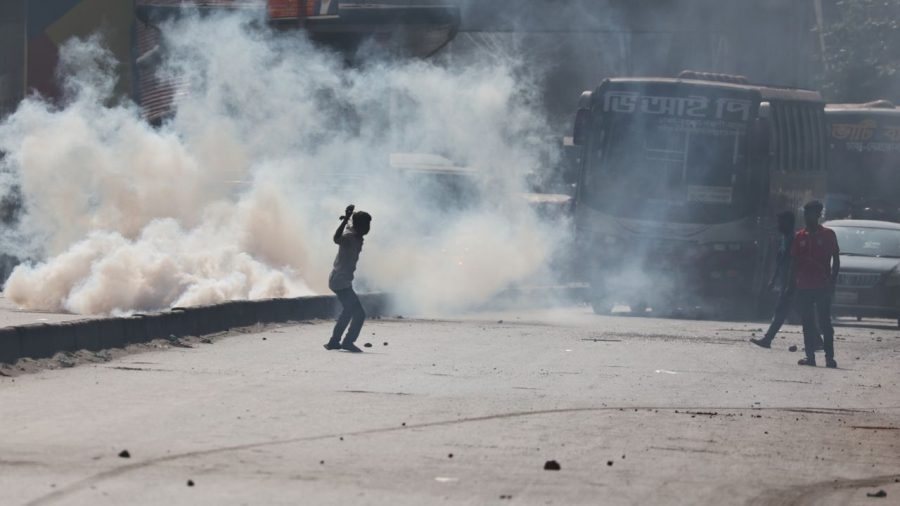
The latest wage announcement was no exception. After the board announced its decision early on Wednesday, protests continued in industrial areas for two consecutive days. Clashes with police disrupted highway traffic and affected businesses in the areas concerned.
This time, workers took to the streets demanding a minimum monthly wage of Tk30,000. However, the workers’ representative on the wage board initially placed a demand for Tk32,000, reducing it by Tk5,000 on each of two occasions during negotiations with employers before settling at Tk18,000.

The employers, meanwhile, proposed Tk15,000 and subsequently raised their offer by a maximum of Tk500, with an increase of just Tk200 coming after several hours of discussion.
This raises a fundamental question: how were the figures of Tk30,000 and Tk32,000 calculated in the first place?
The same question arose in 2023, when workers demanded Tk25,000, and in 2018, when they sought Tk16,000 as the minimum monthly wage. Yet the basis for arriving at these figures has never been clearly established.
Asked by TIMES, Anwar Hossain, the workers’ representative on the Minimum Wage Board and president of the BNP-affiliated Jatiyatabadi Sramik Dal, openly acknowledged that the initial demand was deliberately set higher to allow room for negotiation. “We make a slightly higher demand when we put it forward so that negotiations can begin from a better position. Otherwise, the discussion would start from a much lower figure,” he said.




Following the board’s decision to set the minimum wage at Tk17,000, garment workers now rank third among the 45 occupations covered by the board in terms of minimum pay. Only sawmill workers, with a minimum wage of Tk17,900, and tannery workers, at Tk17,048, earn more.
Economists and other stakeholders have expressed broad satisfaction with the latest wage decision. Even Anwar Hossain, who negotiated on behalf of workers, described the outcome as “more or less satisfactory”.
But the Tk30,000 demand remains firmly in the minds of many workers. Mustafizur Rahman, a garment worker in Gazipur, said, “We demanded Tk30,000. We could have accepted even Tk25,000. But they have given us only Tk17,000. That is why I am still part of the protests.”


Another worker, Ashraful, said the difference between expectations and the final outcome had made it difficult for workers to come to terms with the decision. “We asked for much more but received much less. If we had asked for less and received less, we could have consoled ourselves. Now we have no way to convince ourselves that this is enough,” he said.
Experts say the persistent gap between workers’ demands and the final wage reflects the absence of a research-based mechanism for determining minimum pay. This fuels frustration among workers and creates opportunities for different groups to exploit their discontent for their own interests.
A review of garment workers’ minimum wage revisions from 1994 to 2026 shows that workers have demanded increases ranging from 59 per cent to 223 per cent over their previous wages at different times. The actual increases, however, ranged from 36 per cent to 80 per cent.

In 2018 and 2023, minimum wages rose by 50 per cent and 56 per cent respectively, with both revisions coming after five-year intervals. This time, the minimum wage has increased by just 36 per cent, despite the revision taking place after only three years.
Nazma Akter, president of the Sommilito Garments Sramik Federation, said making a high initial demand during negotiations was not unusual. However, ordinary workers were often unfamiliar with the bargaining process and became frustrated when the final wage fell far short of their expectations. “Workers expect to receive higher wages, but when the final decision fails to meet those expectations, it affects their morale,” she said.
Syed Sultan Uddin Ahmed, executive director of the Bangladesh Institute of Labour Studies (BILS), said the Minimum Wage Board should formulate its own proposal based on research and then seek the views of both employers and workers.
Instead, the board asks the two sides to submit their proposals, a process that complicates wage negotiations, he said.
He also stressed the need for objective assessments of the cost of living, household requirements and the industry’s capacity before fixing minimum wages.
“But there is no effective mechanism for such research and analysis. As a result, a gap emerges between workers’ demands and what they eventually receive, fuelling frustration among them,” the BILS executive director said.