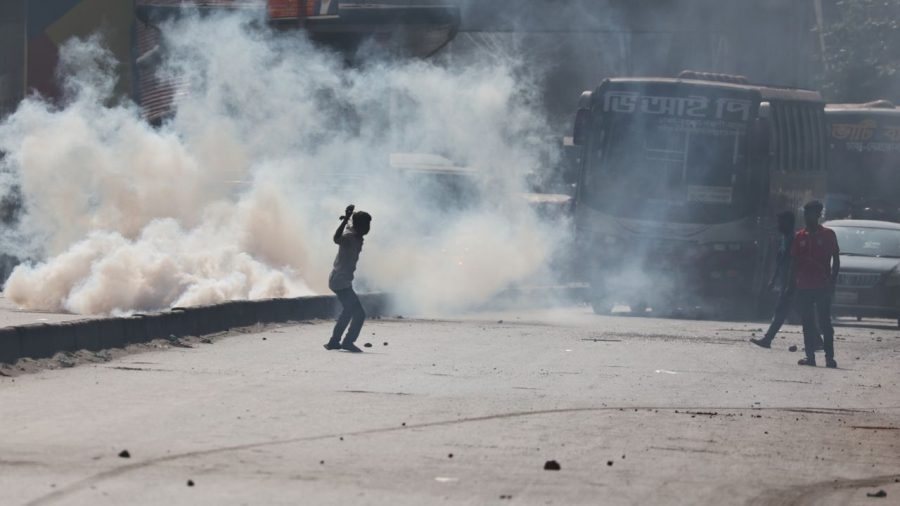

The government suspects political instigation behind fresh garment unrest that swept industrial areas around Dhaka on Wednesday, triggering protests, work stoppages, road blockades and clashes despite the announcement of a 36 per cent minimum wage hike to Tk17,000.
Home ministry and intelligence sources said the Awami League, whose activities are banned, was instigating the movement by capitalising on workers’ discontent.
Workers in Gazipur, Savar, Ashulia, and Narayanganj resumed protests, work stoppages and road blockades on Wednesday morning, triggering clashes and chases and counter-chases with police in several areas.
Six police officers and five Ansar personnel were injured in Gazipur, while at least 25 people were injured in Savar and Ashulia. General holidays were declared at dozens of factories across industrial areas, while Border Guard Bangladesh (BGB) personnel were deployed to control the situation.
Speaking at a press conference at the Secretariat on Wednesday, Home Minister Salahuddin Ahmed said the minimum wage had been determined democratically through the Wage Board and signed with the consent of employers’ and workers’ representatives. Genuine workers and employers were satisfied with the decision, he said.
Those attempting to create disorder by spreading rumours in industrial areas were not genuine workers, the minister said, adding that a quarter was seeking to exploit the issue as part of a political conspiracy.
Authorities were investigating who was behind the instigation, he added.

Two highways blocked in Gazipur, 11 injured
Workers began demonstrations around 8:30am on Wednesday, occupying roads in several areas of Gazipur, including Chandana Chowrasta, Bhogra Bypass, Naozor, Bhavanipur, and Salna, halting traffic along sections of the Dhaka-Tangail and Dhaka-Mymensingh highways.
Workers refrained from starting work and staged protests demanding higher wages. Tensions escalated when law enforcement personnel attempted to disperse them. Police fired tear gas after a section of workers threw brickbats.
Around noon, five police officers and five Ansar personnel were injured in a clash in Salna. Sub-Inspector Hamidur Rahman was also injured by a brickbat in the Maleker Bari area and received treatment at Shaheed Tajuddin Ahmad Medical College Hospital.
Gazipur Metropolitan Police Additional Police Commissioner Mohammad Belayet Hossain said the situation had returned to normal.
Gazipur Industrial Police-2 Superintendent of Police Mohammad Amzad Hossain said general holidays had been declared at 15 factories in view of the situation.



Clashes in Savar-Ashulia, 11 factories closed
Repeated clashes and chases and counter-chases between workers and police in the Savar and Ashulia industrial areas left at least 25 people, including police personnel, injured on Wednesday.
Workers entered factories around 8am but began work stoppages instead of starting work. They subsequently staged protests in Jamgara, Narsinghapur, Zirabo and Baipail in Ashulia and Hemayetpur in Savar.
Clashes broke out around 9am when police attempted to disperse workers blocking the road at Padmar Mor in Hemayetpur. Brickbats were thrown, prompting police to fire tear gas and sound grenades to control the situation.
An AKH Group factory in Hemayetpur was vandalised during the unrest. Local residents handed over four people to police at the scene, while police detained two others at Padmar Mor.


Savar Model Police Station Officer-in-Charge Md Saiful Alam said police were verifying the identities of those detained.
According to the Industrial Police, general holidays have been declared at least 60 garment factories in Savar and Ashulia amid workers’ unrest, while 11 factories remain closed under Section 13(1) of the Labour Act.
Industrial Police-1 Superintendent of Police Mohammad Mominul Islam Bhuiyan said BGB personnel had been deployed alongside police to ensure security. Water cannons and armoured vehicles had also been kept ready.
Unrest in Narayanganj, holidays at three factories
Workers’ unrest also continued in the BSCIC and Masdair areas of Fatullah in Narayanganj.
General holidays were declared at Fariha Knitex Limited, NR Group and Reebline Limited following workers’ protests and road blockades over various demands.

Narayanganj Industrial Police Additional Superintendent of Police Anwarul Haque said workers were demanding higher grades for senior and skilled workers, promotions for those who had remained in the same grade for a long time and full payment of leave benefits.
Meanwhile, workers of the closed Century Garments were staging a sit-in outside the BKMEA building in Chashara, demanding payment of outstanding service benefits.
Section of workers rejects Tk17,000 wage
Following prolonged protests, the Wage Board finalised the new minimum wage for garment workers on Tuesday night. With no consensus reached at its fourth meeting, four of the six board members voted for Tk17,000 in a secret ballot, while two voted for Tk18,000.
Wage Board Chairman Syed Azad Subhani said the new wage structure set monthly wages at Tk17,000 for the lowest grade, Tk19,200 for Grade 3, Tk20,000 for Grade 2 and Tk21,500 for Grade 1.
The minimum wage represents a 36 per cent increase from Tk12,500. The new wage structure is scheduled to take effect from 1 December, with workers receiving their first salaries under it in January.
However, workers remain divided over the decision. While some are willing to accept Tk17,000 and return to work, a section of protesters demanding a wage of Tk30,000 has rejected the new wage.
They said the amount was insufficient to cover house rent, food, medical expenses and transport costs.
Workers’ unrest across industrial areas has yet to be fully brought under control despite the announcement of the new wage.