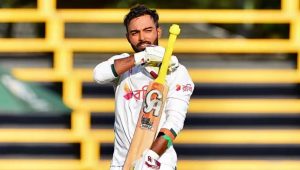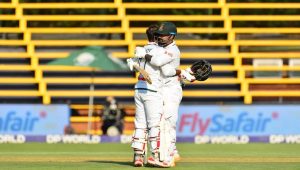


Deepto (a pseudonym) had waited a long time for this!
When the school-goer heard that his favourite cricketers would face West Indies in his hometown of Sylhet, he was overjoyed.
Watching his heroes live was a rare chance. But the experience fell short of what he had expected.
There was hardly any buzz in the city, and the venue felt neither welcoming nor festive.
He enjoyed the cricket but went home feeling that something was missing.
His disappointment is not unusual.
Bangladesh has a long tradition of passionate following for cricket and football and regularly hosts international fixtures, yet it has not established itself as a destination for sports travellers.
That gap matters, because major sporting events are economic engines as much as entertainment.
They can stimulate tourism, create jobs, attract media revenue and draw investment.
India offers the clearest example.
According to the Boston Institute of Analytics, citing an ICC report, the 2023 Cricket World Cup generated an estimated economic impact of $1.39 billion for the country.
The figure covers tourist spending, organisers’ operational spending and indirect economic activity.
Tourism alone accounted for nearly $861 million, as hotels, restaurants, transport operators and travel agencies saw a surge in demand.

More than 1.25 million spectators attended matches, and about 19 percent of international visitors were travelling to India for the first time.
In other words, a tournament can double as a marketing campaign for a nation.
Bangladesh will soon get its own chance.
It is set to host two major ICC events within five years: the 2028 U19 World Cup and the 2031 ODI World Cup (jointly with India).
The country is no stranger to big tournaments, having co-hosted the 2011 World Cup and staged the 2014 T20 World Cup.
But the recent Test series in Sylhet and the SAFF Championships in Dhaka offer little reassurance.
Sylhet saw hardly any promotional activity and crowd, while SAFF failed to draw foreign fans with most matches played before empty galleries.
Part of the answer lies in what the matchday itself offers.
TIMES spoke to professionals and fans who have seen both sides.
Sports entrepreneur Quazi Sabir has travelled widely to follow his favourite sports matches.




For him, the difference begins at the gate.
“The security guards or staff in the USA and elsewhere are very, very welcoming. Here (Bangladesh), people are almost frisked at the gates.”
Deploring that he had never experienced such patting anywhere else, especially at Lord’s in London and stadiums across America, Sabir recalls, “I feel everyone there really wants to celebrate the event. The seating arrangements, parking, everything put together creates a wonderful atmosphere.”
Jeffrey Dias, a journalist and NBA fan, described something similar while watching the Dallas Mavericks.
Enthusing about the restaurants, special menus with discounts on match days inside the venue, he said, “In Texas I saw NFL and NBA matches where there were stadium tours, fan fests, gifts and souvenir shops, entertainment shows for the crowd.”
Overall, the overseas experiences are truly memorable, he added.
Their accounts point to a basic distinction.
In Bangladesh, a match is treated as a ninety-minute sporting contest.
Elsewhere, it is treated as a day out, with reasons to arrive early, stay late and spend money.


Fans who spend more time at a venue, and more money around it, turn a fixture into an economic event.
Events are also a chance to present the host country to the world, and here, veteran sports journalist MM Kaiser believes, Bangladesh is missing the trick.
He recently covered the Asian Games in Aichi-Nagoya, Japan, and was struck by the off-field arrangements.
Speaking to TIMES, Kaiser said that in addition to providing necessary facilities to foreign journalists covering the games, the organisers were keen to ensure that the visiting media got an in-depth idea about Japan.
The aim is simple and canny: when they (visiting media) go back to their own country, the journalists will be ambassadors of Japanese hospitality and tourism, observed Kaiser.
Bangladesh certainly has the resources to boast.
It is home to the Sundarbans, the world’s largest mangrove forest, and to Cox’s Bazar, often described as the world’s longest continuous sea beach, along with other natural attractions.
So why do sporting events fail to bring visitors? In most cases, the answer is a lack of planning and vision.
Mohammad Khatibur Rahman, a Sylhet-based tourism writer, said the Bangladesh Cricket Board’s (BCB) lack of effort was evident during the recently concluded Test series.

He believes much more could have been done.
Pointing to the importance of multifaceted branding which can develop Sylhet’s tourism, he observed, “Instead of limiting things merely to unveiling a trophy at a tea garden, 10–20 second short documentaries or promotional videos featuring Sylhet’s tourist spots, nature, heritage along with captivating scenes of tea-leaf picking should have been played on the big screen before the match or during breaks.”
Fortunately, officials in Sylhet say improvements are coming.
Deputy Commissioner Abdullah Al Mamun said there are plans to promote and brand the district’s tourism by capitalising on international cricket.
Talking about a soon to be launched special tourism app, being developed for both local and international tourists, the DC, said, “Alongside information on all tour operators, the app will also include phone numbers of boatmen.”
Contending that the responsibility does not solely lie with the BCB, Director Abdul Quiyum Chowdhury shared an optimistic plan, “Work on Sylhet’s tourism development and branding is under way in coordination with the relevant local departments.”
Cox’s Bazar, the country’s biggest tourism draw, has voiced similar expectations.
Administrators and organisers hope to plan better for future international events, and locals argue the city has more to offer sports tourists than only beaches.
Underscoring the need to protect the beach, hills and biodiversity, Nurul Amin Sikder Bhutto, President of the Cox’s Bazar Sabuj Andolon, observed, “Foreign tourists do not just come to see the sea beach; they also value the local natural environment and cleanliness.”
He feels if entertainment suitable for foreign tourists can be arranged while keeping the natural environment intact, Cox’s Bazar can emerge as an international tourist hub.
At the national level, the Bangladesh Tourism Board says it is watching the sector closely.
Tourists from many of the participating countries have shown interest in upcoming sporting events, said the Board’s Chief Executive Officer Mutasim Billah Faruqui.
Cricket lovers from other countries want to come and watch cricket matches, he asserted, adding, “That is the core spirit, which creates the foundation of sports tourism.”
The board is working with the ICC, the BCB and the Sports Ministry, and has signed an MoU with the cricket board that includes provisions for promoting Bangladesh’s destinations when overseas spectators arrive.
Admitting that Bangladesh hasn’t reached the stage to turn sports tourism into an appealing product, he adds, “We have resources, destinations, various interesting local sports of our own, and international sports are also quite popular. What is required is the strategy to make it attractive plus lucrative.”
Several policy-level issues are being addressed, he assured, including an update to the National Tourism Policy.
The essential features of a sports tourism industry are present and visible: a sport-loving public, striking destinations, planning and officials who acknowledge the gap and understand what needs to be done.
What is missing is an astute execution: welcoming atmosphere, lively matchday, promotional film (s) on the big screen and a visitor-friendly easy to use app.
With the 2028 and 2031 tournaments approaching, Bangladesh has a limited window to turn good intentions into a working system.
Otherwise, the next generation of fans may repeat Deepto’s story of excitement and exuberance followed by a flat and insipid matchday.