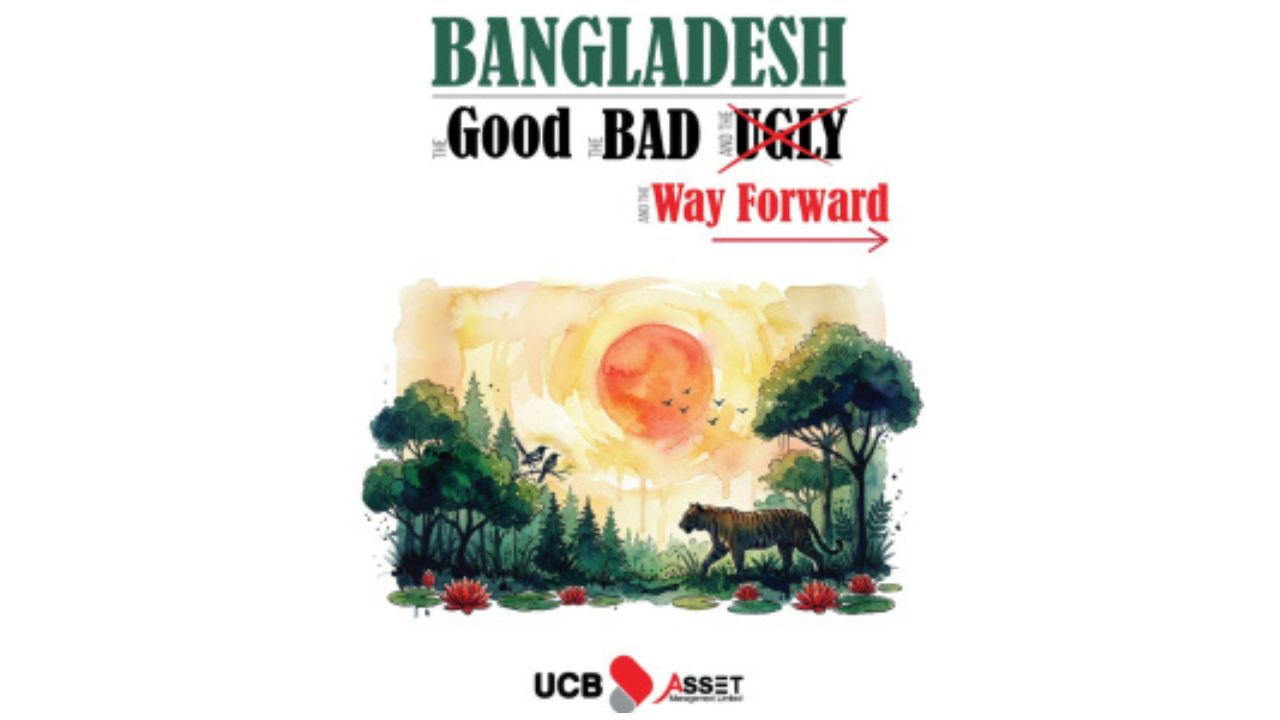



A new research publication by UCB Asset Management Limited has offered a sweeping assessment of Bangladesh’s economic journey, identifying the country’s core strengths, structural weaknesses and the reforms needed to secure sustainable growth.
The study, titled Bangladesh: The Good, the Bad and the Way Forward, was unveiled this week as part of UCB Asset’s broader research initiative aimed at contributing to informed policy debate and long-term economic thinking.
Authored by members of the firm’s research team, the report traces Bangladesh’s development from independence in 1971 through to the present, combining historical analysis with data-driven evaluation. It is structured in three broad sections: the country’s economic evolution, the major imbalances that have emerged over time and a forward-looking reform agenda.

According to the study, Bangladesh’s growth story is marked by notable achievements, including decades of real gross domestic product expansion above 6 per cent, rapid poverty reduction, export-led industrialisation driven by the ready-made garment sector and the rise of remittances as a key source of foreign exchange. The report also highlights improvements in health, education and connectivity that supported social progress and economic resilience.
At the same time, the research flags deep-rooted vulnerabilities that have accumulated beneath headline growth figures. These include weak governance, rising inequality, declining capital efficiency, financial sector fragility and growing dependence on debt-financed public investment. The study argues that a combination of policy distortions, politically influenced lending and delayed reforms has left the banking sector under stress, while inefficiencies in energy planning and large infrastructure projects have strained public finances.




One of the central contributions of the report is its examination of trade-offs between growth and reform. Rather than framing the debate as a choice between the two, the study contends that Bangladesh must pursue both simultaneously. It identifies financial sector reform, energy security, prudent monetary policy and stronger fiscal discipline as critical priorities that underpin all other development goals.
Beyond macroeconomic analysis, the publication devotes significant attention to sectoral opportunities. It underscores the continued importance of garments while pointing to untapped potential in agriculture, light engineering, electronics assembly, automotive components, information technology-enabled services and the semiconductor value chain. The report argues that diversification and productivity gains in these areas are essential to absorb the country’s young workforce and sustain export competitiveness.
UCB Asset Management said the study draws exclusively on publicly available data from domestic and international institutions, including the Bangladesh Bank, World Bank, International Monetary Fund and Bangladesh Bureau of Statistics. The firm emphasised that the publication is intended for informational and analytical purposes, not as investment advice.
By combining historical perspective with forward-looking recommendations, the report aims to serve policymakers, investors, academics and business leaders seeking a clearer understanding of Bangladesh’s economic inflection point and the choices that will shape its next phase of development