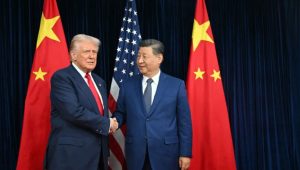
US President Donald Trump on Friday proposed a 10 per cent cut in non-defence spending for fiscal 2027 alongside a $500 billion surge in military spending, as the US continues its war against Iran.
The defence budget would rise to $1.5 trillion from about $1 trillion in 2026, including a 5 per cent to 7 per cent pay increase for troops deployed abroad, reports Reuters.
The White House said the increase mirrors the “historic increases just prior to World War II.”
The proposal comes amid rising fuel prices and public concern at home, while US forces remain active in the Middle East.
Congress must approve the plan, following recent disputes that triggered the longest government shutdown in US history.
Trump, who pledged to curb spending, had enlisted Elon Musk to cut the federal workforce by about 300,000.
However, the deficit is projected at $1.853 trillion this year, widening from $1.775 trillion, with total debt reaching $39.016 trillion.

The plan also proposes privatising airport security but avoids cuts to Social Security and Medicare.
Total federal spending would reach $2.2 trillion in 2027, up from about $1.8 trillion currently.
Defence costs
The military request will please defence hawks on Capitol Hill, but also highlights how Trump is trying to pay for doubling down on military pursuits, even after Republicans boosted defence spending last year in party-line legislation.




The Pentagon already requested $200 billion in extra funding to pay for the Iran war, but the White House has not yet officially made that request to Congress, where it is also likely to face scrutiny from lawmakers in both parties.
Other specific funding increases proposed by Trump include his controversial Golden Dome missile defence shield, money to build up critical mineral supplies for the defence industry and $65.8 billion to build 34 new combat and support ships.
Funds for shipbuilding, a priority for Trump since his first term, include initial funding for the so-called Trump-class battleship as well as submarines.
“Fiscal futility is ending,” White House budget director Russell Vought said in a letter to Congress, adding, “Our fiscal ship has turned to face in the right direction.”
Messaging in a midterm year
The president’s budget underscores political priorities ahead of the November 2026 midterms, though lawmakers often treat White House proposals as suggestive.
Democrats rejected the plan outright.
“It’s just an out-of-touch plea for more money for guns and bombs, and less for the things people need, like housing, healthcare, education, roads, scientific research, and environmental protection,” Oregon Senator Jeff Merkley said.
The White House did not include deficit projections.
The budget is “light on details and heavy on borrowing,” Maya MacGuineas said.
Trump claimed anti-fraud efforts could “balance our American Budget,” while proposing cuts to “woke” and “wasteful” programmes.
Nasa cuts after Artemis launch
Trump’s budget proposes deep cuts, including 19 per cent for agriculture, 12.5 per cent for health and 52 per cent for the Environmental Protection Agency.
It seeks a 13 per cent rise to “maximize” the Justice Department’s “capacity to bring violent criminals to justice” and maintains $2.2 billion for immigration enforcement.
Nasa faces a 23 per cent cut, including $3.6 billion for science, cancelling about 40 programmes.
The plan includes $152 million to revive Alcatraz and $481 million for air traffic hiring.
It also allocates $10 billion for the “Presidential Capital Stewardship Program” for projects in and around Washington, DC.