The United States Navy has used torpedoes for more than a century, but modern warfare has rarely seen them destroy an enemy warship.
That changed this week when a US submarine sank an Iranian naval vessel with a single torpedo in the Indian Ocean — the first such combat kill by a US submarine since World War II.
The Pentagon confirmed in a press briefing on Wednesday that a US Navy fast-attack submarine fired a torpedo that sank the Iranian frigate IRIS Dena while the vessel was sailing in international waters in the Indian Ocean near Sri Lanka.
According to The New York Times, the attack marked the first time since 1945 that a US submarine destroyed an enemy combat ship using a torpedo.
US Defence Secretary Pete Hegseth announced the strike during a Pentagon briefing on the military campaign known as Operation Epic Fury.
Chairman of the Joint Chiefs of Staff Gen Dan Caine joined him at the briefing.
“Yesterday, in the Indian Ocean, an American submarine sunk an Iranian warship that believed it was safe in international waters,” Hegseth said.
“Instead, it was sunk by a torpedo. Quiet death. The first sinking of an enemy ship by a torpedo since World War Two” he added.

Pentagon officials did not reveal the identity of the submarine involved. The US military usually keeps submarine operations confidential for security reasons.
The Iranian vessel was later identified as IRIS Dena, a Moudge-class frigate assigned to the southern fleet of the Islamic Republic of Iran Navy. The ship had reportedly participated in naval exercises in the Bay of Bengal before the incident.
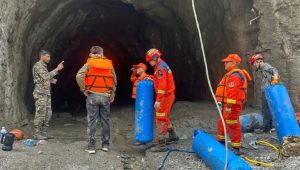
Sri Lankan authorities said the frigate carried about 180 crew members. Naval personnel rescued 32 sailors after the attack and continued recovery operations at sea. Officials said teams were also retrieving bodies from the wreck site.
Gen Caine said the submarine used a Mark-48 heavyweight torpedo to destroy the ship. The weapon created what he described as an immediate and decisive impact.
“For the first time since 1945, a United States Navy fast-attack submarine has sunk an enemy combatant ship using a single Mk-48 torpedo,” Caine said.
“The weapon achieved immediate effect and sent the warship to the bottom of the sea” he added.




Pentagon-released footage showed a torpedo striking the rear section of the Iranian frigate, sending a large column of water into the air before the vessel began to break apart.
Mark-48 torpedo
The Mark-48 torpedo is one of the most advanced underwater weapons in the US arsenal. First introduced in 1972, the torpedo weighs about 3,800 pounds and uses sonar guidance to track targets. Instead of striking a ship’s hull directly, the weapon usually detonates beneath the vessel’s keel. The explosion forms a powerful gas bubble that breaks the ship’s structural spine, causing it to split and sink rapidly.
The Mark-48 is a 21-inch (533 mm) submarine-launched torpedo designed to destroy both submarines and surface warships.
It is one of the most advanced underwater weapons in service. The Advanced Capability (ADCAP) version remains the United States Navy’s only submarine-launched torpedo and is carried by all US submarines, including strategic missile submarines, where it also serves as a key self-defence weapon.
The US Navy introduced the Mark-48 replace the Mark-37 and the Mark-45 ASTOR anti-submarine torpedo. Engineers first designed it in the mid-1950s and introduced an innovative multi-speed propulsion system.
This allows the torpedo to travel quickly while under wire guidance and then slow down to home in on its target more accurately.
Before entering service, the weapon underwent one of the most extensive underwater testing programmes in US Navy history, including 227 range runs of the Mod-1 version and about 300 runs across the Mod-0 and Mod-2 variants.
Today the Mark-48 serves as the primary weapon of US nuclear-powered attack submarines (SSNs) and ballistic missile submarines (SSBNs). It can strike fast, deep-diving submarines as well as high-performance surface warships.
The torpedo has a long cylindrical body with a flat nose and a pump-jet propulsor at the rear, while its internal structure includes the nose unit, warhead, control system, fuel tank and propulsion section.
A weapon with a long history
Although torpedoes remain a core weapon of submarine warfare, their use against surface ships has become rare in modern conflicts. Over the decades, US submarines have mostly fired cruise missiles such as the Tomahawk during operations in Iraq, Afghanistan, Libya, Somalia and Yemen rather than using torpedoes.
The word ‘torpedo’ originally described underwater explosive devices similar to naval mines, according to ‘A Brief History of US Navy Torpedo Development’ by San Francisco Maritime National Park Association. The term is widely believed to have been introduced around 1800 by American inventor Robert Fulton, who used it to describe a submerged explosive designed to destroy ships.
Early versions of torpedoes were stationary charges placed underwater. Russian forces used them widely during the Crimean War in the 1850s, while both Union and Confederate navies deployed explosive devices during the American Civil War.
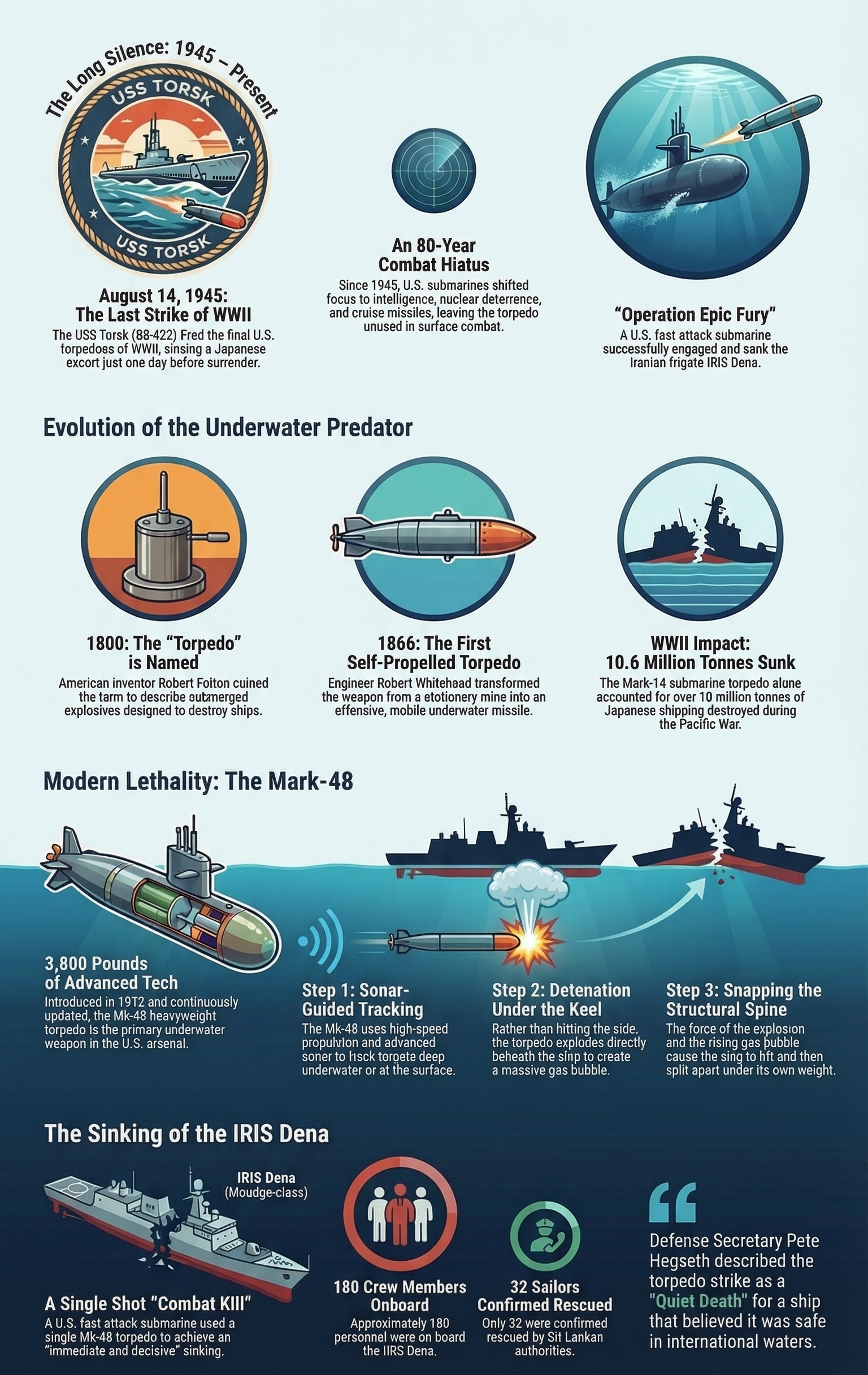
Modern self-propelled torpedo emerged in 1866 when engineer Robert Whitehead designed a weapon that could travel through water towards a target. His invention marked a turning point by transforming torpedoes from defensive mines into offensive naval weapons.
Throughout the early twentieth century, navies improved torpedoes with faster engines, better guidance systems and more powerful explosives. By the time of World War II, submarines, destroyers and aircraft all used torpedoes as key anti-ship weapons.
The US Navy fielded several important models during that era. According to US Naval Institute Mark-14 submarine torpedo alone sank 10,689,800 tonnes of Japanese shipping during the Pacific War. Later developments introduced acoustic homing systems that allowed torpedoes to track the sound of enemy vessels.
After World War II, advances in missile technology gradually reduced the need for torpedo attacks on surface ships. Submarines shifted toward intelligence missions, nuclear deterrence patrols and long-range missile strikes.
Today’s torpedoes remain highly sophisticated weapons. Modern designs use advanced sonar, wire guidance and high-speed propulsion to track submarines and ships deep underwater. Mark-48, which sank the IRIS Dena, remains the primary heavyweight torpedo in US submarine service.
Echoes of World War II
The last time a US submarine sank an enemy warship with a torpedo before this week occurred on 14 August 1945, during the final hours of World War II. The submarine USS Torsk (SS-423) fired the US Navy’s final torpedoes of the war in the Sea of Japan.
Torsk used a combination of Mark-28 acoustic-homing and Mark-27 “Cutie” torpedoes to sink a Japanese coastal defence escort vessel. Japan announced its surrender the following day, making that attack the final enemy warship destroyed in the entire conflict.
The sinking of IRIS Dena therefore ends an almost eighty-year gap in US submarine torpedo combat. It also highlights how naval warfare has evolved. World War II submarines relied on relatively simple straight-running torpedoes that travelled at modest speeds and required precise positioning.
Modern torpedoes such as the Mark-48 operate with far greater sophistication. They can track targets using sonar, adjust courses during flight and detonate beneath a ship’s keel to cause catastrophic structural failure. This difference illustrates how underwater warfare has moved from mechanical weapons of the mid-twentieth century to highly advanced guided systems.
Even so, the recent attack shows that one of the oldest naval weapons still holds devastating power in modern conflict.