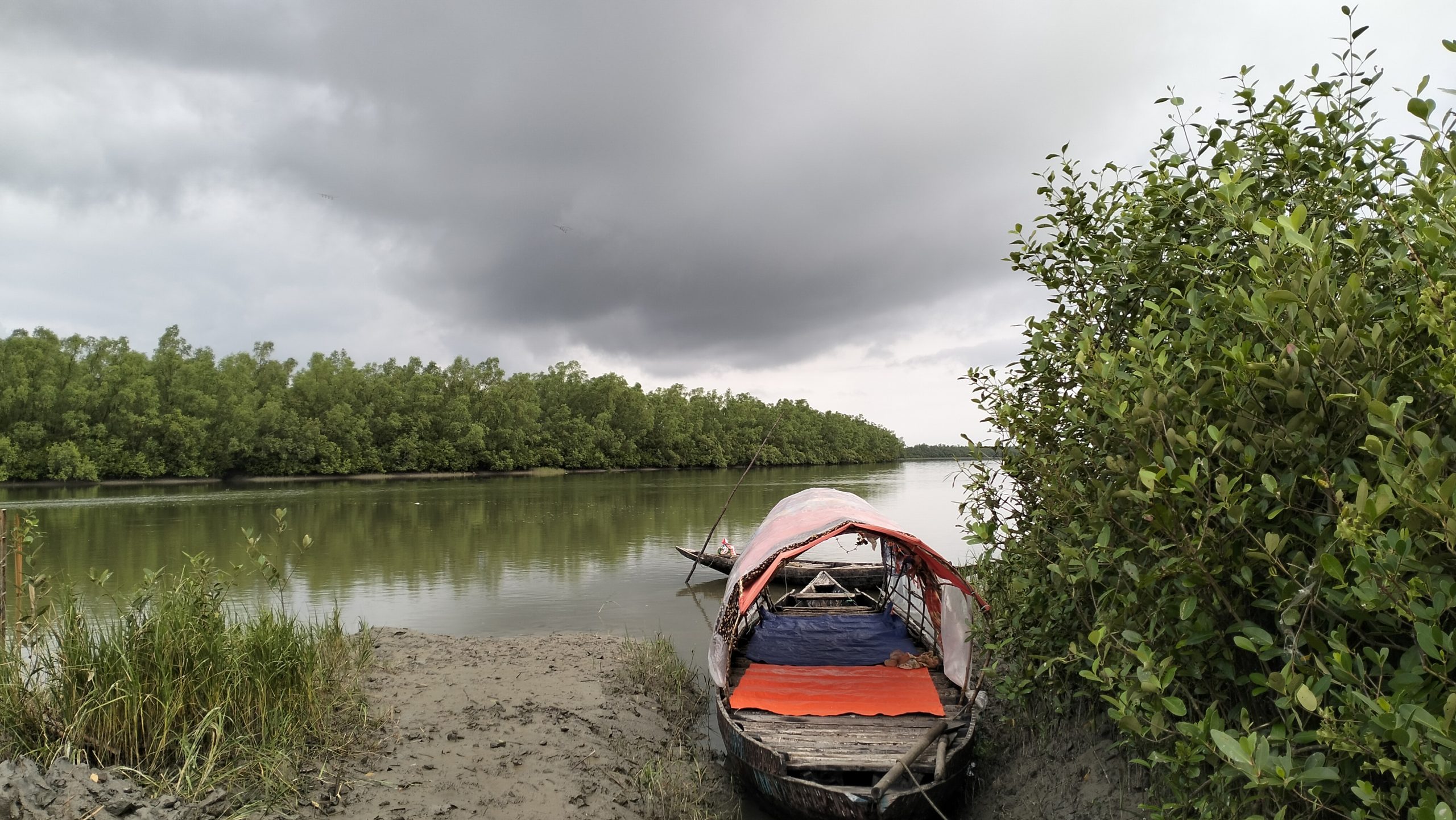
It’s a monsoon-drenched Sunday afternoon of July along the banks of the Khulpetua River, a tidal waterway in southwestern Bangladesh that connects the interior of the world’s largest Sundarbans mangrove forest to the Bay of Bengal. Near the muddy edge of Nildumur Bazaar in Shatkhira, one of the three districts the mangrove forest go across in Bangladesh part; the sky hangs low, bruised with storm clouds, and rain drizzles like a whisper. Thunder cracks in the distance, echoing over the water.
Sitting on muddy block on the riverbank, 55-year-old Amena Begum casts her fishing hook with quiet precision. Her sari clings to her frame, soaked from the hour-long effort. Above her, a faded umbrella flutters in the wind as she hums a folk tune: soft, wavering, and nearly drowned out by the weather. It’s a song meant for hook fishing, once sung in chorus by riverside women like her. Now, it hangs lonely in the air.
Near her, dozens of villagers fish silently. No one sings anymore. Amena was born on the other side of the river, in Gabura Union near Sundarbans in Shyamnagar upazila in the district of Shatkhira. She married at 17 and still remembers the joy of her wedding night, when her parents hired Pala Gaan (A traditional form of Bengali folk theatre that combines music, storytelling, and performance) artists who wove epic tales into melody.
“Whenever people talk about marriage, I always go back to the day of my own wedding,” Amena said with a faint smile. “A group of artists performed that night. Their songs made the evening unforgettable. Back then, every family tried to bring folk musicians to a wedding. But now? I can’t remember the last time I heard them at a ceremony, not in the past five years.”
Amena, now a mother of three, has watched the change unfold in her own household. When her eldest son married, someone in the family suggested hiring Pala Gaan performers. She loved the idea, but her son insisted on renting only a sound system. Instead of live folk music, the wedding was filled with recorded tracks, mostly classical tunes, with a few Jari, Sari and Pala Gaan mixed in. Her younger son’s wedding in 2011 was no different; the folk singers were absent, replaced once again by playlists.
The transformation has spread across almost all areas near Sundarbans in Bangladesh. Weddings, religious rituals, and community gatherings that once pulsed with live music by Jari Gaan, Sari Gaan, Kabi Gaan, Pala Gaan, Marfati and Sariati singers are now dominated by cheap DJs, loudspeakers, and Bluetooth playlists. In place of the proud, poetic verses passed down through generations, villages echo with borrowed voices and foreign beats.
“In the old days, these songs filled the local village markets. Folk singers would go from market to market, collecting money every year by singing those traditional songs. Life had joy then. In our time. We didn’t have mobile phones or modern things, but we had folk music. Even after long days of cutting wood in the Sundarbans, we sang.”, says 82-year-old Hazrat Ullah from Nildumur village, on the edge of the Sundarbans in Shatkhira.
But Cyclone Aila in 2009 changed everything. “The storm swallowed it all,” he said quietly. “We stayed in a shelter for eight or nine days. Many people died. Cows and goats were washed away. The water rose 12 to 15 feet. Musical instruments were also destroyed. Since then, the music has never returned in the village.”

For many, this silence signals more than a cultural shift. It is a symptom of survival. Since Cyclone Aila devastated the Sundarbans in 2009 that left 190 people dead and 7,100 injured, killed 100,000 livestock, destroyed crops across 350,000 acres of land of Satkhira, Khulna and Bagerhat districts completely; The powerful cyclone Bulbul in 2019, Amphan in 2020, Yaas in 2021, Sitrang in 2022, and most recently Remal in 2024 made the situation worst. Each cyclone left behind more than just broken embankments and flooded villages. Salinity has crept deeper into farmland, forcing families to abandon crops for shrimp farming or migration. Communities have been displaced, schools destroyed, and traditional gathering spaces lost. With every storm, survival becomes the only priority in the region. In the struggle to survive, intangible traditions like folk music: fragile, unrecorded, and dependent on community gatherings are among the first to vanish. Nowadays, people are not taking it as their professions, those used to sing in the area now joined other professions to survive as it’s not bringing them money to lead families.
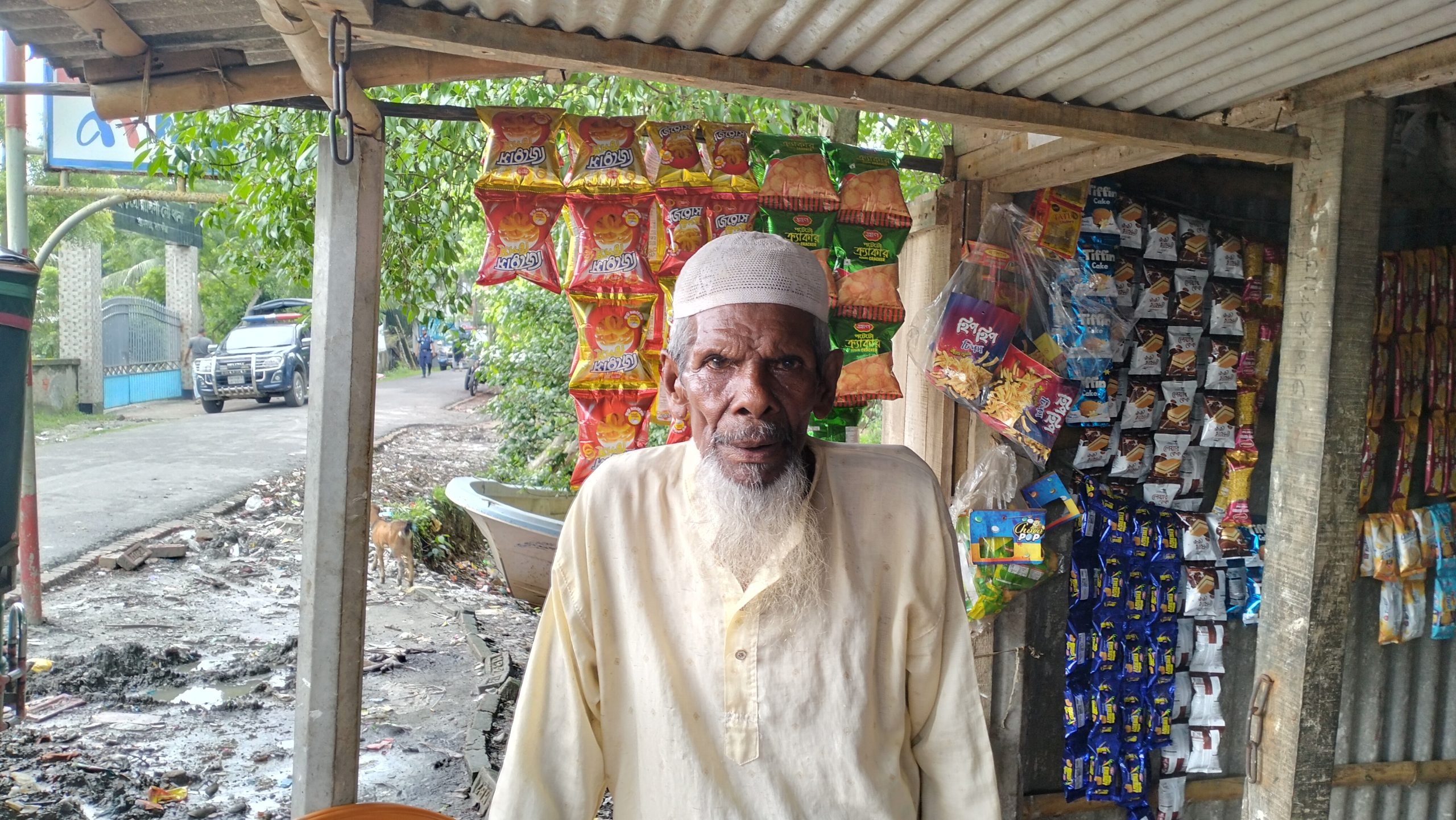
Among those who once kept the musical traditions of the Sundarbans areas alive is 55-year-old folk singer Kabi Tofazzel from Shyamnagar was a familiar voice in Sundarbans areas for decades, known for performing Marfati, Sariati, and Islamic devotional songs. He started singing full-time at just 17, forming a troupe of 12 young performers. Together, they traveled from markets to wedding halls, from cultural evenings to village fairs, keeping alive the oral traditions that bound communities together. But today, that team no longer exists. If anyone hires him now, he performs with only one companion, his 25-year-old son, Sajedar Hossain. With requests for performances dwindling to a trickle, Tofazzel has been forced to shift his livelihood. He and Sajedar now run a small grocery store, which consumes most of their time.
“In the 1990s, as a team leader I would get 20 to 25 proposals every month. Even before Cyclone Aila struck, there were still 15 to 20 events a month. But after Aila, people left the area. Many moved to Dhaka or Khulna for work. The requests stopped coming,” he recalled.
Now, at best, he receives one or two offers in a month. Some months, none at all. Payment has risen on paper, he now earns between 1,000 and 1,200 taka per event, compared to BDT 400 to 600 in the 1990s. But the math no longer works.
“Back then, with 20 to 25 events a month, I could earn BDT 15,000,” he said. “That was a big amount in those days. Now, even though the rate is higher, there are hardly any requests. And with today’s prices, what I earn from a program feels like only BDT 200 from the past.”.
“My father devoted his life to folk-art,” says 25-year-old Sajedar Hossain, son of folk singer Kabi Tofazzel.




“I grew up listening to his verses, but today my friends don’t care for them. They prefer DJs or YouTube music. Sometimes I feel torn, I want to carry forward his legacy, but I don’t know if people will listen. How do you keep a tradition alive when the audience itself is disappearing?”
A similar fate befell 70-year-old folk singer Abdul Majed Gazi of Maukhali village, on the Sundarbans coast. He began singing folk music in his twenties and once received 10 to 12 invitations a month, even in the 2000s. Now, he gets barely one or two requests and sometimes none for months.
“I need to feed my family,” he said.
“The songs no longer bring income, so I had to become a full-time fisherman. Young people aren’t interested anymore. The music is losing its appeal and with it, part of our identity.”
“In my whole life, I’ve seen live folk-music events only twice,” says 22-year-old Mazharul Islam, who runs a small tea stall in Gabura Union of Shatkhira.
“The last one was three years ago. Young people like us don’t really enjoy those songs anymore, they feel too slow, too old. We have mobile phones now; we stream Hindi songs and watch YouTube. Modern music is fast, catchy, and exciting. For us, cricket, football, and social media are more entertaining than regularly sitting through long traditional performances. There aren’t many folk singers or events happening these days, so we don’t go even if we want to.”
Gazi Nazrul Islam, 72, a two-term Member of Parliament from Satkhira-5, told that frequent cyclones, river erosions, tidal surges and storms have forced many residents to leave parts of the Sundarbans. “When these people migrated, their cultural identity migrated with them,” he said.
“Jari, Sari, Kabi Gaan, Jhumur Dance, Kabaddi, Lathi Khela (traditional Bengali martial art) were once the main sources of entertainment. But it wasn’t just culture, familial bonds were shattered as well. When families moved to cities like Dhaka or Khulna due to climate change, they often lost touch. Drums, harmoniums, and clapping were once the heartbeat of the village, carrying our stories, our pain, our pride. New generations no longer know these rhythms and the songs hardly fill the air anymore.” he added,
This decline has cut across religions. Once, Muslims sang Bonbibi Pala (folk theatre) and Hindus performed Marfati songs (a genre of Bengali Sufi folk music), reflecting a shared reverence for the Sundarbans’ guardian spirit, Bonbibi, a deity who protects fishers and honey gatherers from tiger attacks. These traditions once united communities, but now they are vanishing.
Rany Baulia, 45 from Jelekhali village in Shatkhira of Sundarbans, recalls how Bonbibi Pala, Dukher Bonobash, Manasa Jatra Pala (folk theatre), Jhumur and Putul Nach (folk puppetry art form) once echoed in the mind of every Hindu man and woman in her community, filling them with rhythm and spirit. Her late father-in-law, Nagan Baulia, even led a troupe that carried these traditions from one festival to the next.
“After his death, no one kept the legacy,” she says softly. “When I was a child, our afternoons and nights came alive with those fork-art. Now parents no longer want their children in these traditions. The songs and dances that once defined us are vanishing into silence.”
Rafiqul Islam, Cultural Officer for Khulna and formerly for Bagherhat, both districts encompassing parts of the Sundarbans region, said the government has taken steps to preserve traditional arts such as Pala Gaan, Kabi Gaan, Jari Gaan, Lathi Khela, and Putul Dance through organized cultural events.
“We arrange these events so that these traditions do not disappear but there are financial challenges. Many singers have lost interest because their income is too low. The environment for performing is also no longer the same as people’s mindsets have changed, and many have turned to other professions. Only a handful of artists remain committed to preserving these Cultural traditions.”, he added.
“It is not possible for the government alone to sustain these traditions. Preservation depends on spirit and passion. Even with financial incentives, these arts cannot survive without true dedication. Climate change has been a major factor, frequent tidal surges, storms, and other disasters have forced many musicians to leave their villages. As a result, numerous traditional practices are being forgotten.”
In Bangladesh, the preservation of traditional folk arts falls under the Ministry of Cultural Affairs, with institutions like the Bangladesh Shilpakala Academy playing a central role. These bodies organize festivals and training sessions to promote folk art forms. However, no dedicated incentives exist to sustain these traditions, and few studies have assessed the cultural loss caused by their decline. However, some NGOs have stepped in, using traditional folk music to raise awareness about issues like climate change, child marriage, and dengue outbreaks, allowing some singers to earn a modest income while pursuing their passion.
Rahul Prosad Das, President of Sundarbans Theatre, a cultural organization that has been performing traditional songs for over 25 years, with its main office in Mongla, Bagerhat of Sundarbans said, “We have collaborated with government and development organizations across Bangladesh to promote nearly lost forms of folk performance including Potgan, Jari Gaan, Gambhira, Pala Gaan, and street theatre, raising public awareness on social and environmental issues. Through these efforts, we are trying to keep the traditions alive, but the songs are disappearing for many reasons including climate change, financial issues etc. Out of my own passion, I continue this work as a legacy of my father.”
Professor Dr. Shahnaz Nasrin Ila of Dhaka University’s Music Department told that Folk music and other cultural traditions in Sundarbans region is deeply tied to nature, professions, and the rhythms of daily life. When climate change forces people to leave their land, abandon their livelihoods, or change their way of living, the songs vanish with them.
“These are non-economic damages, losses of memory, of tradition, of cultural soul that are harder to measure but equally devastating.” she explained
“When a fisherman leaves his nets for a garment factory, the bhatiyali he once sang no longer fits his life. When families migrate from lowlands to cities, their tastes change, and with them, the songs fade.”
She emphasized that preservation cannot rest with government alone, communities, cultural activists, and local people must take part.
“We need more research on how to cope with these changes and how to preserve what can still be saved. Folk traditions must adapt to new realities and technologies, but they should not lose their essence.”
(This story was produced with the support of Internews’ Earth Journalism Network)