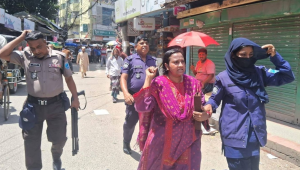
The July–August 2024 uprising in Bangladesh marked one of the most dramatic chapters in the country’s political history. What began as a student-led protest quickly transformed into a broad-based movement of citizens demanding democracy, accountability, and institutional reform. The central target of public anger was the government led by Sheikh Hasina, whose long tenure in power had, in the eyes of critics, become synonymous with centralised authority, shrinking political space, and weakened public trust in electoral and governance systems.
The movement was powerful not only because of its scale but because of its moral claim. Students stood at the frontlines, framing their struggle as one for the future of the republic. Civil society actors, professionals, and ordinary citizens joined them. The language of the streets was clear: restore democratic balance, ensure credible elections, end partisan capture of institutions, and rebuild trust between the state and the people.
When the government fell and power shifted, many believed a new political era was at hand. But revolutions are judged not by how they begin, but by what follows.
History offers a familiar pattern. Movements born in moral outrage often face their greatest test when they transition from resistance to governance. In 2024, several prominent faces of the uprising found themselves absorbed into the structures of state power – through advisory roles, party alignments, or appointments within transitional arrangements. This was, in many ways, inevitable. Revolutions produce leaders, and leadership carries responsibility.
Yet within months, allegations of favouritism, opaque decision-making, and personal gain began to circulate around some of these very figures. Critics pointed to inconsistencies between the ideals articulated during the movement and the conduct displayed afterward. Questions arose: Were appointments merit-based? Were procurement processes transparent? Were alliances formed on principle or political convenience?

Even where evidence of wrongdoing remained contested, perception itself became a political force. For a movement built on the promise of ethical renewal, the mere suspicion of corruption was damaging.
When leaders of such a movement are later perceived as replicating the behaviours they once condemned, the disillusionment cuts deep. It is not just about financial misconduct or administrative irregularities. It is about betrayal of expectation.
Public opinion surveys and media commentary in the months following the transition suggested a growing skepticism among citizens, particularly youth. Many began to question whether the uprising had been co-opted by opportunistic actors. Others argued that the structural realities of politics in Bangladesh, where patronage networks and party loyalties are deeply entrenched, make rapid ethical transformation unrealistic. Both perspectives contain elements of truth.
To understand the trajectory of the post-uprising period, one must look beyond individual leaders. Bangladesh’s political system has long been characterised by intense polarisation, winner-takes-all competition, and personalised leadership. Institutions often reflect partisan alignments rather than neutral authority.




In such an environment, even well-intentioned reformers face immense pressure. Aligning with established political actors may appear necessary to maintain stability. Compromises become routine. The boundary between pragmatism and principle grows thin.
This does not excuse corruption. But it does suggest that systemic reform requires more than a change of faces. It demands institutional redesign, strengthening anti-corruption bodies, ensuring judicial independence, reforming electoral processes, and protecting media freedom.
A revolution that stops at leadership change, without structural transformation, risks becoming cyclical.
Declaring the 2024 uprising a failure would be premature. Political change unfolds over years, sometimes decades. The movement succeeded in demonstrating that citizens, especially young people, remain deeply invested in democratic accountability. It disrupted a narrative of political inevitability and proved that public mobilisation can reshape power dynamics.
At the same time, the erosion of trust in some revolutionary leaders reveals a painful truth: moral legitimacy is perishable. When expectations are high, even minor lapses can appear magnified. Failure, in this context, is not simply about unmet goals. It is about the gap between promise and performance.
If the movement’s leaders are unable or unwilling to hold themselves to higher standards than their predecessors, public cynicism will deepen. Citizens may conclude that all political actors are interchangeable. Such disillusionment poses a greater threat to democracy than any single administration.
The challenge now is whether this generation will retreat into apathy or double down on civic engagement. Democratic culture is not built in one season of protest. It requires sustained participation – monitoring public spending, engaging in policy debates, building independent organisations, and voting strategically.
Several lessons emerge from the July–August experience. First, movements must institutionalise accountability early. Clear codes of conduct, transparent funding mechanisms, and internal democratic processes are not luxuries; they are safeguards against later compromise. Second, leadership rotation and collective decision-making reduce the risks of personalisation. When a movement becomes overly dependent on a few charismatic figures, it becomes vulnerable to their weaknesses. Third, civic vigilance must extend beyond regime change. Removing one government does not automatically transform governance culture. Citizens must remain engaged even when their preferred leaders hold office. Finally, political education matters. Democracy is not only about elections; it is about norms, respect for dissent, adherence to law, and ethical public service.
The July–August 2024 uprising remains an unfinished chapter in Bangladesh’s political journey. It exposed the depth of public frustration and the resilience of collective action. It also revealed how fragile revolutionary ideals can be once confronted with the realities of power.
Whether the movement ultimately strengthens or weakens democratic culture will depend on what happens next. If corruption among some leaders goes unchallenged, the narrative may solidify around disillusionment. If, however, institutions are strengthened and accountability mechanisms enforced – even against former revolutionaries – the uprising may yet be remembered as a turning point.
The views expressed in this article are solely those of the author
The writer is a Business leader, Governance advocate, and Specialist of the Centre for Political Innovation and Transformation (CPIT)