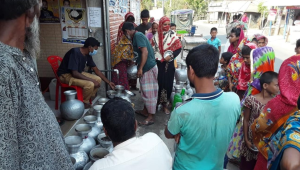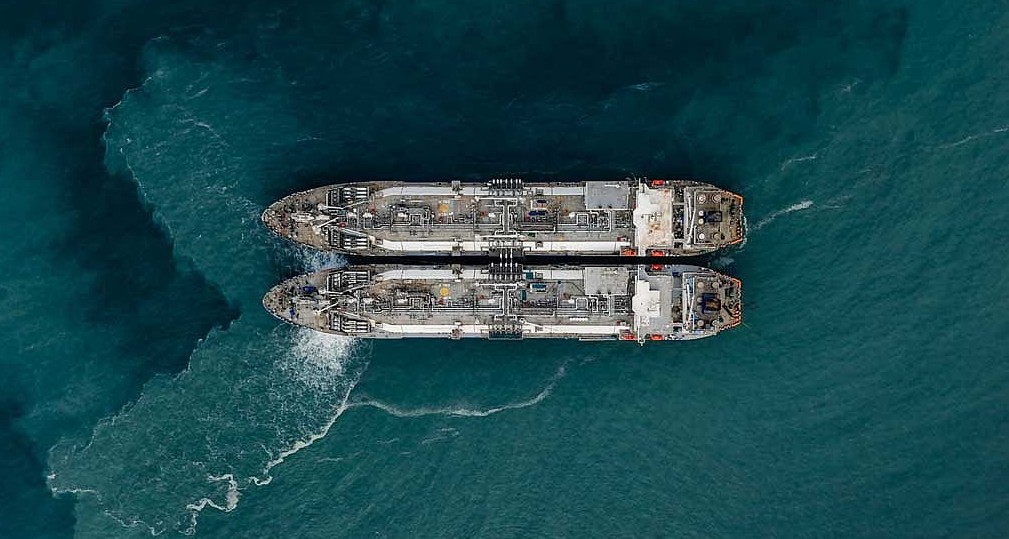



The Moheshkhali Liquefied Natural Gas (LNG) plant operated by Excelerate Energy was the site of a fire last month. Overnight, it knocked out almost 400-500 million cubic feet of gas supply per day. Within days, women of Mirpur were preparing mud stoves for cooking dinner, CNG drivers were preparing for a long queue at refuelling stations, and textile factories in Narayanganj were firing up boilers at ‘trickle’ pressures. All this was not about a fire only. It was about a country that has wagered its kitchen stoves, factories, and power plants for a decade that it cannot control the price of the fuel it is using.
There was a time when Bangladesh ran almost entirely on its own gas. In 2000, the country’s reserves would be approximately 28 trillion cubic feet. Today, that figure is around 10.6 trillion cubic feet, and daily production is barely meeting three-quarters of the country’s demand. To fill the gap, Bangladesh addressed its LNG needs by buying LNG provided by Qatar and the spot and regasified at two floating terminals off Moheshkhali and Kutubdia. This is a reasonable patch for an emergency. It was never intended to be the backbone of a nation’s energy supply, but it has become just that. Today, 35-40 percent of the country’s daily gas is supplied from LNG.
The key problem is the cost factor. Domestic gas is cheaper and equivalent to BDT22-25 per unit. The price of imported LNG is BDT110-140, while much higher during spikes worldwide. This government absorbs the price gap via subsidy, an outflow that is surely more than $500 million annually. The country finds itself increasingly unable to afford using foreign currencies. In addition, earlier this year, the turmoil in the Middle East caused problems at QatarEnergy – a large company in Qatar that trades natural gas. They had declared force majeure on cargoes, legally pausing their promises. Such a scenario exposed Bangladesh to a major vulnerability as it is heavily dependent on this major supplier. Meanwhile, one of the floating stations (i.e., Moheshkhali) that turns liquid gas into regular gas caught fire, temporarily got shut down, and made the gas-related shortages more brutal.

In energy economics, there is a known pattern called ‘rockets and feathers’, which refers to the phenomenon where prices increase rapidly (like rockets) but decrease slowly (like feathers). The more time passes, the higher the spike in prices occurs continuously, affecting households and factories immediately. However, if any fall in prices occurs, it reaches people in an extremely slow manner. Such a scenario is not a coincidence. It is a routine feature of the way energy markets and regulators operate, and its impact on how Bangladesh is financing itself. The trend of tariffs rising and fiscal burden will continue until there are changes in the way tariffs are applied.




Right now, there are three changes which are urgently required. Firstly, diversify the long-term contracts with multiple sourcing countries rather than relying on one supplier and the volatile spot market, so that any single country’s force majeure cannot disrupt the country’s gas supply. Secondly, build redundancy: the country with a population of 170 million cannot rely on two floating terminals, since a fire at one of them slashes nearly a fifth of the national supply, as we just saw. Finally, eliminate the tariff formula, making it automatic and transparent. The pass-through mechanism would facilitate price adjustments to costs that are short-term in nature for both parties. Rather than piling up as an invisible subsidy bill that taxpayers eventually pay anyway.
None of these recommendations are exotic. They are not new, but they have already been implemented in other import-dependent countries. What Bangladesh has lacked is not knowledge but the realisation of urgency to secure our energy grid with proper contingency. The stoves that went dark last week are a warning, not a footnote, that the era of importing energy security through improvisation is almost over.
The views expressed in this article are solely those of the author
The writer is an Assistant Professor, Economics, BRAC University. E-mail: [email protected]