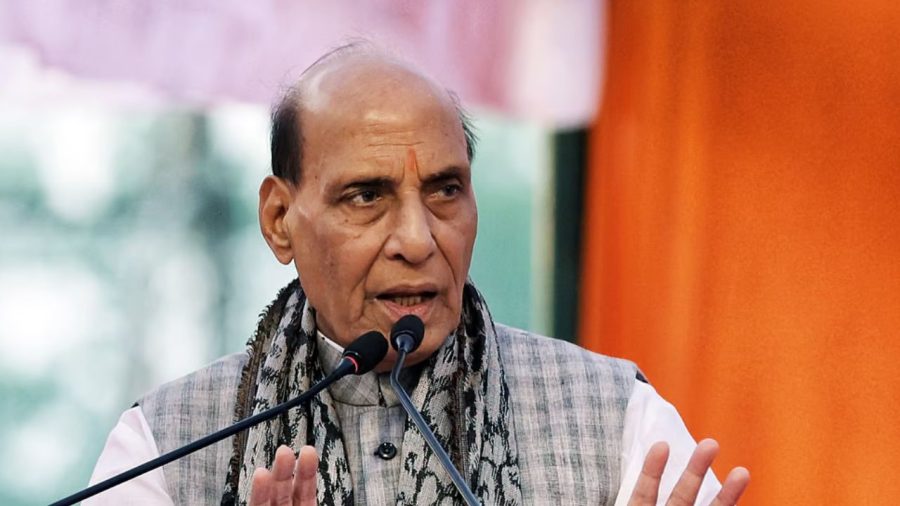



Union Defence Minister Rajnath Singh accused the opposition Congress party and its political allies of trying to plot a Bangladesh-style regime change in India by driving youth towards anarchy rather than constructive nation-building.
Addressing a press conference on Friday in Delhi, Rajnath said democracy does not grant anyone the licence to create disorder or erode the credibility of constitutional bodies, reports PTI.
He added that the opposition and its affiliated organisations were turning young people into pawns in a strategy focused on political confrontation and anarchy.
Referring to the 2024 mass uprising in Bangladesh that ousted the Sheikh Hasina government, the union defence minister for defence noted that opposition leaders have openly acknowledged drawing inspiration from Bangladesh for regime change during press conferences, while others have spoken openly about overthrowing the government.

He said such statements make it clear that the opposition’s primary agenda is to tear down democratic institutions and destabilise the country.
According to him, the opposition’s use of terms like “regime change” demonstrates that their campaign is not genuinely about electoral reforms or concerns surrounding the Special Intensive Revision (SIR) of electoral rolls.




His comments come amidst widespread demonstrations in the Indian national capital Delhi by opposition parties and civil society groups, demanding the resignation of Gyanesh Kumar, chief election commissioner, over alleged irregularities in the SIR process.
Opposition leaders have claimed that the revision exercise lacks transparency and risks disenfranchising eligible voters.
Recalling observations made by the Supreme Court on Thursday, Rajnath said Congress leader Rahul Gandhi and his allies must recognise that democracy prohibits attempts to spark anarchy, undermine constitutional bodies, or obstruct India’s development.
He emphasised that adhering to the law is vital for maintaining law and order, adding that India’s democratic institutions cannot be sacrificed for political self-interest.
Rajnath added that falsehoods, anger, political opportunism, and attempts to tarnish institutions would not halt the country’s progress.
He urged Gandhi to respect the public mandate and reflect on his political role rather than pursuing what he described as “politics of destruction” under the guise of protecting democracy.
Rajnath concluded by stressing that India’s future remains a collective responsibility, calling for a path of dialogue and nation-building over confrontation.