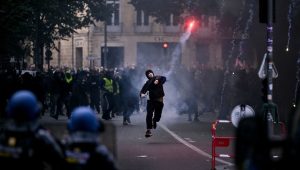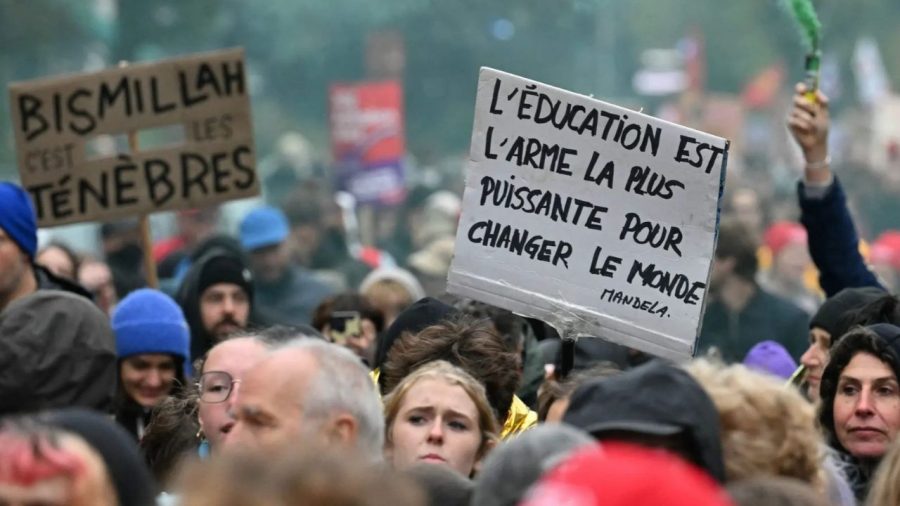



As violent protests roil France, uniting students demanding improved educational conditions and groups opposing the high cost of living, an improbable chant has emerged as a central rallying cry – “Bismillah, c’est les ténèbres.”
Hundreds of thousands took to the streets nationwide over the weekend in the largest mobilisation since demonstrations against education reforms and rising prices began last month.
The protest movement stems from widespread grievances ranging from overcrowded classrooms and teacher shortages to systemic inequality and a lack of opportunity.
Anatomy of a nonsensical slogan
Taken literally, the phrase translates as “In the name of God, it’s the darkness,” an expression that holds no clear inherent message on its own.

In French slang, “Bismillah” – the Arabic phrase for “in the name of God” used by Muslims prior to starting an activity – has shifted to mean “let’s do it.”
Meanwhile, “c’est les ténèbres” translates literally to “it’s the darkness”, referencing a situation that is bleak and hopeless. Though nonsensical on the surface, students have channelled core grievances into the expression to mock racial stereotyping by law enforcement.
Undercover infiltration, police mockery
Students say the slogan originated as a mockery of police officers who attempted to infiltrate social media coordination chats.




A screenshot from Snapchat circulating in early October showed a user named Mamadou requesting entry to a group chat with the message, “Hi, in the name of God, it’s the darkness. When’s the blockade, wallah, bro?”, alongside Algerian flag emojis.
Demonstrators contend the message was sent by undercover officers using an unconvincing mix of Arabic and slang. French authorities have issued no statement regarding the unverified claim.
However, Youssef El Chazli, associate professor in Arab and Mediterranean sociology at Paris 8 University Vincennes – Saint-Denis, said the phrase reinforces an image of out-of-touch policemen filled with stereotypes that disproportionately target youth of Arab and African descent.
Meanwhile, police conduct has come under scrutiny, with France’s police inspectorate, the IGPN, opening dozens of investigations into alleged police violence since protests began.
Spread across Europe and political fallout
The slogan has appeared on cardboard placards as both a satire of racial stereotypes and a symbol of disconnected authority, spreading to Italy and Belgium where parallel protests over education and living costs took place over the weekend.
The associate professor said satirical memes and subcultural trends have become creative tools for youth mobilisations, noting that Arab and African influences have steadily mainstreamed in youth subcultures through sports, arts, radio shows, and social media.
The movement coincides with growing public debate over Islamophobia, an issue French authorities have been reluctant to comment on despite a 72 per cent surge in Islamophobic acts reported by the Reuters news agency for the first quarter of 2025 compared with the same period in 2024.
Political reactions have been swift, with the French far right using racist language to blame Muslim youths, while Donald Trump, US president, claimed the unrest was about “Islam wanting to take over” and alleged Paris would soon become a Muslim city.