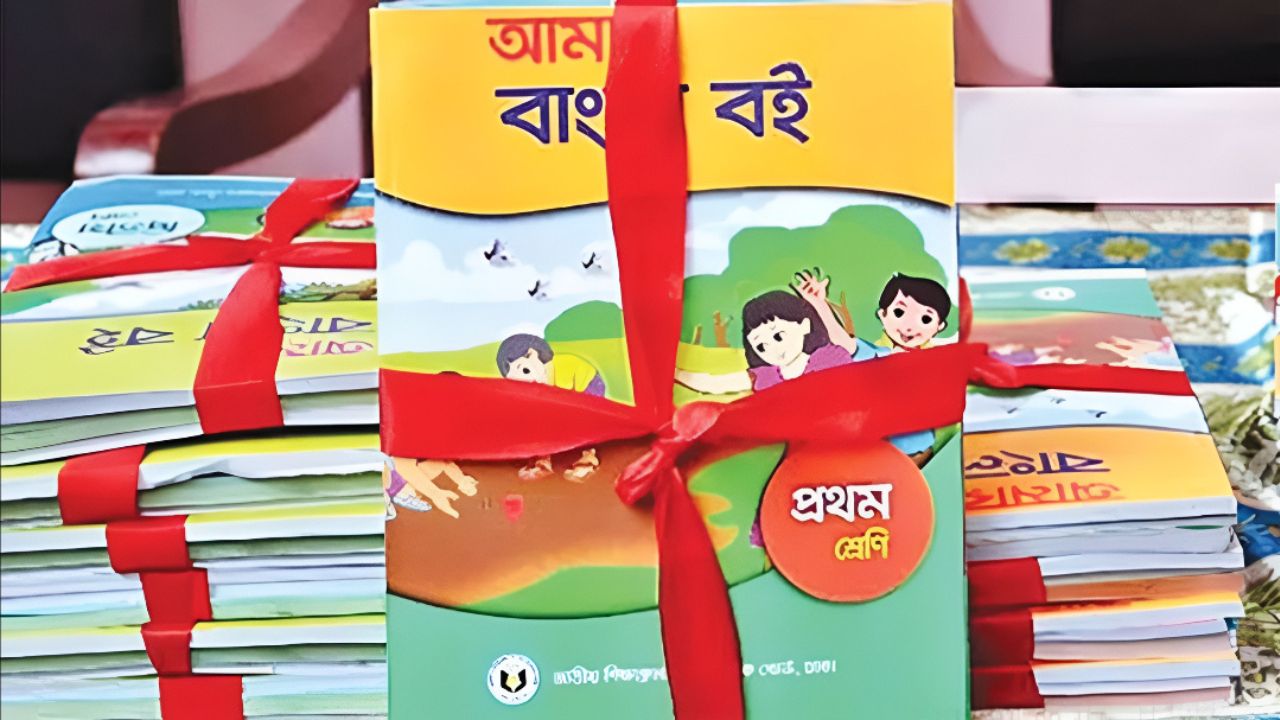



Despite government efforts to end textbook delays, slow progress so far has revived fears that students may again begin the 2027 academic year without receiving all their books.
While revision of Bangla-version textbooks has made substantial progress, work on English-version books has only just begun.
More significantly, writing has yet to start on four new textbooks scheduled to be introduced for primary and secondary students for the first time in the 2027 academic year.
Crores of students began the academic year without complete sets of textbooks in both 2025 and 2026 due to delays in printing, procurement and distribution.
In 2025, only 4 crore of the required 9.19 crore primary books and 1.9 crore of the required 30.96 crore secondary books were delivered initially.
In 2026, while primary students received books on time, around 5.82 crore secondary and Ebtedayee books remained undelivered, with Class VII and Class VIII facing the worst shortages. The National Curriculum and Textbook Board (NCTB) blamed delayed printing following procurement setbacks.
Textbooks must pass through several stages of revision before they are finalised and work orders are issued for publication.
Publishers are then given two months to print the books, after which another crucial stage — quality assessment — must be completed before clearance is given for distribution.

NCTB Member (Textbook) Professor Mohammad Abu Nasher Tuku told TIMES of Bangladesh, “The revision of pre-primary and Ebtedayee textbooks has been finalised and work orders for publication have been issued.
Printing of these books will begin within a day or two. Revision of Bangla-version textbooks for Class I to Class V is also being completed. The matter will soon be sent to the government’s procurement committee.”
He said preparations for the four new textbooks to be introduced next year were also under way.
NCTB Chief Editor AKM Shawkat Ali Khan told TIMES, “Revision of all Bangla-version textbooks has been completed. The finer details are now being checked before finalisation. Revision of the English-version books is also under way. I hope all the work will be completed on time.”
Former NCTB officials highlight quality control as a major concern for primary textbooks due to four-colour printing, which takes extra time. Secondary and higher secondary textbooks also carry a much heavier workload owing to larger page counts.



Printing is only part of the process; binding, multi-tiered quality checks, and transport to schools remain. Still, if tenders are finalised by September and closely monitored, most Bangla-medium books should reach students in early January. However, English-medium versions and four new textbooks may take longer.
An anonymous NCTB official explained, “We are working around the clock, but stages are taking longer than planned. We aim to deliver main textbooks on New Year’s Day, with any remaining books dispatched later in January.”
Given ministerial targets to align SSC and HSC exam schedules, the government aims to deliver textbooks promptly after December exams, expecting fewer delays than last year.
Four new books await authors
To encourage students to take greater interest in sports and cultural activities, the government is introducing two new Class IV textbooks at the primary level — Sports and Culture of Bangladesh.
In line with its election manifesto, two more textbooks covering joyful learning and technical education will also be introduced in Class VI from the 2027 academic year, with the aim of making education more enjoyable and increasing students’ interest in and respect for technical education.
Multiple NCTB sources said a list of prospective authors had already been sent to the Ministry of Education. Writing will begin once the ministry finalises the list.
Although four new textbooks — two each at primary and secondary levels — are being introduced, no separate curriculum has been formulated for them.
An NCTB expert said some lessons on sports and indigenous culture had previously been included in existing textbooks. Those subjects will now be covered in greater depth through separate books.
The concept of joyful learning, however, is entirely new. Experts have finalised a framework for the new books based on the existing curriculum, and the content and syllabus will be structured accordingly.
The NCTB expert, who asked not to be named, said the books would initially be published on a limited scale.
NCTB Member (Primary Curriculum) Md Iqbal Hyder told TIMES, “Revision of Bangla-version textbooks for Class I to Class V at the primary level is also nearing completion and will be finalised and submitted by 10 August.”
Few changes apart from history
At the primary level, the NCTB made additions and omissions to the 2021 curriculum and introduced extensive changes to textbook content for the 2026 academic year.
As a result, relatively few changes are expected in the textbooks for 2027, although some material is being added to chapters dealing with political history.
NCTB Member (Curriculum) Muhammod Fatihul Kadir told TIMES, “Apart from some history-related changes, there will not be many other changes to next year’s textbooks. Emphasis is being placed on arranging the content of the books from a politically neutral perspective.”
He said the role of late prime minister Khaleda Zia in the 1990 anti-autocracy mass movement and the role of Ziaur Rahman on 7 November 1975 were being added to the Bangladesh and Global Studies textbooks for Classes VI to IX.
Ziaur Rahman’s “declaration of independence” will also be included in next year’s books.
An essay written by Ziaur Rahman is also being added to the Bangla textbook for Classes IX and X, while a section on Ziaur Rahman and former prime minister Khaleda Zia is being included in the Class IV Bangladesh and Global Studies textbook.
NCTB sources said 8,21,67,000 books are being published for pre-primary and primary students for the 2027 academic year, alongside 22,05,55,000 books for secondary, technical and Ebtedayee students.
Around Tk1,900 crore has been budgeted to print nearly 31 crore textbooks.