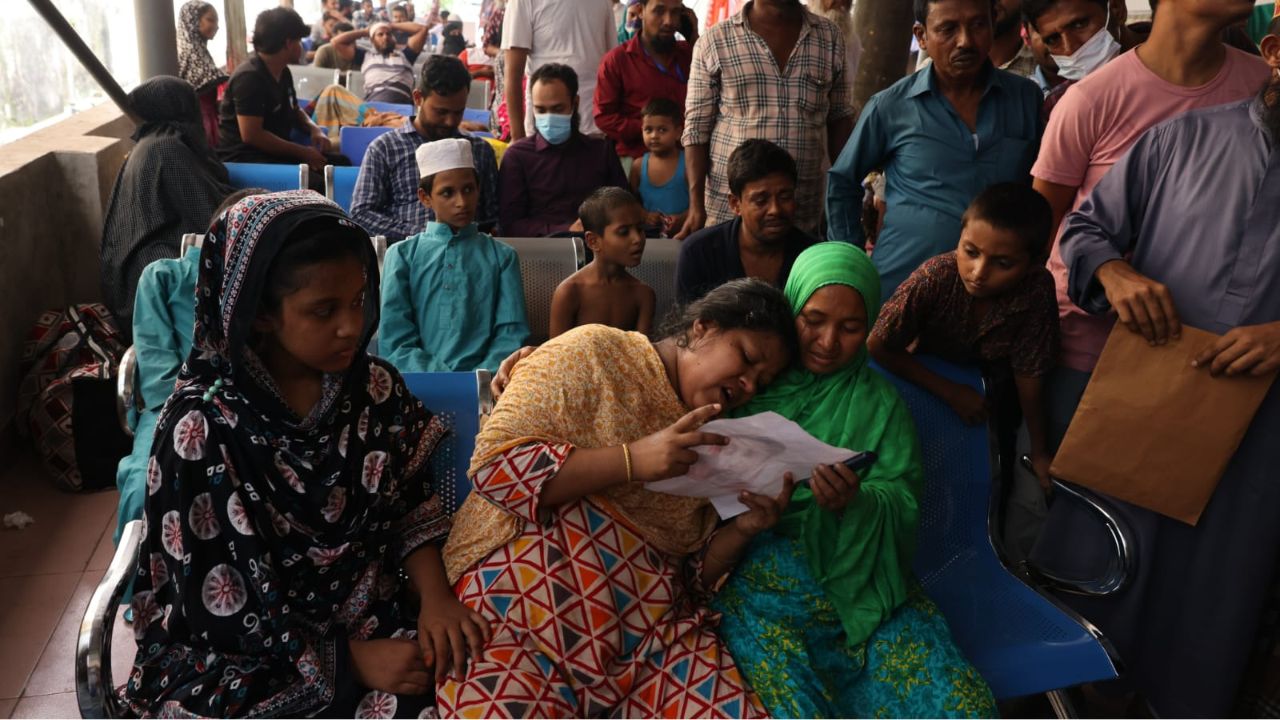

The air was thick with smoke and grief. Wailing mothers, fathers, and siblings gathered outside the blazing garment factory and chemical warehouse in Mirpur, clutching photographs of their missing loved ones—holding them high in desperate hope that someone, somewhere, might recognise a face or bring word of the missing.
Chaos unfolded as dozens of others frantically searched for their loved ones among the ruins of two adjacent establishments.
As firefighters battled the flames, relatives ran between Dhaka Medical College Hospital and the National Institute of Burn and Plastic Surgery, praying to find their family members—alive or at least identifiable.
But for many, even that small hope faded.
“Fire! Fire!” That was all Nasima Begum heard before the phone line went dead.

On the other end was her husband, Najmul Islam, a machine operator at a garment factory in Mirpur where a devastating fire broke out on Tuesday afternoon.
Nasima kept calling back—again and again—but there was no response. Moments later, she rushed out of her home, trembling, her mind clouded with fear.
When she reached the scene, she froze. Flames engulfed the multistorey building, thick black smoke blanketed the air, and the streets echoed with desperate cries.

She stood motionless for a moment—lost, helpless—unsure where to look or whom to ask about her husband.




Among them was Farida Begum, whose 14-year-old daughter Asma worked at the factory. Around 11am, Asma had called her mother one last time.
“I don’t think I will be able to come back,” she said, her voice breaking. “The blaze is too strong… Don’t expect to see me again in this life.”
Farida rushed to the site, but it was too late. Through tears, she pleaded, “Please… at least bring me my daughter’s body.”
Mosammat Noorjahan Khatun was among them, searching for her younger brother Abdul Aleem, a 14-year-old helper at the factory.
“My brother didn’t even have a phone,” she sobbed. “He hadn’t received his first salary yet. I came here as soon as I heard the place was on fire.”
By Tuesday evening, Lt Col Mohammad Tajul Islam Chowdhury, director (Operations and Maintenance) of the Fire Service and Civil Defence, confirmed that at least 16 people had died in the blaze.
“None of the bodies can be identified without DNA examination,” he said during a briefing.
The cause of the fire could not be immediately determined. Witnesses said both the chemical warehouse and the garment factory were ablaze when the fire service arrived. Some claimed the fire started at the garment factory before spreading to the chemical godown, where hazardous materials turned it into an inferno.
Officials said none of the owners, managers, or employees of the chemical warehouse had been found since the incident.
“It appears that this warehouse did not have proper permission,” Lt Col Tajul Islam Chowdhury said. “Details will be confirmed after verification and investigation.”
As night fell, the flames subsided—but the cries of those waiting in the darkness only grew louder.
In the smoky silence of Mirpur, the glow of the dying fire stood as a grim reminder—of lives lost, dreams destroyed, and families shattered in yet another tragedy that might so easily have been prevented.