Donald Trump returned from a visit to China with Taiwan unexpectedly dominating discussions between Washington and Beijing, while trade deals and the Iran conflict produced few concrete outcomes, reports the Associated Press.
Chinese President Xi Jinping warned the US leader that mishandling Taiwan could push the world’s two biggest powers towards confrontation, according to accounts from both sides.
Trump avoided public comment on the self-ruled island while in Beijing but later suggested he was reconsidering a major US arms package for Taipei after hearing Xi’s objections.
The visit marked Trump’s first trip to China since returning to office and was closely watched for signs of how the two countries would manage relations amid tensions over trade, security and global conflicts.
While the US president publicly praised Xi throughout the trip, China portrayed the meetings as the start of a more “constructive” and stable phase in bilateral ties.
Before arriving in Beijing, Trump had already raised questions about Washington’s long-standing support for Taiwan, a democratic island China claims as part of its territory.
Secretary of State Marco Rubio insisted there had been no shift in US policy, but concerns remained that Trump could make remarks unsettling allies in Taipei.

Instead, Trump stayed largely silent on Taiwan during the visit, even as Xi reportedly described it as the most sensitive issue in US-China relations.
Only after leaving China did Trump disclose that the two leaders had spent considerable time discussing the matter.
“President Xi and I talked a lot about Taiwan,” Trump told reporters aboard Air Force One. He said Xi “does not want to see a fight for independence because that would be a very strong confrontation”.
Trump also revealed he had not decided whether to proceed with an $11 billion weapons package approved for Taiwan in December. Another $14 billion arms deal cleared by lawmakers in January still requires presidential approval before moving forward.


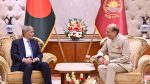

Pressed on whether the United States would intervene militarily if China attacked Taiwan, Trump declined to give a direct answer.
“The last thing we need right now is a war that’s 9,500 miles away,” he said. The comments were broadly consistent with Washington’s long-standing policy of “strategic ambiguity”, under which the United States helps
Taiwan defend itself without explicitly guaranteeing military intervention. The war involving Iran also featured prominently in talks between the two leaders.
Trump said Xi agreed that a nuclear-armed Iran would be dangerous and claimed the Chinese leader had offered assistance in helping resolve the conflict.
China has not publicly confirmed such an offer. Beijing has instead said any solution should address “the concerns of all parties on the Iran nuclear issue”.
Trump argued China should play a greater role given its heavy reliance on Middle Eastern oil and liquefied natural gas supplies.
The conflict has already driven up global energy prices and raised fears of a wider economic slowdown if fighting continues.
China, meanwhile, focused heavily on presenting the summit as the beginning of a more stable relationship with Washington.
The Chinese foreign ministry said both sides had agreed to pursue “a constructive China-US relationship of strategic stability” during the remainder of Trump’s presidency.
The framework would emphasise cooperation, controlled competition and management of disputes. Helena Legarda of the Mercator Institute for China Studies said the goal appeared to be keeping relations “on an even keel”.
George Chen of consultancy The Asia Group described the approach as a shift from the more confrontational tone that characterised relations under former president Joe Biden.
Trade, expected to dominate the summit, produced fewer tangible results. Trump travelled with several prominent business executives, including Boeing chief Kelly Ortberg, Nvidia CEO Jensen Huang and Elon Musk.
The president claimed major agreements had been reached and suggested China could eventually purchase hundreds of Boeing aircraft, though no binding deals were announced publicly.
Chinese Foreign Minister Wang Yi later said the two sides had agreed to create boards overseeing trade and investment and to address market access issues for agricultural goods.
Trump repeatedly praised Xi during the visit, describing him as a “great leader” and saying they would have a “fantastic future together”.
Xi responded more cautiously but called the trip a “landmark visit” that had deepened mutual trust between the two countries.