
Business leaders, regulators and policymakers on Saturday called for embedding environmental, social and governance (ESG) principles into corporate strategy, arguing that stronger sustainability standards will be critical to maintaining Bangladesh’s competitiveness after its graduation from the least developed country (LDC) category.
The message came at Sustainability Summit 2026 in Dhaka, where speakers said responsible business conduct is increasingly becoming a commercial imperative as global investors, lenders and buyers place greater emphasis on sustainability, transparency and governance in investment and sourcing decisions.
Speaking as chief guest, Bangladesh Securities and Exchange Commission (BSEC) Chairman Masud Khan highlighted the role of sustainable finance in mobilising capital for Bangladesh’s green transition, saying capital markets have an important role in financing low-carbon and climate-resilient investments.
Opening the summit, Bangladesh Brand Forum Founder and Managing Director Shariful Islam said sustainability should no longer be viewed as an annual corporate agenda but embedded into the DNA of businesses as Bangladesh advances towards its 2030 Sustainable Development Goals (SDGs) and prepares for LDC graduation.

“As Bangladesh moves toward its 2030 commitments and prepares for LDC graduation, responsible business is no longer a choice; it is the foundation of our competitiveness,” he said.
Throughout the day-long event, speakers argued that stronger ESG reporting and corporate disclosures would improve investor confidence, attract foreign direct investment and help Bangladeshi businesses remain competitive in global value chains, particularly as international markets tighten sustainability requirements.




Discussions also explored how companies are integrating sustainability into business models, using ESG data to strengthen accountability, leveraging carbon markets to support green growth and improving responsible business practices across supply chains.
In a virtual keynote, marketing scholar Philip Kotler and ResInt Sustainability Institute President Khalid Hasan discussed how businesses can create long-term value by integrating sustainability into corporate strategy rather than treating it as a compliance exercise.
Hindustan Unilever Foundation CEO Shraman Jha said sustainability had become a driver of business growth and competitive advantage.
Among the speakers were Policy Exchange Bangladesh Chairman Mashrur Reaz, LafargeHolcim Bangladesh CEO Mohammad Iqbal Chowdhury, Grameenphone CEO Yasir Azman, Shwapno Managing Director Sabbir Hasan Nasir, BGMEA Vice President Vidiya Amrit Khan, DBL Group Chief Sustainability Officer Mohammed Zahidullah, Dhaka Stock Exchange Managing Director Nuzhat Anwar and BRAC Senior Director K A M Morshed.
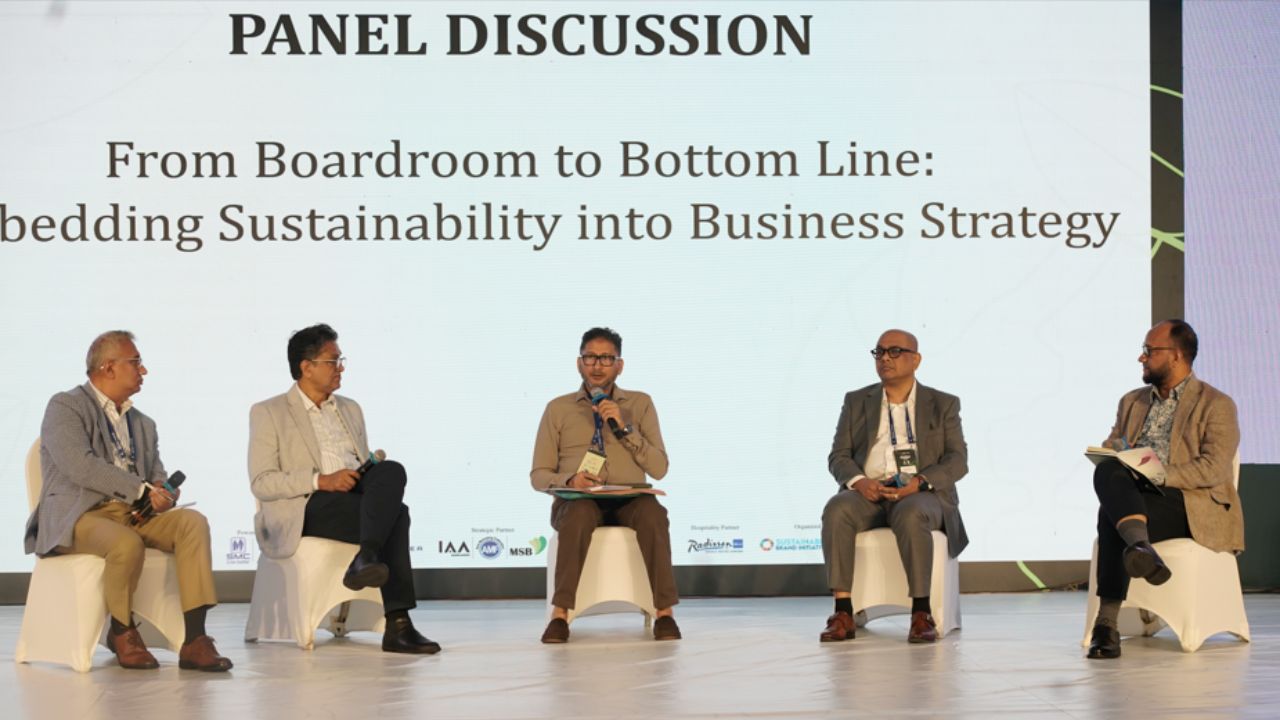
The summit featured keynote addresses, panel discussions, policy dialogue and case studies covering sustainable finance, ESG reporting, responsible supply chains, carbon markets and responsible business conduct, concluding with the SDG Brand Champion Awards recognising organisations for measurable environmental, social and economic impact.
Organised by Bangladesh Brand Forum and Sustainable Brand Initiative under the Bangladesh Innovation Conclave, the summit sought to encourage greater private-sector participation in advancing responsible business practices and the national SDG agenda.