
Business leaders, policymakers, academics and development experts gathered in Dhaka on Saturday to examine how responsible corporate conduct, sustainable finance and environmental, social and governance standards could support Bangladesh’s competitiveness and progress towards the Sustainable Development Goals.
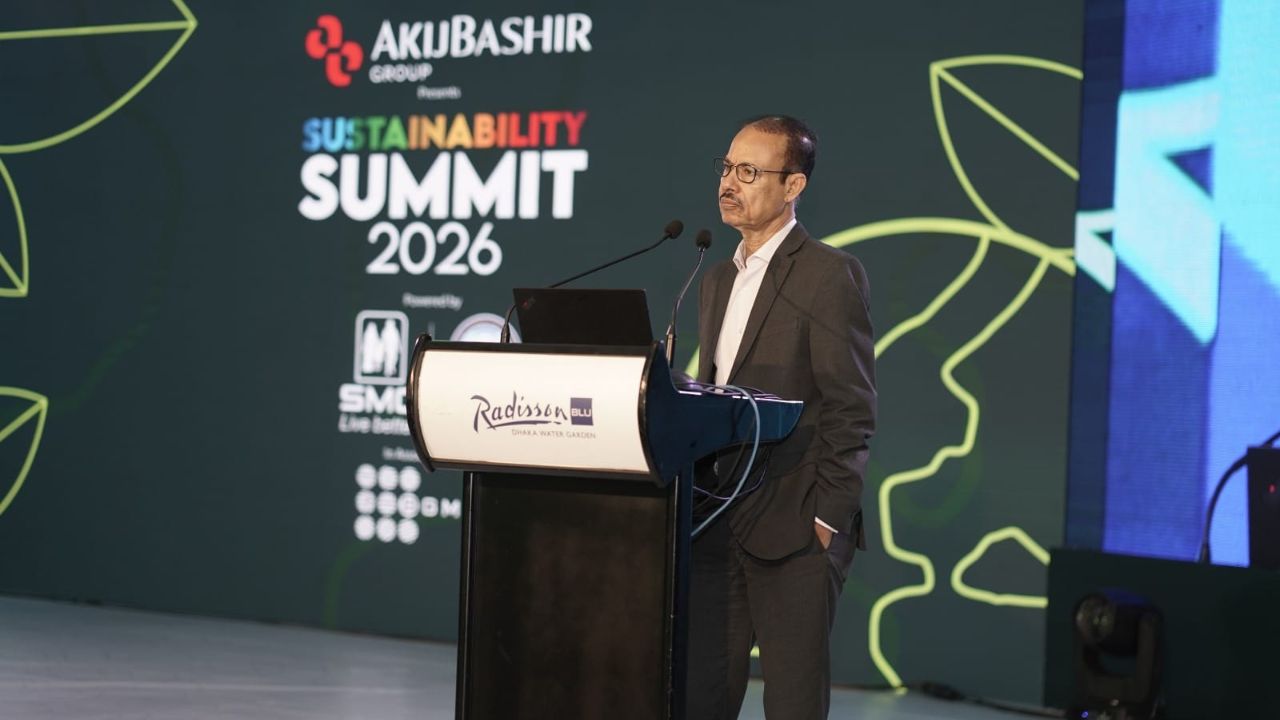
The fourth Sustainability Summit was held on 18 July at the Grand Ballroom of Radisson Blu Water Garden Hotel, Dhaka, with discussions focusing on mobilising capital for the country’s green transition, embedding sustainability in corporate strategy and strengthening accountability across supply chains.
Akij Bashir Group presented Sustainability Summit 2026, powered by SMC Enterprise Limited and American International University-Bangladesh, in association with PRAN-RFL Group and the Bangladesh Garment Manufacturers and Exporters Association.
Bangladesh Brand Forum and Sustainable Brand Initiative organised the day-long event, which was initiated by Bangladesh Innovation Conclave, according to a press release.
The programme brought together industry executives, regulators, social entrepreneurs and academics for three keynote sessions, two panel discussions, three insight sessions, two case-study presentations, an expert deep dive and a policy dialogue.
The sessions examined how businesses could move from compliance towards responsible conduct and convert sustainability commitments into measurable commercial, environmental and social outcomes.

Opening the summit, Bangladesh Brand Forum Founder and Managing Director Shariful Islam said sustainability could no longer remain an issue discussed once a year and then set aside.
It needed to be embedded in the operations of brands and organisations as Bangladesh approached its 2030 commitments and prepared to graduate from the United Nations’ least-developed-country category, he said.
“Responsible business is no longer a choice; it is the foundation of our competitiveness,” Islam said. “This is our moment to move from responsibility to impact, and from compliance to conduct.”
Bangladesh Securities and Exchange Commission Chairman Masud Khan attended as chief guest and delivered a keynote titled “Sustainable Finance: Mobilising Capital for Bangladesh’s Green Transition”.




He discussed how capital markets and green-financing instruments could direct investment towards Bangladesh’s transition to a low-carbon economy.
Marketing author Philip Kotler, professor emeritus at Northwestern University’s Kellogg School of Management, joined ResInt Sustainability Institute President Khalid Hasan in a virtual keynote titled “The Next Evolution of Capitalism: Business, Brands and Sustainable Value Creation”.
They discussed how companies and brands could generate long-term shared value in an economy increasingly shaped by corporate purpose.
Hindustan Unilever Foundation Chief Executive Officer Shraman Jha delivered another keynote, “Why Sustainability is the New Growth Imperative”, arguing that sustainability had moved from the margins of corporate planning to become a central element of competitiveness and growth.
Other speakers and panellists included Policy Exchange Bangladesh Chairman and Founder M Mashrur Reaz; University of Dhaka Institute of Business Administration Professor Melita Mehjabeen; LafargeHolcim Bangladesh PLC Chief Executive Officer Mohammad Iqbal Chowdhury; Grameenphone Ltd Chief Executive Officer Yasir Azman; ACI Logistics Limited, or Shwapno, Managing Director Sabbir Hasan Nasir; and BGMEA Vice-President Vidiya Amrit Khan.
DBL Group Chief Sustainability Officer Mohammed Zahidullah, Dhaka Stock Exchange PLC Managing Director Nuzhat Anwar, BRAC Senior Director KAM Morshed and UNESCO Chair Professor Mohammad Nurunnabi also joined the event, alongside representatives from the private, public and development sectors.
The summit’s insight sessions explored how businesses were turning corporate responsibility into measurable shared value and how data, disclosure and ESG reporting were becoming increasingly important in building market confidence.
Participants also discussed how stronger ESG frameworks could help Bangladesh attract foreign direct investment.
One panel examined the integration of sustainability into core business strategy, while another focused on how Bangladesh’s ready-made garment industry was adapting responsible business practices to meet expectations in global markets.
Case-study presentations addressed the potential use of carbon markets to support green growth and the need for credible communication when companies report their sustainability activities.
An expert session examined the meaning of responsible business across supply chains, while the concluding policy dialogue brought regulators, industry representatives and development leaders together to discuss accountability and corporate conduct.
The summit sought to increase private-sector participation in sustainability initiatives, particularly among local businesses, while highlighting the relationship between responsible business practices and future economic growth.
Discussions also addressed the expectations of Generation Z consumers and workers and the alignment of corporate sustainability programmes with Bangladesh’s national SDG targets.
Organisers said the event was intended to encourage collective action, stronger commitments and partnerships supporting a more inclusive and sustainable economy.
The programme concluded with the SDG Brand Champion Awards Gala, which recognised organisations for measurable environmental, social and economic contributions in Bangladesh.
The summit’s strategic partners were International Advertising Association Bangladesh, Asia Marketing Federation and Marketing Society of Bangladesh. Backpage PR served as PR partner, Turkish Airlines as official carrier partner and Radisson Blu Water Garden Hotel, Dhaka, as hospitality partner.