Prices of most vegetables in the retail markets of Chattogram are on the rise, due to a decrease in supply during the monsoon season.
Traders claim that although demand is high, prices have increased because of insufficient supply. The upward trend has been persistent throughout the whole week.
On Friday, a visit to various kitchen markets in the city revealed that green chillies were being sold at Tk120 per kg. Brinjal was priced at Tk70–80, while pointed gourd was sold at Tk50, tomatoes at Tk80, and papaya, long beans, and ribbed gourd at Tk60 per kg.

Additionally, okra and cucumbers were priced at Tk50 per kg, while potatoes were being sold for Tk25 per kg.
The markets also saw taro stolon (loti) selling at Tk40, cauliflower at Tk100, teasel gourd (kakrol) at Tk50, cabbage at Tk50, bottle gourd at Tk40, and pumpkin at Tk40 per kg. Bananas were priced at Tk60 per dozen.




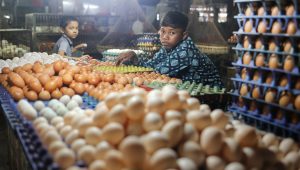
Among spice items in the retail market, onions were being sold at Tk40 per kg, garlic at Tk130, and ginger at Tk140 per kg. Meanwhile, the poultry and egg markets also reflected high prices. Broiler chicken was sold at Tk160 per kg and Sonali chicken at Tk330 per kg. Red eggs were Tk120 per dozen, white eggs Tk110, and duck eggs were priced at Tk180 per dozen.
Traders in various city markets stated that the start of the monsoon season has impacted on vegetable production and supply at the field level, leading to price hikes as supply fails to meet demand.
Md Shohel, a trader at the Anderkilla vegetable market, said, “Vegetable supply in the market has decreased due to the rain. Even though there is demand from buyers, enough quantity is not available.”
Nasir, another trader, noted that the market is currently on an upward trend and while vegetables are available, the supply is lower than before.
Consumers, however, complained that it is becoming difficult to manage household expenses as the prices of nearly all essential commodities continue to rise.
This pressure is felt most heavily by low- and middle-income families. Md Russell Mia, a resident of the Jamalkhan area, told TIMES of Bangladesh, “The price of everything is increasing, but income is not rising accordingly. I am struggling to meet household expenses.”