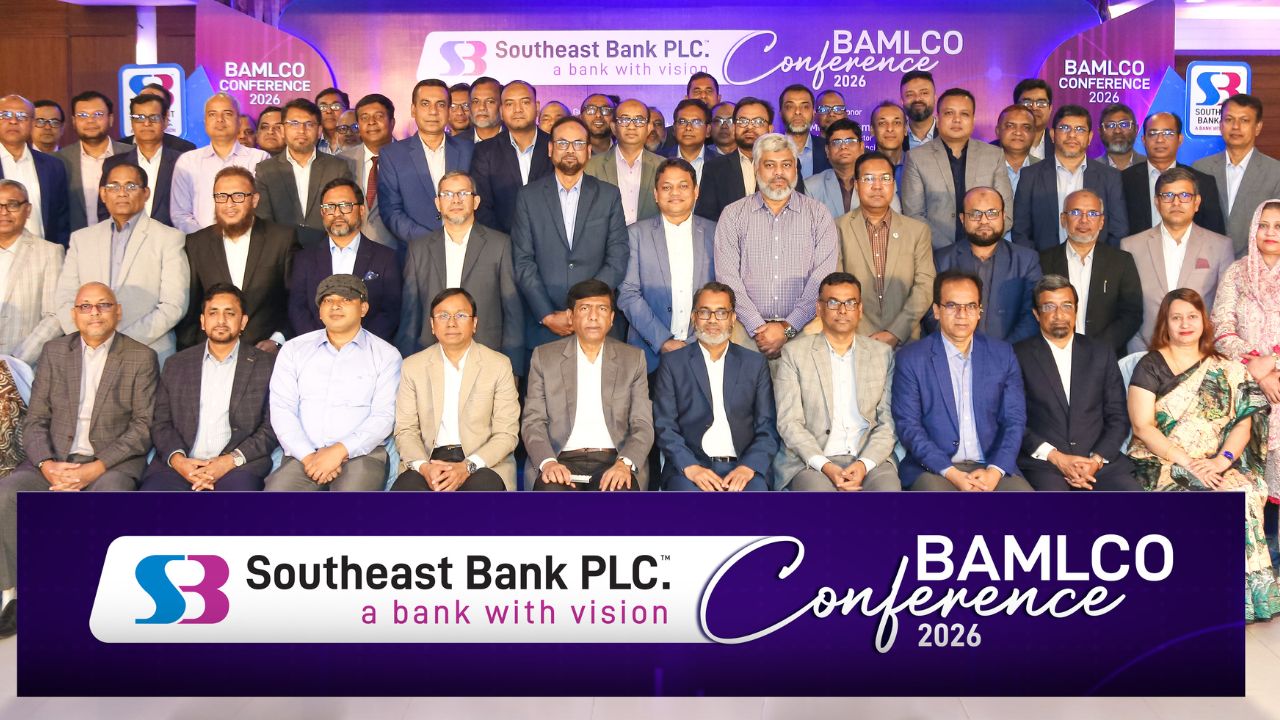

Southeast Bank PLC organised its BAMLCO Conference-2026, bringing together around 380 officials including divisional heads of head office, branch managers, BAMLCOs, in-charges of Uposhakhas and Offshore Banking Units, and other relevant officers, according to a press release said. The conference focused on strengthening anti-money laundering and counter-terrorist financing (AML/CFT) compliance frameworks across the bank and improving regulatory alignment.
The event featured senior officials from the bank and Bangladesh Bank, with sessions dedicated to regulatory expectations, trade-based money laundering, and compliance risks, aimed at enhancing institutional capacity in detecting and preventing financial crime. The conference underscored the growing importance of robust AML/CFT oversight in the banking sector amid evolving regulatory requirements.
Md Khalid Mahmood Khan, Managing Director and Chief Executive Officer of Southeast Bank PLC, attended as chief guest. Abidur Rahman Chowdhury, Additional Managing Director and CAMLCO of Southeast Bank, chaired the programme and delivered the welcome address, highlighting emerging AML and CFT challenges faced by financial institutions.

Md Mahbub Alam, Additional Managing Director and Chief Risk Officer of the bank, also shared observations on AML and CFT risks, reinforcing the need for stronger internal controls and risk governance frameworks across operational units.




From Bangladesh Bank, Amitabh Chakraborty, Additional Director of the Money Laundering and Terrorist Financing Prevention Department, conducted an interactive session on regulatory requirements and AML/CFT issues. Mohammad Mokter Hossain, Additional Director of the Bangladesh Financial Intelligence Unit (BFIU), led another session focusing on trade-based money laundering (TBML) and cross-border money laundering (CBML), with an emphasis on improving compliance standards in banking operations.
The conference concluded with closing remarks by Mohammed Rashedul Amin, Deputy Managing Director of Southeast Bank PLC, who underscored the importance of continued training, supervision and coordination between regulators and commercial banks to strengthen the country’s financial integrity framework.
Officials and participants discussed emerging risks in financial transactions, with particular attention to compliance gaps in branch-level operations, offshore banking, and trade-linked transactions. The sessions encouraged more proactive monitoring and reporting mechanisms to align with national and international AML/CFT standards.