Solving all problems in the country completely within six months is difficult, but the current government has the highest level of sincerity, commitment and responsibility in every sector, said Prime Minister’s Adviser and Spokesperson for the Prime Minister’s Office Mahdi Amin.
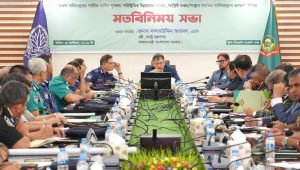
He made the remarks while responding to journalists’ questions at a view-exchange meeting at the Prime Minister’s Office in Tejgaon on Monday to mark the government’s completion of 180 days in office.
The meeting highlighted the government’s initiatives to implement each pledge in its election manifesto and reviewed its activities over the past six months.
Mahdi Amin said, “Prime Minister Tarique Rahman has already completely broken the VIP culture and come down among ordinary people like one of them.”
Claiming that Bangladesh was being rebuilt from a “state of ruins”, the meeting said around 13 lakh farming families had directly benefited after the first cabinet meeting decided to waive agricultural loans of up to Tk10,000, including interest.
The meeting also highlighted the introduction of farmer cards, family cards, expatriate cards and initiatives to launch employment exchanges at district level.
Claiming that commodity prices were successfully controlled during Ramadan, Mahdi said, “Strict measures have been taken to prevent the formation of any syndicate within the state system and to stop artificial increases in prices.”

He also claimed that the highest standards had been maintained in freedom of expression, rule of law and human rights over the past six months. According to him, “There has been no political repression during this period.”
The meeting claimed that SSC answer scripts were evaluated in a completely neutral manner, saying, “Students received the grades or marks they deserved.”
Mahdi also highlighted the allocation of an initial Tk2,000 crore for retirement benefits and welfare trust payments for retired MPO-listed teachers and employees, as well as initiatives for major reforms in the education system.
The meeting also highlighted plans to ensure completely free education for girls up to graduation level, gradually introduce mid-day meals across the country, give special priority to third-language education, and provide bank guarantees of up to Tk10 lakh for skilled students seeking to go abroad.




The prime minister’s adviser blamed the global conflict in the Middle East for the gas and electricity crisis.
He also said steps had been taken to reform the “collapsed” economic structure, expand business opportunities, reduce taxes where necessary and ensure the protection of depositors’ funds.
He said bonded warehouse facilities had been expanded for fully export-oriented industries and that the process of renewing trade and business licences had been simplified.
Mahdi also highlighted measures to remove existing barriers and increase opportunities for repatriating profits to attract foreign investment. He claimed that positive progress had been made through bilateral initiatives with various countries to bring back money siphoned abroad.
The meeting also claimed that the law and order situation had improved. Mahdi said efforts were being made to build a politically harassment-free, people-friendly and service-oriented police and administration.
He claimed that public confidence in the police, administration and law enforcement agencies had been restored as a result.
It was also claimed that people were receiving immediate solutions and legal remedies when they approached authorities with problems.
Regarding foreign policy, the prime minister’s adviser said the government was working to build a Bangladesh where bilateral and multilateral relations with all countries in the world would be based on equality, fairness and dignity.
Prime Minister’s Political Adviser Nazrul Islam Khan said a public administration reform commission would soon be formed to restructure the administration.
“Although it may take some time, the commission will be formed soon,” he said.
Responding to another question, Prime Minister’s Adviser for Public Administration Ismail Jabihullah said, “Mob culture is undesirable at any time. The government will not tolerate any form of mob culture. The country will run according to its own laws, and laws will be enforced.”
Prime Minister’s Political Adviser Ruhul Kabir Rizvi said, “The stronger the rule of law becomes, the lower the mob culture will be.”
He also claimed that no opposition opinion or opposition political leader was facing harassment due to the prime minister’s commitment to ensuring the rule of law.
Information and Broadcasting Minister Zahir Uddin Swapan claimed that no media outlet had so far experienced government control or influence, and that journalists had thanked and congratulated the prime minister for this.
He said work was progressing to establish a Media Commission to institutionalise the arrangement.
Prime Minister’s Press Secretary Saleh Shibli said, “One of the main tasks of the current government over the past six months has been to establish people’s dignity and respect in the state and s