Today marks the 100th birth anniversary of Munier Chowdhury, the eminent playwright, linguist, educator, political activist and literary critic whose work remains central to Bangladesh’s cultural and intellectual heritage.
Various organisations are observing the occasion with tribute programmes. To honour the iconic thinker, Theatre has organised a special commemorative event this evening at 6:30 pm at the Neelima Ibrahim Auditorium of Bangladesh Mahila Samiti on New Bailey Road.
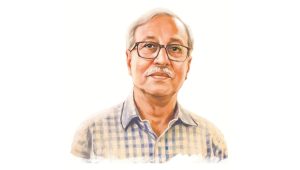
The event, open to the public, will feature a conversation between two cultural figures who knew Chowdhury personally. Dhaka University Emeritus Professor Dr Sirajul Islam Choudhury and Bishwo Shahitto Kendro founder Professor Abdullah Abu Sayeed will reflect on Chowdhury’s pedagogy, literary achievements, progressive ideals and personal influence. Theatre personality Ramendu Majumdar will moderate the session.

Born on November 27, 1925 in Manikganj, Chowdhury spent his early years moving across East Bengal due to his father’s transferable job. After settling in Dhaka in 1936, he completed his SSC at Dhaka Collegiate School in 1941 and briefly attended Aligarh Muslim University before returning to Dhaka University.
He earned a bachelor’s degree with distinction in English literature in 1946, followed by his first Master’s the next year. Amid the political unrest of the Bengali Language Movement, he was arrested for protesting police brutality and spent two years in prison. During his incarceration, he completed a Master’s in Bengali literature in 1954, topping his class and later earned a Master’s in linguistics from Harvard University in 1958.



Chowdhury began teaching in 1947 at Brajalal College in Khulna before joining Jagannath College and later Dhaka University, where he taught in both the English and Bengali departments. He became a professor in 1970 and dean of the faculty of arts in 1971.
His years in prison produced his seminal symbolic play Kobor, followed by notable works including ‘Roktakto Prantor’, ‘Chithi’ and ‘Polashi Barrack O Onyanno’. In 1965, he redesigned the Bangla typewriter keyboard, resulting in the Munier Optima Keyboard.
A vocal cultural activist, Chowdhury protested the 1967 ban on Tagore songs and rejected the Sitara-e-Imtiaz award in 1971.
He was abducted, tortured and executed by the Pakistani Army and its collaborators (Al-Badr and Al-Shams) on December 14, 1971 as one of the martyred intellectuals, aged just 46.
He posthumously received the Independence Day Award in 1980 and the road where he lived has since been renamed Shaheed Munier Chowdhury Road.