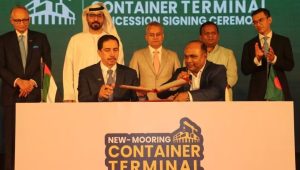
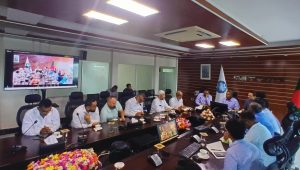
The Chattogram Port Authority is moving towards finalising the appointment of Dubai-based DP World as the operator of the New Mooring Container Terminal, triggering intensified protests and blockades by the Sramik Karmachari Oikya Parishad (SKOP) and allied groups across the port city.
More than a dozen programmes have been announced in recent weeks, with protesters claiming the agreement would threaten national sovereignty and endanger thousands of jobs.
However, port users, business leaders and logistics experts counter that the claims are “irrational, politically motivated and disconnected from reality,” arguing that a global operator is essential to improving port efficiency and expanding Bangladesh’s competitiveness in the South Asian shipping market.
On 26 November, SKOP blocked port access at three key points in Chattogram, halting transport for hours. It has announced a torch procession and additional demonstrations for 5 December, signalling an escalation in its campaign.

Business groups say the agitation is being driven by vested interests seeking to destabilise port operations rather than safeguard workers’ rights. They describe allegations of sovereignty risks and mass job losses as part of a misinformation effort aimed at delaying reforms.
Bangladesh Merchant Marine Officers Association President Captain Anam Chowdhury said the country’s long-standing failure to place the right people in leadership roles has weakened major national projects.
He noted that top global ports such as Singapore handle 50 to 70 containers an hour, while Chattogram manages only 16 to 20 despite upgrades.


“To make Chattogram Port more efficient, there is no alternative to bringing in a global giant operator. The level of technological advancement required simply does not exist here,” Chowdhury said.
Responding to sovereignty concerns, he asked why global operators such as DP World, Maersk Line and Medlog pose no such threat in the many countries where they already operate.
Business leaders say fears of job losses have not materialised. Local firm Saif Powertech, which ran the terminal for 17 years, employed about 3,000 workers. Since the Navy-run Chittagong Dry Dock Limited took temporary control in July, “not a single worker has lost their job,” and the same workforce continues to operate the facility.
Port users argue that the real pushback stems from fears that foreign operators would undermine entrenched business syndicates. “If a foreign operator comes, the corruption and manipulation of a certain quarter will stop. This is the root cause of the agitation,” a senior shipping agent said.
Former Chattogram Chamber of Commerce and Industry director Mahfuzul Haque Shah echoed this, saying certain groups routinely use workers as a “shield” for personal gain. He warned that politically driven blockades would damage foreign investment and Bangladesh’s standing as a regional logistics hub.
SKOP leaders remain adamant that the NCT lease threatens sovereignty and livelihoods. “If any part of the port infrastructure, including the NCT, is leased, national security, the economy and sovereignty will be at risk. Workers will lose their jobs,” said SKOP leader Kazi Sheikh Nurullah Bahar, while insisting the movement is not serving vested interests.
The CPA has confirmed that the six-month contract with Chittagong Dry Dock expires on 7 January. It is preparing to finalise a 22-year agreement with DP World by 15 December, but the process faces a legal test. The Bangladesh Youth Economists Forum has filed a writ petition challenging the validity of awarding terminal operations to a foreign company, with the High Court set to issue a verdict on 4 December.
CPA Secretary Md Omar Faruk said the authority cannot comment further while the case is pending.
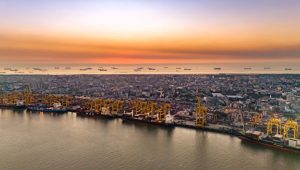
The NCT is one of Chattogram Port’s most important terminals, handling about 1.3 million TEU a year — above its designed capacity of 1.1 million TEU. With four jetties accommodating four container vessels simultaneously, the facility generates nearly Tk1,000 crore in annual revenue.