
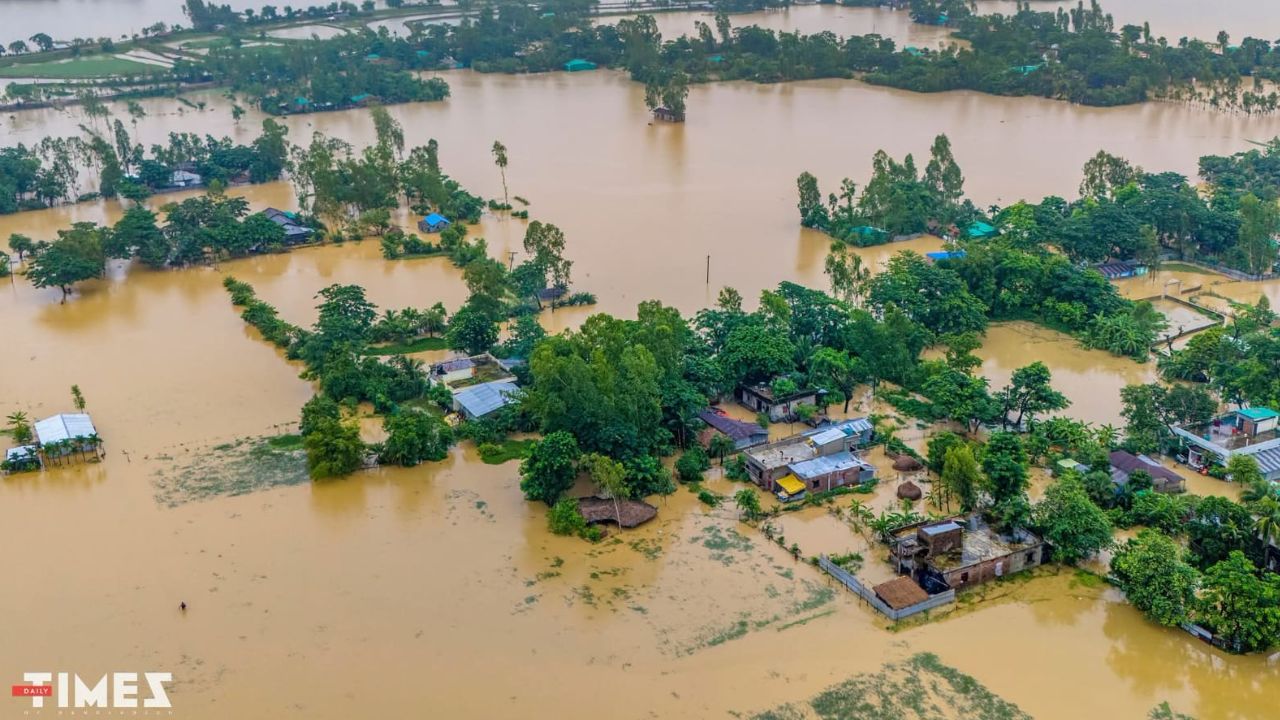

As floodwaters begin to retreat across Chattogram and Cox’s Bazar, a harrowing trail of destruction has emerged, leaving thousands homeless and crippling the local economy.
While the immediate threat of rising water subsides, residents now face razed homes, lost livelihoods, and an emerging health crisis.
Although the water has started to recede, anxieties of the people in Satkaniya, Chattogram, have only intensified as they contemplate their survival. After battling floods for over a week, many returned to find the courtyards where their children once played now buried under mud and debris.
In homes that once held lifelong savings, only twisted corrugated iron sheets, damp clothes, and scattered memories remain. Since Monday morning, the lack of rain has allowed many to return from shelters, but they face a new struggle: many have no roofs, no beds, and no cooking utensils.
Widespread ruin, economic toll in Chattogram
Crops have been destroyed, fish enclosures washed away, and livestock have perished. Many families do not have enough money to buy even a single day’s food.
Hundreds at the Keochia High School shelter are still afraid to return home, as some houses have been washed away, others have collapsed, and many find not a single room fit for habitation.
Nuru Bepari, 60, of Keochia Ward 2, wept as he said, “We have been made destitute. No one came to save us. Please write about this if you can.” His homestead and all essential belongings were swept away, leaving the shelter as his only address.
Rani Dash of Nalua shared a similar plight, stating she has no safe shelter and can only rebuild if people provide assistance.

Nurul Kabir of Amilaish union has also been left penniless. Having stayed in a shelter with his wife and three young children, he returned home with no money and no idea how they will eat or clothe themselves.
While the district administration has not yet finalised the total account of the damage, they reported on Sunday that 176 unions and municipalities were flooded, with 14,281 houses damaged. Approximately 22,600 people took refuge in 670 shelters across the district.
The administration has confirmed 13 deaths in Chattogram. Initial estimates suggest that thousands of ponds and hundreds of fish enclosures across 153 unions in 15 upazilas were flooded, resulting in a loss of Tk109.23 crore in fish and infrastructure.
According to the Chattogram Livestock Department, 4,218 livestock farms and 5,674 poultry farms were damaged, with losses valued at Tk60,68,01,140. Additionally, 212 educational institutions and 145 bridges or culverts have been damaged.
Rising health concerns, official assurances
Health risks are also on the rise, with the District Civil Surgeon identifying 85 cases of snakebites and 102 cases of diarrhoea in flood-affected areas.
Snakebite victims were reported across various upazilas, including 20 in Boalkhali, 18 in Patiya, 12 in Banshkhali, nine in Raozan, eight in Hathazari, six in Satkaniya, five in Anwara, three in Chandanaish, two in Lohagara, and three in Rangunia.




The health department confirmed all these victims were bitten by non-venomous snakes.
Diarrhoea cases include six in Satkaniya and four new cases in Banshkhali, while 19 others were injured in various accidents.
State Minister for Power, Energy and Mineral Resources, Anindya Islam Amit, visited the affected areas of Keochia, Dharmapur, and Bajalia to distribute relief and provide assurances.
He stated, “No affected family will be left out of assistance. The government is giving the highest priority not only to relief but also to rehabilitation.” Those in shelters emphasised that their greatest need is a roof over their heads.
Staggering casualties, infrastructure damage in Cox’s Bazar
In Cox’s Bazar, the extent of the damage is becoming clear as water recedes from the coastal district. Preliminary data from the district administration shows that 49 per cent of the area across 70 unions and four municipalities were flooded during nine days of rain from 4 to 12 July.
During this period, 30 people, including 13 Rohingyas, died due to landslides and drowning, while one person remains missing. In the district, 1,613 houses and 30 educational institutions were damaged, alongside 2,048 kilometres of roads and 79 bridges and culverts.
Deputy Commissioner Md A Mannan stated that 1,580 people took refuge in 618 shelters, where 7,790 packets of dry food and 298 tonnes of rice have been distributed. Further requirements for relief have been sent to the ministry.
Water Development Board Executive Engineer Nurul Islam, reported that 381 kilometres of embankments were damaged in 44 locations, including a 25-metre breach in Purutyakhali Purbapara of Konakhali union, Chakaria.
Department of Agricultural Extension Deputy Director Bimal Kumar Pramanik said 4,212 hectares of crops, including 2,620 hectares of Aush paddy, 470 hectares of Aman seedbeds, 995 hectares of vegetable fields, and 166 hectares of betel leaf gardens, have been damaged.
This has affected 43,210 farmers. District Fisheries Officer Nazmul Huda estimated losses at Tk 46.22 crore, with 3,918 ponds and 453 shrimp enclosures washed away.
These losses include 1,097 tonnes of fish and 385 tonnes of shrimp, alongside damage to 768 fishery infrastructures. In the education sector, 30 institutions were damaged, with 15 each in Pekua and Kutubdia.
Economic paralysis in the hill districts
The tourism and agriculture sectors in the hills have also suffered significantly. The Bandarban Hotel-Motel-Resort Owners Association stated that while infrastructure was not destroyed, the business has been heavily impacted.
Association President Sirajul Islam noted that although the monsoon is typically an off-season, Bandarban usually sees many tourists, but this year the sector lost Tk 3 to 5 crore in potential transactions.
Approximately 400 young tour guides are in distress due to the lack of visitors. Mohammad Alamgir, a guide in Ruma, mentioned that guides who usually earn Tk 20,000 to 25,000 a month are now unemployed.
Chittagong Hill Tracts Development Board (Bandarban Unit) Executive Engineer Abu Bin Yasir Arafat said damage would be fully assessed once the situation normalises. In Rangamati, travel bans remain in place for all tourist centres, including Sajek Valley.
While a final assessment is pending, 131 landslides have been reported, alongside damage to farmland, ponds, and businesses.
Currently, 3,487 people remain in 50 shelters. Areas such as Chhoto Harina and Bor Harina markets in Barkal Upazila remain submerged, where shopkeepers have been worst hit.
Shuvotom Chakma of Babupara in Baghaichhari said although the water has receded, their houses are uninhabitable and farmland is severely damaged.
Department of Agricultural Extension Deputy Director Md Moniruzzaman, said 3,500 hectares of farmland were damaged, and fish from 76 ponds in 20 unions were washed away.
Executive Engineer of Rangamati Roads and Highways Department, Sabuj Chakma, reported Tk 9 crore in damage across 26 spots on major highways and regional roads. Notably, a bridge on the Bandarban road is broken, and traffic is being diverted through the Rajbhila road.
Rangamati Deputy Commissioner Najma Ashrafi has instructed upazila nirbahi officers to prepare a list of those affected.
Bandarban correspondent Monirul Islam Monu and Rangamati corresondent Supriyo Chakma contributed to this report.