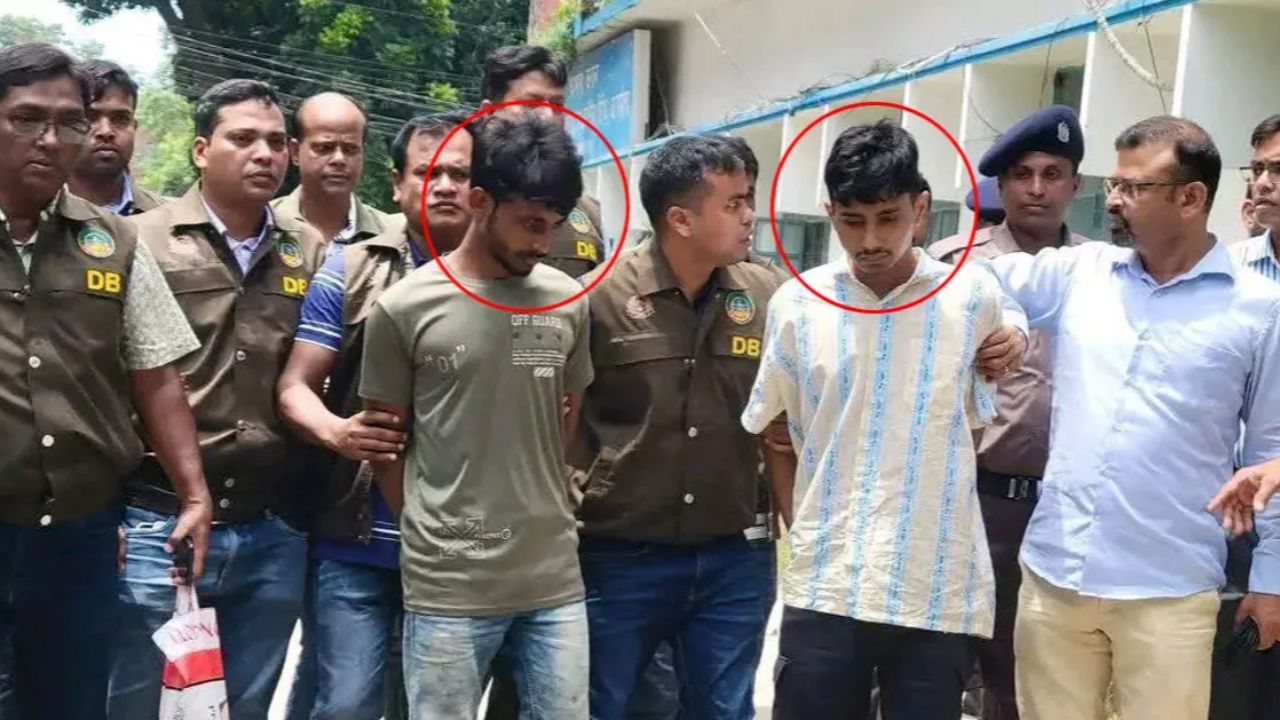



The investigation into the brutal murder of four members of a family in Rangpur has intensified as law enforcement agencies face growing scrutiny over unresolved anomalies surrounding the crime.
Key areas under close examination include the financial backing behind the suspects’ illicit drug consumption, the deliberate disconnection of electricity to the victims’ residence, and potential ulterior motives behind the slaughter.
The two primary suspects, Siddhartha Das and Mugdha Das, remain in custody while court-approved drug screens and forensic DNA sampling are processed.
According to police, Siddhartha admitted in his formal confession that he and Mugdha regularly consumed yaba on Thursday nights. On the day of the killings, 20 August, the pair reportedly ingested nine yaba tablets in three separate stages.
However, significant doubts have arisen regarding how the two youths – given their modest socioeconomic background – could afford such a substantial quantity of narcotics in a single day.

Investigators are actively probing whether an external benefactor provided the funds or directly supplied the substances.
Addressing a press conference, outgoing Rangpur Metropolitan Police Commissioner Abdul Mabud stated that the duo initially consumed three tablets. Around 3:00am, Siddhartha allegedly pledged his mobile phone to a neighbouring dealer to secure four more tablets, before consuming an eighth tablet.
While Siddhartha’s statement records eight tablets taken that night, Mugdha’s account specifies nine. Police acknowledged that the pair had never previously ingested such high doses, having previously taken a maximum of two tablets at a time.
Siddhartha’s father, Binoy Das, expressed total ignorance regarding his son’s actions and finances, stating that he earns his living selling fish and has no knowledge of how his son acquired the money or fell into bad company.




The deliberate disabling of the electricity supply at the residence of the lead victim, Ganapati Chakraborty, has emerged as a central point of suspicion.
A physical inspection of the crime scene revealed distinct marks showing that the main feed lines connecting to the electric meter had been severed. Electrician Ujjal Kumar Barman testified that when police initially accessed the property on Saturday night, the house was plunged into complete darkness.
Following a request from a local gold trader, Belal, Barman reconnected the main line from the street pole at approximately 1:00 am on Sunday.
Key questions remain as to how and why the main line was severed while four family members were being killed inside the house, on the staircase, and on the roof.
Public figures and local academics have raised concerns regarding the mechanics and timing of the power disruption.
Former Rangpur Zilla School teacher Safiar Rahman and Professor Tuhin Wadud of Begum Rokeya University both urged deeper scrutiny, highlighting that victim Ananya Chakraborty informed a friend via Messenger at 5:50 am that there had been no electricity throughout the night.
Furthermore, a key witness named Aditya, who was in matrimonial discussions with Ananya’s family, revealed that when he checked on the silent house, three unknown women standing outside misled him by claiming the family had travelled elsewhere.
Palash Kanti Nag of the Rangpur Metropolitan Citizens’ Committee urged police to establish whether the arrested suspects were merely tools used by third parties operating in the background, noting that police have yet to provide satisfactory explanations regarding the power disconnection.
Detectives are also examining long-standing real estate transactions between the families.
Ex-Commissioner Mabud noted that the plot of land housing Ganapati’s home originally belonged to Siddhartha’s ancestors, prompting police to investigate whether lingering resentment over the historical sale price or the distribution of proceeds among heirs served as a catalyst for the crime.
Siddhartha’s mother told police that their family maintained no close social ties or regular interactions with Ganapati’s household due to caste and social differences.
Meanwhile, official post-mortem reports confirmed that all four victims died from strangulation, with police clarifying that post-mortem physiological changes had been misconstrued by a mortuary worker and affirming that forensic examinations found no evidence of sexual assault on the two female victims.