


Lakshmi Puja, one of the major religious festivals of the Hindu community, will be celebrated Sunday with religious fervour and enthusiasm. The festival is observed on the first full-moon night following the conclusion of Durga Puja, the largest religious festival of Hindus.
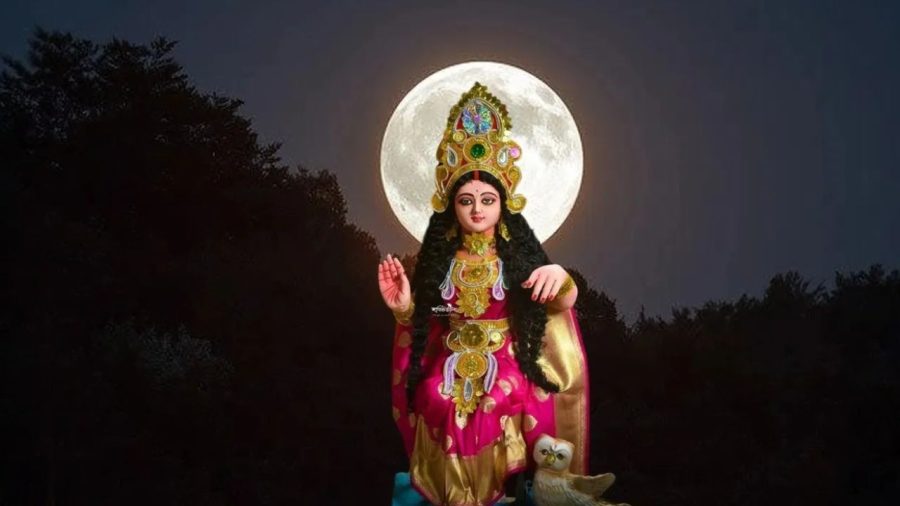
The auspicious full-moon night is known as Kojagari Purnima, and the worship of Goddess Lakshmi on this occasion is therefore called Kojagari Lakshmi Puja.
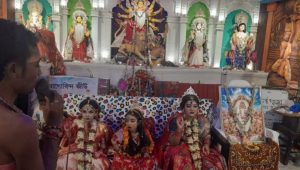
According to Hindu beliefs, Goddess Lakshmi, the deity of wealth and prosperity, visits the homes of her devotees on the night of the full moon to bless them with abundance and good fortune. In keeping with this belief, Bengali Hindus traditionally perform Lakshmi Puja in their homes, seeking the goddess’s blessings for prosperity and well-being.
Apart from the annual worship on the full-moon night in the month of Ashwin, many Hindus also perform special worship of Goddess Lakshmi every Thursday. In some regions, there is also a tradition of worshipping the goddess on the evening of Dipanwita Amavasya, the new-moon night associated with Diwali. The rituals may be performed with a ghat, or consecrated pot, or an idol of the goddess, either individually or collectively.

Goddess Lakshmi embodies wealth and prosperity. She is revered as the deity of progress, light, knowledge, good fortune, fertility, generosity, courage and beauty, and is widely regarded as the goddess of opulence. Her divine vehicle, or bahan, is the owl.
In Hindu tradition, Goddess Lakshmi is also associated with the incarnations of Lord Vishnu. When Vishnu incarnated as Rama and Krishna, Lakshmi accompanied him as Sita and Radha, respectively.
On the night of Kojagari Purnima, the goddess is believed to visit the homes of devotees to bless them with abundance and prosperity. From kings and monarchs to merchants and ordinary householders, people have worshipped Goddess Lakshmi since ancient times in the hope of securing wealth, happiness and good fortune.


According to the Vishuddha Siddhanta Panjika, an authoritative Hindu almanac, Kojagari Lakshmi Puja will be observed on Sunday (25 October). The Purnima Tithi, or lunar day of the full moon, will begin at 11:55am on 25 October and end at 9:41am on 26 October.
In Bengali society, numerous popular tales about Goddess Lakshmi have been passed down through generations. These stories are composed in the form of Panchali, a traditional style of narrative verse, and are recited during the Puja. The practice is known as Lakshmi’r Panchali and remains an integral part of the household observance.
The essential items used in Lakshmi Puja include vermilion, or sindoor; a consecrated pot, or ghat; unhusked rice, or dhan; earth; mango leaves; flowers; durva grass; tulsi leaves; haritaki, or myrobalan; sandalwood; incense; lamps, or diya; naivedya, or food offerings; atap rice, which is sun-dried rice; and water.
On the occasion, household courtyards are traditionally decorated with a mangalghat, or sacred pot, and sheaves of paddy. Alpona, decorative patterns made from rice flour, are also drawn on the floors of homes, often depicting the footprints of Goddess Lakshmi. These symbolic footprints represent the goddess’s arrival and are associated with the hope that prosperity and good fortune will enter the household.
Many women and other members of the Hindu community observe a fast as part of the religious rituals. Alongside the worship and offerings, families recite Lakshmi’r Panchali and perform other customary rites according to their household traditions.
Another important aspect of the festival is the tradition of remaining awake throughout the night. The word Kojagari is derived from the question, “Who is awake?” According to religious belief, Goddess Lakshmi visits homes on this auspicious night to bless those who remain awake and devoted to her worship.
It is believed that if the doors of a house are closed and its residents are asleep, the goddess will turn back without entering. This belief underlies the custom of keeping an all-night vigil during Kojagari Lakshmi Puja.
The worship of Goddess Lakshmi thus combines religious devotion with long-standing household traditions, including fasting, recitation of sacred narratives, the preparation of offerings and the decoration of homes with alpona. For Bengali Hindus, the festival is an occasion to pray for wealth, prosperity, happiness and well-being for their families.