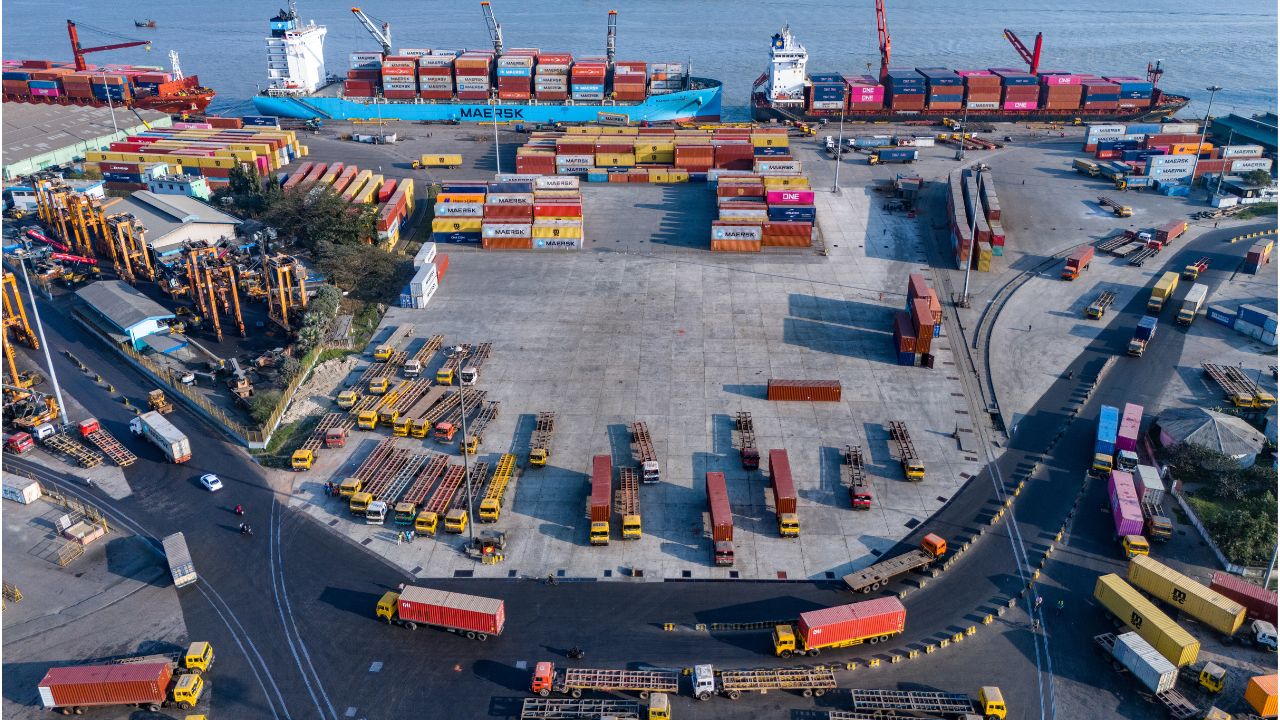
Chattogram port serves as the main maritime gateway connecting Bangladesh to global markets, placing it at the heart of the country’s trade for more than a century.
Established under British rule on April 25, 1887, the port has transformed from a modest anchorage for open hatch bulk carriers to a bustling container-handling hub.
As Bangladesh’s economy started gaining pace after the country gained independence, larger container ships became necessary to carry the import-export cargo of burgeoning local businesses.
As such, Chattogram port initially began container-handling activities in 1977, moving just 34,048 TEUs (twenty-foot equivalent units) in its first year of operations, while processing the same cargo volume would take merely days at present.
At one point though, the port’s General Cargo Berth (GCB) started struggling to cope with the growing number of containers.
So, recognising the need to match global standards, the New Mooring Container Terminal (NCT) was constructed in 2007 to significantly expand the port’s handling capacity.
With infrastructure designed to facilitate modern container operations, including five jetties stretching across more than 1,000 metres, the NCT was built with the expectation that it would be managed by a world-class global terminal operator.
However, that vision has been repeatedly derailed, often not because of policy disagreements or feasibility issues.
Instead, the blame should mainly fall on intense political lobbying, entrenched business interests, and organised resistance framed around one emotionally charged phrase: “national security risk.”
The lost opportunity of 2009
In 2009, shortly after the NCT’s construction, the Chattogram Port Authority (CPA) initiated a systematic and transparent process to bring in an operator from abroad.
The port shortlisted four of the world’s top terminal-operators, namely APM Terminals, Hutchison Port Investments, ICTSI, and P&O Ports, which had already been acquired by Dubai-based DP World in 2006.
These companies were invited to submit final bids, and the stage was set for Bangladesh to join the global trend of modernising ports through PPP-style global operator models.
However, the process abruptly collapsed due to pressure from influential politicians and vested groups within the ruling party.
But rather than selecting a world-class operator, the NCT’s management fell to Saif Powertech, a local supplier of port equipment.

And although the company had political backing, it lacked the necessary technical expertise or operational capacity to run a terminal built to match global standards.
From there, the NCT entered a lost decade, with bureaucratic complications delaying essential equipment purchases.
The gantry cranes that should have been installed shortly after construction began arrived only in 2015, while full equipment delivery was finally complete in 2018 – 11 years after the terminal was built.
During this long period of equipment deficiency, the NCT functioned with significantly reduced capacity, causing congestion, delays, and rising costs for traders.
Yet throughout the period, one narrative consistently resurfaced whenever global operators were considered: foreign involvement would pose a threat to national security.
‘Security risk’ becomes protesters’ main shield
Concerns over “national security risk” have taken centre stage in ongoing protests against appointing foreign operators to manage Chattogram port’s terminals, including the NCT and Laldia.
Platforms such as SKOP, Port Protection Council and other political, social organisations argue that Chattogram port is a strategically sensitive installation.
With vital state infrastructure, such as the Navy headquarters along with oil and energy facilities located nearby, they claim that placing any part of the port under foreign management would endanger national security and sovereignty.
Security analyst Major (retd) Emdadul Islam (Emdad) echoed the same, nothing that if a ship or tugboat were deliberately sunk to provoke hostility, naval vessels could be blocked from entering or exiting the port.
“That is essentially the primary security concern if someone attempts sabotage,” he said. “A foreign operator may be friendly today, but that may not remain so in the future.”



“They could even work in favor of another party. Besides, the terms of the proposed agreements are not being fully disclosed, which raises further concerns,” he added.
However, the CPA dismissed such claims as exaggerated and misleading.
As per CPA data, more than 4,000 vessels call at the port each year.
About 45 percent of these are container ships, another 45 percent are open hatch bulk carriers, and around 10 percent are liquid bulk carriers transporting oil, LPG and LNG.
All container vessels and some bulk carriers berth at the jetties, while most bulk carriers unload at the outer anchorage.
According to the CPA, traffic, navigation, berthing and departures remain strictly under port authority control.
“CPA’s pilots, not any operator, guide ships from the outer anchorage to the jetties,” said an official of the port authority.
“Linking national sovereignty to the appointment of foreign terminal operators is unrealistic. Security threats, if any, fall under the jurisdiction of relevant state agencies.”
Echoing this, Shipping Adviser Brigadier General (retd) M Shakhawat Hossain questioned the logic behind the protests.
He noted that Bangladesh has established border markets and constructed roads in sensitive frontier regions without sparking similar objections.
“So, is foreign involvement in Chattogram port inherently a security concern?” he asked.
Hossain also argued that the real motive behind the agitation lies elsewhere.
“Every year, corruption and illegal transactions worth around Tk200 crore take place around the port and NCT,” he said. “These organised groups fear losing their benefits, so they are using the rhetoric of ‘security risk’ as a tool to obstruct agreements with foreign operators.”
According to Brig Gen (Retd) AKM Shamsuddin, the port is vital for Bangladesh’s economy and defence, and foreign control risks the country losing authority over a key national asset, potentially affecting military logistics and trade during crises.
He said such arrangements create dependency on foreign operators, allowing them to dictate terms, raise costs or disrupt trade flows, which could undermine Bangladesh’s economic sovereignty.
Foreign entities might also gain access to sensitive cargo manifests, ship movements and economic data, posing intelligence risks, he added.
Chattogram Port Authority’s Member (Engineering) Commodore Kaosar Rashid dismissed the protesters’ claims that allowing foreign operators into the port would compromise national security, calling the allegations “unrealistic and baseless.”
He said DP World is a Dubai-based company and that Bangladesh has long-standing and friendly diplomatic relations with the UAE.
“Involving a company from such a friendly nation in the management of Chattogram Port does not pose any security threat — rather, it will further strengthen our operational capability,” he said.
Commodore Rashid added that Bangladesh will ensure all DP World officials assigned to terminal management are citizens of countries with which Bangladesh maintains strong diplomatic ties.
CDDL’s interim success raises new questions
In July 2024, after Saif Powertech’s contract expired, the Navy-run Chittagong Dry Dock Limited (CDDL) assumed temporary management authority over the NCT on 7 July. The outcome was immediate and dramatic.
On the day CDDL took over, 18 container ships were waiting at the outer anchorage, with each incurring $15,000 to 100,000 in extra charges depending on size and waiting time.
Each ship often waited up to seven days for a berth due to terminal inefficiencies.
By December this year, the congestion had nearly disappeared.
Port data shows that only one to three ships now wait at outer anchorage at any time. On multiple days, no ships waited at all.
The waiting time even dropped to “zero” on 9 days in September, 18 days in October, and 19 days in November. Meanwhile, crane productivity increased. Besides, the turnaround time fell from 61 hours to 57, and it is expected to soon reach 48 hours.
All 3,000 workers of Saif Powertech have continued working at the NCT uninterrupted, disproving claims that foreign or external operators would “take away local jobs”.
As such, the CDDL’s success has sparked an important debate.
If efficiency improved so quickly under temporary Navy-run oversight, what could be achieved by a global operator with decades of experience and advanced technology?
Why DP World and what’s in it for Bangladesh?
Why did the government select DP World, a Dubai-based giant, to operate the NCT under a government-to-government (G2G) agreement?
It is because DP World is not just any another port operator – it is one of the world’s most sophisticated port and logistics conglomerates.
As of today, the company operates more than 80 seaports and inland terminals across 60+ countries, including: India, Pakistan, Vietnam, and the UAE.
In India, DP World and APM Terminals have transformed productivity in ports such as Mundra, Cochin, and Nhava Sheva.
India’s largest private port group, Adani Ports, now handles one-fourth of the country’s total cargo across 13 ports in seven states, which are all operated by private or global operators.
Meanwhile, Bangladesh remains one of the few countries in South Asia still resisting global terminal operators due to internal political resistance.
The benefits of global operators are well documented: container handling in India is faster than in Bangladesh, requiring just one day as opposed to the three-four needed at Chattogram.
Why the agreement is stuck again
Chattogram port handles over 3.2 million TEUs each year, and the NCT alone accounts for 44 percent of this total, underscoring its critical role in the country’s maritime trade.
The CPA had been preparing to finalise the NCT’s operational agreement with DP World by 15 December.
However, the process has come to a halt following a writ petition submitted by the Bangladesh Youth Economists Forum and its president, Mirza Walid Hossain.
Deliberating on the writ, a split verdict was delivered by a High Court bench. As a result, the agreement will remain in limbo until further judicial resolution.