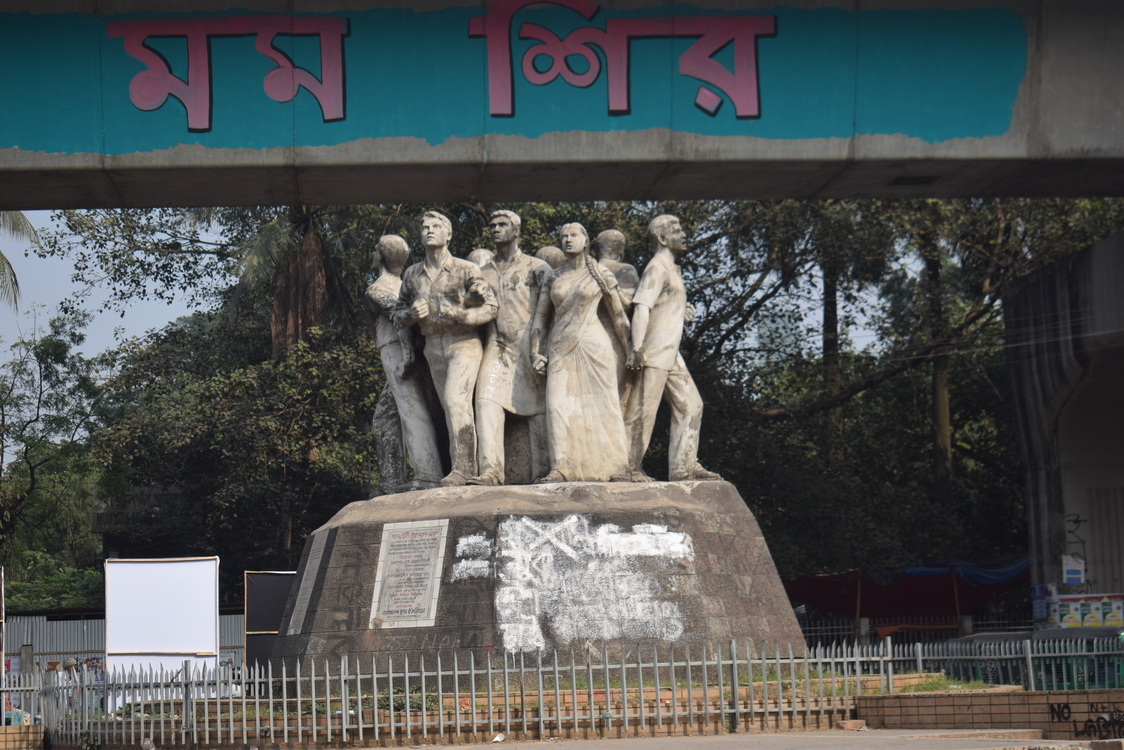

In Bangladesh, politics does not reside only in parliament or protest slogans. It lives in concrete, steel and stone. Across decades, the country’s struggle over political memory has been etched into monuments, museums and public spaces that claim to hold history still. Yet history here is rarely allowed to rest.
After the July 2024 Mass Uprising, the nation’s symbolic landscape entered another moment of rupture. Two sites now stand in sharp opposition. One lies in ruins, the Museum of Independence at Suhrawardy Udyan. The other rises with intent, the newly constructed July Memorial Monument at Shahbag. Together, they tell a story of erasure and resistance, loss and reinvention.

From the Liberation War of 1971 to the student-led uprising against quota discrimination in 2024, Bangladesh’s political identity has been shaped by an unresolved conflict between competing narratives. The moral authority of the Muktijoddha stands constantly challenged by forces historically aligned with the legacy of the Razakar. This battle is no longer fought only through speeches or textbooks. It is waged on walls, plaques and exhibition halls.

The Museum of Independence has long been a physical reminder of the liberation struggle. Yet its fate reveals how vulnerable memory becomes during political transition. In the power vacuum following the July uprising, a highly organised mob descended on Suhrawardy Udyan.


Unlike the spontaneous unrest seen elsewhere, this attack was deliberate. Exhibits were smashed. Documents burned. Liberation War artefacts, including weapons, were looted. It was not random violence, but an attempt to rewrite condemnation into absence.
Such acts follow a familiar pattern. When political actors fail to confront their own ethical or historical burden, they often turn to architecture. Vandalising monuments, altering inscriptions or replacing structures becomes an easier route to power than accountability. In doing so, history is not debated, it is physically dismantled.

Just a short distance away, Shahbag presents a counter-image. The July Memorial Monument, built in the aftermath of the 2024 movement, rises in iron and steel. Its design is intentional. Its material choice speaks of endurance. It reflects a generational insistence that memory must be protected, not left exposed to the next ideological storm.
These two spaces, one shattered, the other fortified, capture a nation in negotiation with itself. They reveal how Bangladesh continues to carry its politics through architecture, even as those structures are broken or reborn. In ruins and reconstruction, they document a country still deciding which histories it will defend, and which it will allow to disappear.