Political misinformation has seen a sharp rise in Bangladesh in the third quarter of 2025, with misleading claims about rallies, violence, and political statements dominating social media.
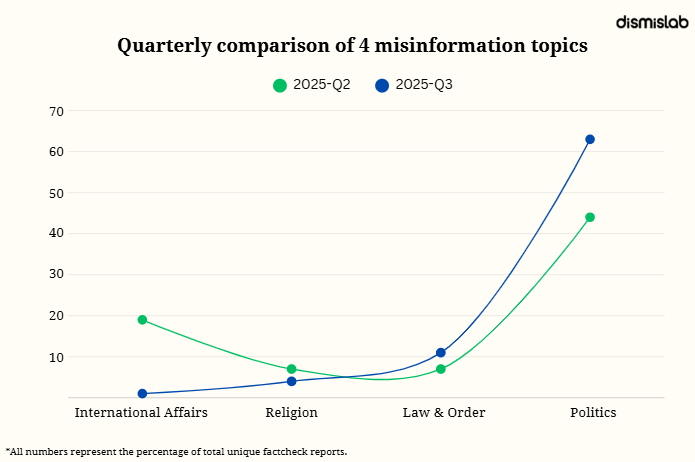
According to a recent report by a coalition of eight Bangladesh-based fact-checking organizations, political falsehoods made up 63% of all debunked claims between July and September, a significant increase from earlier in the year. This surge is linked to the upcoming February 2026 elections, which have become a focal point for misinformation campaigns.
Fabricated claims surrounding political events
False political claims have continued to revolve around fabricated reports about rallies, clashes, and fake statements by political figures. More than half (52%) of debunked political misinformation focused on these fabricated claims. High-profile incidents, such as the National Citizen Party (NCP) rally in Gopalganj, the commemoration of Sheikh Mujibur Rahman’s death anniversary, and the Dhaka University Central Students’ Union (DUCSU) election, fueled these falsehoods.

The spread of fake political information spiked after the July Gopalganj violence and the August 15 memorial for Rahman. Many misleading posts falsely claimed that the Awami League (AL), the party ousted in 2024, continued to hold rallies despite being banned. AI-generated videos were used to exaggerate the size of these rallies, with manipulated images and old footage passed off as recent.

Old videos and fabricated clashes
One of the most frequent types of misinformation involved old videos of rallies misrepresented as current events. In the case of the NCP rally in July, false claims about clashes between law enforcement and activists led to widespread rumors. Videos from other countries were falsely attributed to Bangladesh, including footage from Taiwan and Kenya, which was claimed to show violence in Gopalganj or Dhaka University. Fact-checkers found these videos to be unrelated to the claimed events, further compounding confusion.

Another common theme was false reports about political violence. Videos and images, often from past incidents or foreign locations, were misused to create a sense of instability and unrest in the country.
AI-generated misinformation and fabricated statements



AI-generated videos also became a key tool for spreading fabricated political statements. False quotes were attributed to political figures such as Chief Adviser Dr. Muhammad Yunus and Home Affairs Adviser Md. Jahangir Alam Chowdhury, manipulating videos to make it appear as though they had made controversial comments. These AI-generated clips ranged from fabricated election-related statements to fake criticisms of political opponents.

Election misinformation spreads rapidly
As Bangladesh approaches its national elections, misinformation related to the electoral process has become more prominent. False claims about vote-rigging, manipulated election statistics, and fabricated statements from political leaders circulated widely on social media. Misinformation also targeted the student union elections at Dhaka University and Jahangirnagar University, with fake reports of violence, fraud, and external interference.

AI-generated videos were used in several election-related misinformation campaigns, further adding to the confusion and polarizing the political landscape. For example, one AI video falsely promoted Awami League candidates, while another claimed to show an Islamic preacher discouraging voters from supporting the Jamaat party.
Misinformation on Law and Order and Foreign influence
The third quarter of 2025 also saw a rise in law-and-order-related misinformation, largely driven by false claims about the violence in Khagrachhari after the alleged gang rape of an indigenous girl. False images and videos of clashes in the hill district were shared widely, with misleading claims about the death toll and the involvement of security forces.

Conspiracy theories alleging foreign interference in Bangladesh’s politics also gained traction. Claims were spread that various countries, including India and Pakistan, had commented on Bangladesh’s political situation, or that foreign agents were involved in domestic affairs.
Videos dominate misinformation format
For the first time, videos became the dominant format for spreading misinformation, comprising 66% of all fact-checks, up from 48% in the previous quarter. The use of graphics, images, and text posts declined significantly, reflecting a broader shift in how misinformation is being disseminated online.
Decline in Religious and International misinformation
Misinformation related to international affairs dropped sharply, from 19% in the second quarter to just 1% in the third. Religious misinformation also declined, falling from 7% to 4% of all fact-checked content during this period.
As political tensions rise ahead of the February election, the spread of political misinformation continues to shape public discourse in Bangladesh.