Along the vast bends of the Padma and Meghna in Munshiganj, the autumn stillness is fractured by speedboats and hurried bargaining at makeshift fish bazaars.
To safeguard spawning mother hilsa and augment national production, the government enforced a 22-day nationwide ban on catching, transporting, stockpiling, and selling the fish from 8 to 29 October.
Yet hundreds of fishermen venture out in open defiance, alarming local residences who urge administrative surveillance expand from river channels to shoreline trading points.
In Louhajang upazila, the ban is flagrantly disregarded as mother hilsa is sold openly across multiple spots. At Kanaksar, along the Padma, makeshift markets run from dawn to dusk amid complaints of administrative laxity and absent oversight.
Fish are displayed in tiers and hung for sale at the Kanaksar bridge area, Singherhati, Bejgaon, Paschim Gaodia, Shamurbari Ghat, and embankments bordering Para, Gujob, and Baisha mouza, where substantial volumes of egg-bearing hilsa are traded daily.
In Shamurbari under Gaodia union, an open bazaar convenes thrice daily: 6am to 8am, noon to 4pm, and 5pm to 8pm. A one-kilogram hilsa sells for Tk2,000 to Tk2,200, whilst 1.5-kilogram fish fetch Tk 2,700 to Tk 4,000.
Informant networks, armed lookouts
The illicit trade relies on an informant network keeping poachers ahead of law enforcement.

Sharifullah, a Shamurbari resident, explained that merchants station lookouts at riverfront points, Purba Burdia Bormokam Bazar, Haridia High School intersection, and speedboat terminals to alert traders to approaching patrols.
Locals alleged a group armed with indigenous weapons stands by to resist enforcement teams. Sellers vanish during raids and resume once patrol craft leave, with riverside inhabitants observing poachers receive advance tip-offs to shift reaches unimpeded.
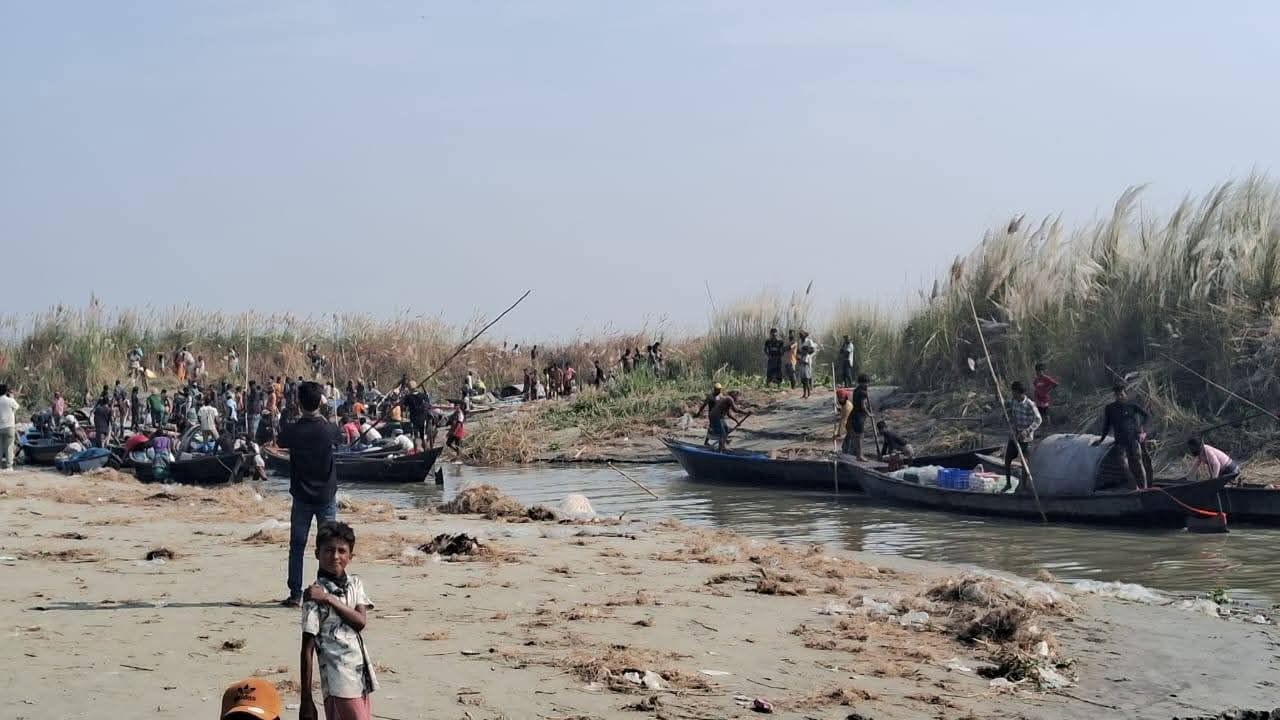
Over 100 vessels operate on the Padma, including dozens of boats and nearly 70 craft from Siddarchar, where fishermen pay daily rentals of Tk3,000 to Tk3,200 for nocturnal trips.
Allegations implicate fishermen from Mairel and nearby Kolma union settlements, boats from Shamurbari, Dohori, and Nurpur, and incursions from Siddarchar.
In Dohori, trawlers run by Aslam and Jalil Gazi ferry buyers across the river to buy brood fish.




Accusations of brazenly selling brood hilsa have been levelled against Kudduch Sardar of Mairel, and Nantu Ostagar, Sabuj Ostagar, Lokman Ostagar, Shafi Ostagar, Ali Ostagar, Swapon Ostagar, Bagha Mia, and Khorshed Ostagar of Shamurbari Ostagar Para.
River patrols, mobile court crackdowns
Despite poachers fleeing in fast trawlers, the administration, fisheries department, river police, and coast guard mount sustained river drives.
Last Friday, a morning drive on the Padma in Louhajang joined by Advocate Abdus Salam Azad, lawmaker for Munshiganj-2 and joint secretary general of the BNP, and Farzana Boby Mitu, upazila nirbahi officer of Louhajang, detained nine dishonest fishermen and seized illegal nets.
Earlier operations from 6am to 11am across Louhajang and Sreenagar, and 2pm to 3pm in Khancha and Shimulia, confiscated 130,000 metres of monofilament current nets and jailed 22 fishermen.
Rezaul Islam, senior fisheries officer of Louhajang upazila, said a Tuesday drive in Louhajang detained 14 fishermen and seized 130,000 metres of nets, adding that mobile courts would extend to Shamurbari, Singherhati, and other trading points.
He noted Shafi Ostagar of Shamurbari received a 15-day jail term from a mobile court for selling mother hilsa.
During recent joint drives with the Mawa Coast Guard and Mawa River Police, Farzana Boby Mitu, executive magistrate, sentenced 14 fishermen detained in Louhajang to 10 days’ imprisonment each, with 210,000 metres of seized nets destroyed.
In Sreenagar, Hafizur Rahman, executive magistrate, sentenced 20 fishermen to 10 days’ imprisonment each and incinerated 50,000 metres of nets, in operations attended by Rezaul Islam, senior fisheries officer of Louhajang, Monowara Begum, senior fisheries officer of Sreenagar, Malek Khasru Khan, in-charge of Mawa river police outpost, and administration and coast guard officials.
Breeding cycle, stock conservation
Administrative sources explained hilsa migrate between sea and freshwater rivers to feed and breed, a cycle jeopardised by siltation and riverbed changes. Outlawed gear, juvenile jatka netting, overharvesting, changing temperatures, and pollution threaten yields.
Bangladesh Fisheries Research Institute data shows average hilsa length rose from 27 centimetres in the 2023–24 financial year to 30 centimetres in 2024–25.

Authorities emphasised the 22-day programme provides vital growth room, with government food assistance provided during the ban alongside round-the-clock enforcement.
Experts observed seasonal bans alone cannot guarantee sustainability, urging measures to maintain river depth, curb pollution, eliminate destructive nets, protect jatka, and evaluate submerged shoals across the Padma and Meghna through surveys.
Coordinated research on hilsa size and colouration, linked with river management and enforcement, remains vital to safeguard riverine livelihoods and the economy.
Mounting fisher distress
Ecological disruptions cast a shadow over traditional fishing communities, with the Padma and Meghna supporting at least 30,000 fishermen across Munshiganj.
Fishermen and merchants pointed out catches are declining sharply, yielding fewer and smaller fish as silt and shoals obstruct migratory paths, causing economic distress amidst rising costs for boats, gear, and fuel.
Discussions have also arisen regarding the declining silvery sheen and noticeable body colour alterations in local hilsa.
Experts noted visual inspection of colour alone cannot determine a fish’s age, growth rate, or water pollution levels, stressing laboratory examination and water quality analysis remain necessary to safeguard this prized aquatic resource.