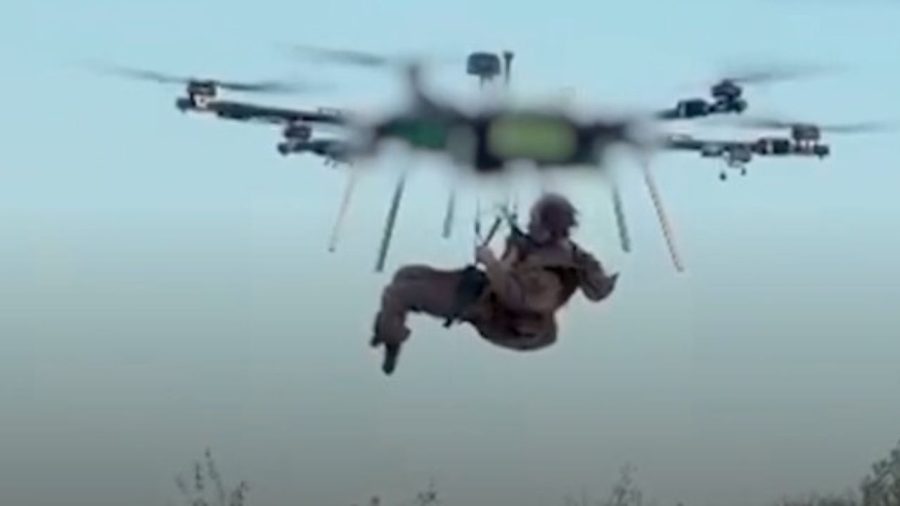



In a tragic yet extraordinary tale of human endurance, a 49-year-old Ukrainian soldier who amputated his own remaining foot with a knife to survive in an underground pit has been rescued by a giant remote-controlled drone.
Kostiantyn Vlasenko, a married infantryman in the 30th Mechanised Brigade, spent 491 days on Ukraine’s front lines in the Kharkiv region, including almost eight months holed up in a tiny boilerhouse pit beneath a bombed-out school, reports Reuters.
Vlasenko’s ordeal began in May last year when he was sent to a front-line position to join a fellow soldier, whose call sign was Basky. Huddled together in a cramped dugout, the two men relied on daily drone drops for food and supplies, including chocolate and premium cigarettes sent as a birthday gesture for Vlasenko.
Their isolation deepened in autumn when an attempted troop rotation ended in tragedy: two relief soldiers sent to replace them were killed on their way, as were two more soldiers dispatched to retrieve their bodies.
“That’s when I remember realizing that this would definitely be a turning point,” recalled Vlasenko, as the grim realization settled in that no one would be able to reach them.

After 10 months sharing the dugout, rising floodwaters in mid-February forced the pair to abandon their shelter and take refuge in a ruined school building. When the men emerged briefly to collect a dropped package containing dry clothes and food, a Russian surveillance drone spotted them.
Severing a foot to stay alive
A subsequent strike by a Russian attack drone killed Basky on his 50th birthday, ripped apart Vlasenko’s left foot, and severely fractured his right leg in the fall. Barely able to move, Vlasenko crawled into a cramped pit measuring just 80 by 60 centimetres beneath a metal heating boiler.




Trapped in the swarming “kill zone” – where massive armies of drones make any surface movement fatal – he watched his left foot gradually rot away while his broken right lower leg dragged behind him with the bone protruding. Three months later, working up the courage to survive, he used his knife to sever his right foot and applied a tourniquet to staunch the heavy bleeding.
“I had to amputate it because it was just dragging along behind me,” Vlasenko said from his bed at a hospital in Kharkiv, where he lay looking down at his two bandaged stumps. “I had already buried myself. I knew there was no hope left.”
Farther back from the front lines, commanders worked with the 92nd Assault Brigade to devise a way to save him. Traditional evacuations using pickup trucks or armoured vehicles were impossible owing to the constant drone threat, while two unmanned ground vehicles dispatched to reach Vlasenko were both destroyed by Russian strikes.
The heavy-lift drone
According to an officer in charge of planning, known only by his call sign Alex, rescue appeared impossible until they learned of a giant heavy-lift drone produced by local manufacturer Gurzuf Defence.
Resembling a massive insect with six vertical rotors on a black frame, the craft was capable of lifting up to 90 kg over 25 km – enough to carry Vlasenko, whose weight had dropped to roughly 70 kg.
In early October, a routine supply drop delivered an unexpected parcel containing a harness and a mobile phone loaded with instructional videos. On October 4, the six-propeller drone arrived, and Vlasenko clipped himself onto a carabiner dangling from its winch before being hoisted 70 metres into the air.
To protect the high-risk 15-kilometre flight from enemy attack drones, Ukrainian forces conducted a coordinated two-hour suppression operation, using artillery, fixed-wing drones, four first-person-view (FPV) drone teams, and three decoy six-propeller escort drones. After a tense 15-minute flight, the drone landed safely at an undisclosed location, completing what commanders described as the first known aerial drone rescue of a soldier in the conflict.
For Vlasenko, who survived near-fatal trauma and months of despair, the terrifying airborne escape held its own poignant fear.
“I wasn’t afraid of falling, say somewhere into the forest, I wasn’t afraid of that,” he said. “But I was afraid of falling into the water, because I can’t swim.”
Vlasenko’s survival story was corroborated by the Ukrainian military and video footage from a camera mounted on the rescue drone.