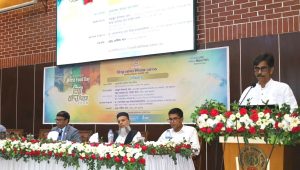
Prime Minister Tarique Rahman on Sunday unveiled plaques for various government development initiatives at the historic Sholakia Eidgah, where he announced a Tk17 crore project to improve facilities at the centuries-old Eid prayer ground.
Addressing the gathering, he noted that as lakhs of people assemble at the venue to offer Eid prayers, the government has taken the initiative to develop the field and make it more suitable for devotees so they can offer their prayers comfortably.
The prime minister revealed that Tk6 crore has already been released to the district administration, and development and beautification work will commence shortly.
During his visit, he also participated in a tree-planting programme organised by the Kishoreganj district unit of Bangladesh Jatiyatabadi Chhatra Dal, planting a sapling himself to highlight the importance of protecting the environment and increasing greenery.
He said the government intends to plant a large number of neem trees on the Eidgah premises, drawing inspiration from the Arafat Maidan, to provide shade and a healthier environment for worshippers, playing children, and local residents who visit for morning and evening walks.
He further urged local residents to take active initiatives to protect the environment of the Eidgah and its surrounding areas.

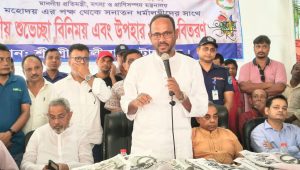
Speaking at a separate event at the Old Kishoreganj Stadium to inaugurate the distribution of Family Cards, financial assistance, and honourariums for religious personnel, the prime minister strongly urged the public to remain vigilant against those spreading confusion and rumours in the country, advising citizens to assess their activities in light of their past roles.
He cautioned that there are many “confusion-makers and rumourmongers” and asked the people to keep their “eyes and ears open.”
“The time has come to keep the country stable. We must not be misled by anyone trying to create confusion. If anyone comes to mislead the people, they must be given a befitting response as in the past,” Tarique said.



In an oblique reference to the opposition Bangladesh Jamaat-e-Islami, he recalled its role in 1971, 1986, and 1996, noting that the public had witnessed its stance during those periods.
The prime minister claimed that those currently trying to create confusion against the Bangladesh Nationalist Party (BNP) government had not been seen on the streets during the people’s movement of the past 17 years.
He highlighted that BNP leaders, activists, and allied political parties had faced severe repression, enforced disappearances, and killings during the movement, noting also that the BNP had presented formal reform proposals in 2022.
Emphasising the party’s ideology, the prime minister said the BNP’s politics is centred on the people and aimed at changing their fortunes. “Our goal is to work for the people and change their fortunes. Only by changing the fortunes of the people can we change the fortunes of the country,” he said.
He explained that the government’s political vision is to make every citizen economically self-reliant by creating employment, expanding education, and strengthening economic opportunities.
The prime minister reiterated that the government is actively implementing its election pledges following the mandate it received in the February 12 general election. These pledges include the Family Card, Farmers’ Card, tree plantation, canal excavation, the Notun Kuri sports programme, honourariums for imams, muezzins, and religious leaders, and the waiver of agricultural loans up to Tk10,000, including interest.
He expressed the government’s aim to develop agriculture and establish mills and factories to generate employment for unemployed young men and women. “People cannot be left behind if we want to move the country forward. We have to make every citizen economically self-reliant,” he said, adding that support is also being extended to meritorious students and people with disabilities to help them become self-reliant.
He noted that patience, peace, and stability are vital to implementing these commitments, as the government’s ultimate priority is to build Bangladesh as a welfare-oriented state where all sections of society receive state support according to their needs and enjoy dignity.
He specifically highlighted that the Family Card programme is aimed at empowering women, who make up half of Bangladesh’s population, with female heads of families being prioritised for the cards. “A country can never move forward by leaving women behind,” he said.
He urged the public to remain alert to ensure no one obstructs the government’s efforts to implement its political and development agenda, adding that the government is focused on implementing its election pledges rather than engaging in confrontational politics.
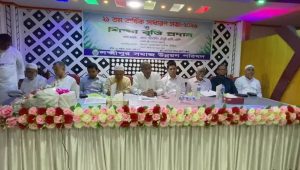
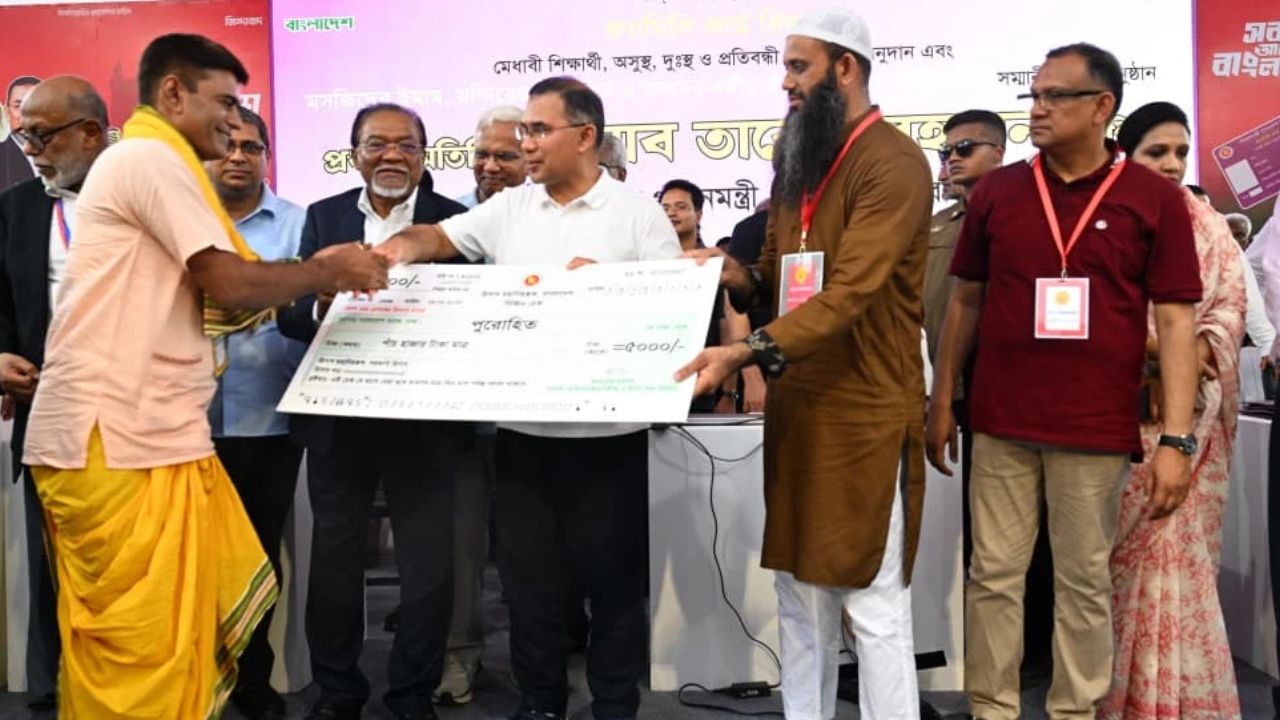
During the stadium programme, the prime minister distributed Family Cards to local women, handed over honourariums to imams, muezzins, and other religious leaders, and distributed financial assistance to the distressed and persons with disabilities. He also personally handed over a job appointment letter to a person with a disability.
The event was presided over by Social Welfare Minister Prof AZM Zahid Hossain. State Minister for Textiles and Jute Md Shariful Alam, along with local lawmakers Fazlur Rahman, Mazharul Islam, and Jalal Uddin, among others, addressed the gathering.
Later in the day, Tarique inaugurated the tree-plantation programme at the Sholakia Eidgah ground, concluding his daylong visit to Kishoreganj. His presence generated considerable enthusiasm among local residents, with people from all walks of life gathering to see him and hear his remarks.
He subsequently departed Kishoreganj for Dhaka by road, as confirmed by his Deputy Press Secretary Md Suzauddhowla.