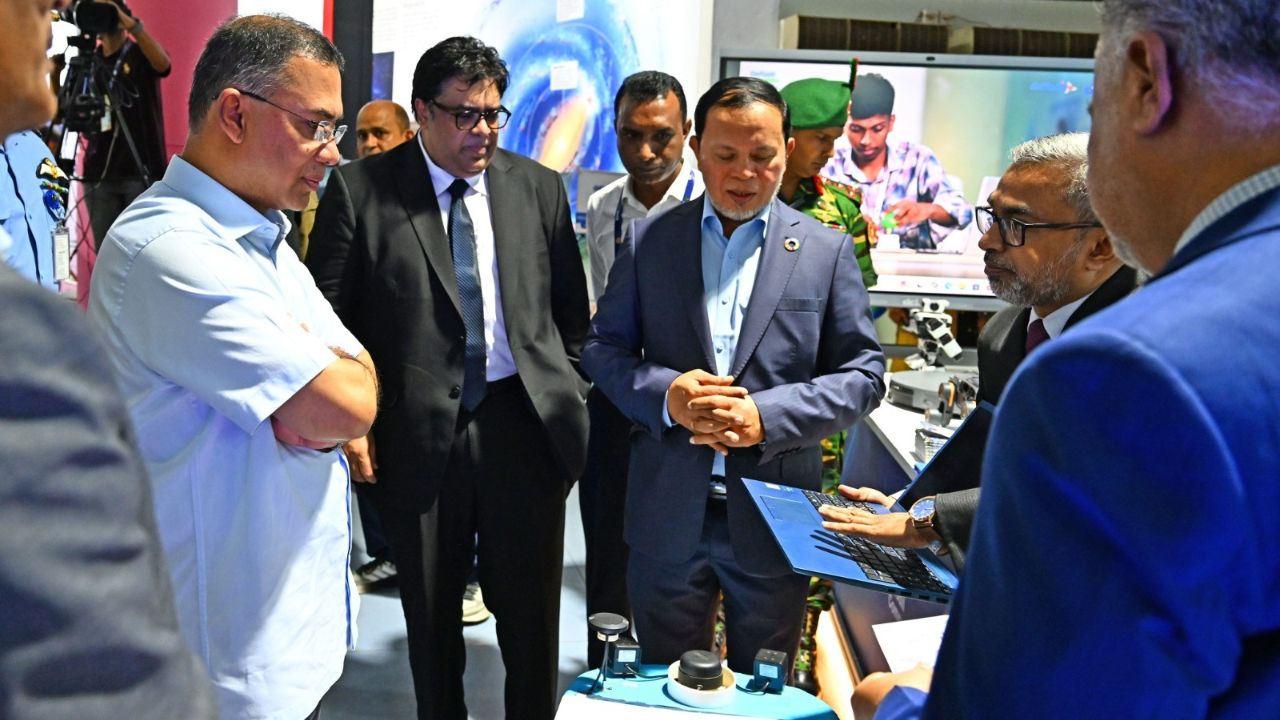

Prime Minister Tarique Rahman called for locally manufactured technology products to be strengthened and promoted in global markets under the Made in Bangladesh brand as he visited the Daffodil Computers pavilion at the Semiconductor Symposium and BEAR Summit 2026 in Agargaon, Dhaka, on Saturday.
Daffodil Group showcased its capabilities in artificial intelligence, robotics, smart manufacturing, electronics and the emerging semiconductor industry at the event held on 25 July at the Bhashani Novotheatre. The group said in a press release that it was presenting an integrated ecosystem linking education, research, industry and innovation to support Bangladesh’s transition towards a knowledge- and technology-driven economy.
Rahman toured Daffodil’s exhibits, focusing particularly on the laptop and ICT hardware manufacturing operations of DCL Hi-Tech.
He observed the company’s manufacturing capacity and praised the initiative, stressing the importance of strengthening domestic production and positioning Bangladeshi technology products in international markets.
The Prime Minister was accompanied by Faqir Mahbub Anam, MP, Minister for Posts, Telecommunications and Information Technology and Minister for Science and Technology; Rehan Asif Asad, ICT Adviser to the Government; and senior government secretaries.
During the visit, Rahman also held discussions with Dr Md Sabur Khan, Chairman of Daffodil Group.

Khan presented several innovative projects and technology-based solutions developed by students of Daffodil International University, saying the initiatives could support government development programmes in a more efficient and cost-effective way.
The Prime Minister expressed appreciation for the projects, while the accompanying minister and ICT adviser also endorsed the significance of the proposals.
Khan invited Rahman to visit Daffodil Hi-Tech Park, saying the facility was helping develop Bangladesh’s technology ecosystem and prepare skilled professionals for industry.




The Prime Minister responded positively to the invitation.
Khan also proposed reactivating the ICT Task Force, which was originally established in 2001 under late former Prime Minister Begum Khaleda Zia, to accelerate the development of the country’s ICT sector.
Rahman assured him that the proposal would receive due consideration.
DCL Hi-Tech showcased its electronics manufacturing operations, including Surface Mount Technology, Printed Circuit Board assembly, product integration and quality-assurance processes.
The displays reflected Bangladesh’s expanding capacity in electronics manufacturing, according to the release.
Daffodil Robotics presented solutions covering robotics, automation, embedded systems and AI-powered technologies, alongside industry-focused projects developed by students and researchers.
Daffodil International University displayed initiatives in artificial intelligence, the Internet of Things, cybersecurity, extended reality, capstone projects, start-up development and research conducted jointly with industry.
The university said the initiatives were part of its efforts to develop professionals equipped for future technology industries.
Daffodil Software exhibited several AI-powered products as part of its digital-transformation initiatives.
The products included AI Professor, Central AI, the Integrated University Management System and 1 Card, which were presented as tools to improve education, institutional administration and organisational efficiency.
Through its participation in the summit, Daffodil Computers sought to strengthen links with policymakers, universities, research institutions, industry leaders, development partners, investors and international technology organisations.
The participation was also aimed at creating opportunities for technology transfer, joint innovation, research cooperation and industry-academia partnerships.
The organisers said the combined ecosystem of education, research, industry and technology could contribute to the development of Bangladesh’s semiconductor and high-technology industries while equipping young people with skills needed to compete in the global technology sector.