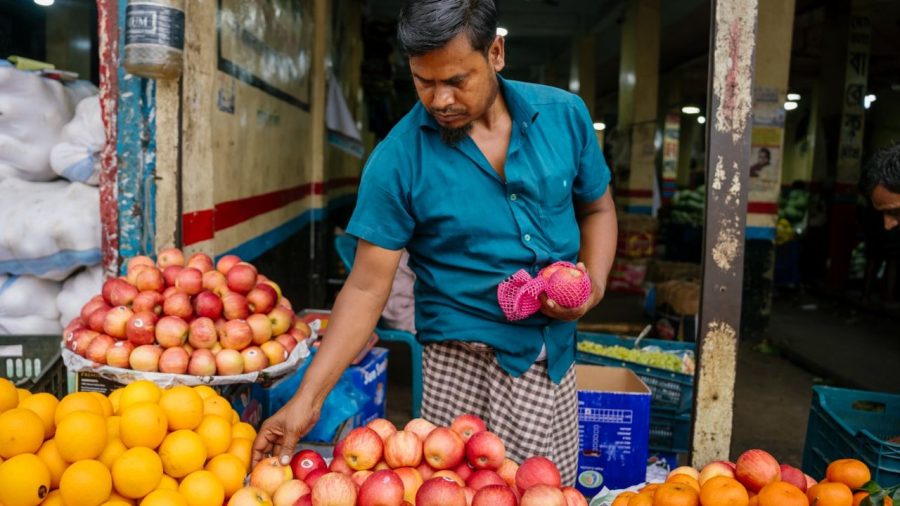



With dengue cases rising in Chattogram, relatives of patients are facing severe financial strain in the fruit market.
Although demand for liquid and nutritious items such as sweet lime, orange, apple, grape, and green coconut has surged for dengue sufferers, prices have escalated rapidly alongside demand. Consequently, relatives adhering to doctors’ advice are struggling to purchase fruit.
The situation has reached a state where taking a 500-taka note to the market offers no guarantee of receiving change after buying a single kilogramme of certain fruits.
According to data from the Civil Surgeon’s Office released on 25 September, 63 new dengue patients were admitted to hospitals in Chattogram in the preceding 24 hours.
Since 1 January this year, the total number of dengue infections in the district has reached 3,985, with 212 patients currently undergoing treatment across various hospitals.
As admission numbers have steadily climbed since early September, extra demand has surged in the fruit market. Mohammad Shahjahan, a resident of Hamjarbagh area, encountered this predicament while attempting to buy fruit for his child.
Hearing the steep prices of sweet lime, apple, and orange, he was ultimately forced to consider purchasing cheaper guava instead.

Footpath and van vendors are similarly enticing buyers by announcing, “Instead of apples and sweet limes, buy guava for just 80 taka; it is as sweet as an apple”.
Wholesale to retail jump
The price discrepancy between the wholesale market at Station Road’s Folmondi and various retail outlets across the city illustrates another dimension of the market.
In the wholesale market, a 20-kg carton of Chinese apples sells for Tk4,000 to Tk4,200, working out at Tk200 to Tk210 per kg.
An 18-kg carton of Brazilian apples sells for Tk4,000 to Tk4,200, whilst an 18-kg carton of South African apples ranges between Tk5,000 and Tk5,500. In retail markets, however, apple prices soar to between Tk300 and Tk400 per kg.
Similarly, a 10-kg carton of South African oranges fetches Tk3,500 to Tk3,800 wholesale (Tk350 to Tk380 per kg), but retail prices range from Tk420 to Tk450 per kg.




A 6.5-kg carton of red grapes sells for Tk1,850 to Tk1,950 wholesale, whilst white grapes of the same quantity cost Tk2,000 to Tk2,200. Yet retail red grapes command nearly Tk450 per kg, with black grapes completely absent from the market.
Meanwhile, a 15-kg carton of sweet lime sells wholesale for Tk5,700 to Tk6,000 (Tk380 to Tk400 per kg), but reaches up to Tk500 per kg in retail markets.
Purchasing multiple fruit varieties for a patient can thus push a family’s daily fruit expense beyond several hundred taka.
Prices vary further depending on location; Farzana Rubayet, a housewife from Mohammadpur, said whilst prices in her locality are lower, they increase by an extra Tk40 to Tk50 in hospital areas.
Traders deny artificial shortage
Muhammad Tauhidul Alam, general secretary of Chattogram Fruit Traders Association, said attributing the price hike solely to dengue-driven demand yields an incomplete picture.
He explained that import, transport, storage, and spoilage collectively drive up the actual cost of fruit. Because shipping fruit from abroad takes considerable time, a portion inside the cartons spoils, and this loss is ultimately reflected in the final retail price.
He nevertheless denied allegations that traders are artificially inflating prices by exploiting supply shortages.
Traders also highlighted the national deficit in dedicated cold-chain storage infrastructure suitable for imported fruit. Storing diverse goods in uniform refrigeration systems makes it difficult to maintain fruit quality and shelf life.
Moreover, operational overheads at the retail level contribute to high costs, with fixed shop and superstore expenses – including rent and electricity – reaching up to Tk40,000 per month, forcing retailers to maintain margins of Tk100 to Tk150 per kg.
Conversely, mobile van vendors face lower fixed costs, creating significant price variations per kg for the same fruit.
Prices may drop with large consignments
Traders anticipate potential market relief, as a major consignment of approximately 130 containers of imported fruit from China has arrived at Chattogram Port. Clearance procedures are scheduled to begin on Sunday following bank and customs reopening after the weekend.
Tauhidul Islam noted that if this substantial volume enters the market, wholesale prices could fall by at least Tk200 per carton, which may subsequently ease retail prices.
However, with rising dengue cases, whether fruit demand will abate despite increased supply remains uncertain. Stakeholders stress the dual urgency of expediting market entry for port consignments and monitoring price management from import through to retail.
Nazer Hossain, vice president of Consumers Association of Bangladesh (CAB), observed that essential fruit prices for dengue patients are currently inflated by Tk100 to Tk150 per kg in retail and wholesale markets compared to ordinary periods.
He highlighted arbitrary price gouging on fruit and green coconut across short distances in areas such as Bahaddarhat, Chawkbazar, and adjacent to Chattogram Medical College Hospital.
He pointed out that government tariff reductions on fruit imports have failed to benefit consumers, as prices remain unchanged.
“Our country’s traders turn any crisis or medical advice into an opportunity to raise prices,” he remarked, adding that their opportunistic mindset is so extreme that they would not hesitate to syndicate shroud cloth during a deadly pandemic.
He concluded that a lack of administrative oversight enables unchecked price hikes, demanding immediate, rigorous government market supervision to investigate and address unjustified price inflation.