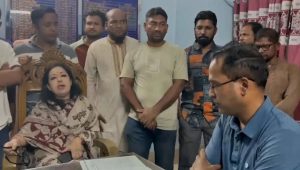
Despite repeated assurances from the government and law enforcement agencies that there are no extremist activities in Bangladesh, the recent discovery of bombs at several locations has sparked widespread concern.
Counter Terrorism and Transnational Crime (CTTC) unit of the police has established links between banned militant organisations and several bombs and improvised explosive devices (IEDs) recovered recently from the capital and other districts.
Investigators have noted a clear pattern connecting these incidents and following a raid in Savar and the subsequent recovery of a pressure cooker bomb, police have confirmed that the banned militant outfit Neo-JMB has been planting these devices in various locations with the intent of carrying out sabotage.
The group is reportedly amassing large quantities of explosives to manufacture different types of bombs as part of a major sabotage plan, with approximately 15 to 20 active members believed to be involved in this circle.
Escaping extremists, rising risks
The arrest of an individual named Arif has revealed his links to a notorious militant known as “Bomaru Mamun,” who remains active after being released from prison and is reportedly serving as an explosives trainer for the group.
Following Arif’s arrest in Savar’s Shyampur, he provided information regarding sabotage plans during interrogation, leading to ongoing operations.
Data reveals that since 5 August 2024, over 300 individuals arrested for militant ties have been released from prison on bail, while 98 inmates with militant affiliations were among those who escaped from various jails during that period.
Of these, four were death-row convicts out of nine sentenced to various terms, and while 28 have since been re-arrested, 70 remain at large.

Crime and security analysts warn that the escaped and bailed militants now pose a significant security risk, with Maj Gen (retd) Fazle Elahi Akbar suggesting that the creation of a “bomb panic” could be part of a geopolitical strategy aimed at destabilising the government.
Akbar emphasised that the matter should not be taken lightly, as trained individuals and significant investments are involved, urging authorities to trace the network to its roots and eradicate it entirely.
CTTC Joint Commissioner Munshi Shahabuddin told TIMES of Bangladesh that several recent incidents are the work of Neo-JMB, including the explosion at a madrasa in Keraniganj’s Hasnabad, an attack on a police officer at a Jatrabari checkpoint, the placement of an IED inside an umbrella on the Ratha Yatra route in Motijheel, and the recovery of two pressure cooker bombs in Ashulia.
A CTTC official of additional deputy commissioner rank noted that extremist members communicate online using “cut-out” methods and warned that the two pressure cooker bombs could have caused significant loss of life had they detonated.
While these militants are “homegrown,” they have gained expertise in bomb-making through online resources, though CTTC Chief Mohammad Shamsul Haque said extremist groups currently lack the strength or capability to organise large-scale sabotage.
Neo-JMB’s plot for nationwide attacks
Back on 1 July 2025, the then Dhaka Metropolitan Police (DMP) commissioner Sheikh Md Sazzat Ali had claimed there were no militants in Bangladesh.


Again, on 28 April this year, Home Minister Salahuddin Ahmed claimed there was no militant activity in the country, suggesting the term was previously used as a tool for political gain.
However, the history of “Bomaru Mamun” dates back to August 2017, when Neo-JMB members took up positions at “Hotel Olio International” in Panthapath, an event that led to the death of a militant named Saifullah Islam in a suicide blast.
A charge sheet named Nazmul Hasan, alias “Bomaru Mamun,” as a key figure; he is a top-tier leader and Shura member of Neo-JMB responsible for fundraising, manufacturing explosives, training, and planning attacks.
After being released from prison following the events of 5 August 2024, Mamun began residing in Keraniganj and Savar, joined by at least 15 others, including Sheikh Al Amin and Mohammad Arif.
This group reportedly began gathering bomb-making equipment, funds, and manpower for large-scale attacks across the country, with Mamun serving as the primary explosives trainer leading an active secret cell.
Police recently recovered a pressure cooker bomb wrapped in adhesive tape in the Sadapur area of Savar, which the DMP’s Bomb Disposal Unit later neutralised at the scene.
Residents in Sadapur had found a blue plastic drum containing clothes, a copy of the Holy Quran, and the pressure cooker in a field near the Laltak Ghora Mosque, reporting that three unidentified men had left the drum earlier that night.
Shift to concealed pipe bombs
Security analysts noted that militants frequently use IEDs due to the high risk of mass casualties.
Savar Model Police Station OC Md Saiful Alam confirmed the device found in Sadapur was a pressure cooker bomb, similar to one recovered on 30 July in Ashulia’s Khejur Bagan area; both bombs shared technical similarities.
CTTC officials revealed that militants are now also using common household water pipes to manufacture bombs, as they are easy to carry and conceal.
Technical similarities were found between the explosives recovered from the Shyampur residence and other recently discovered objects, and investigators are looking into potential links with the “umbrella bomb” found near the Motijheel metro station and the explosion at the Keraniganj madrasa.
On Tuesday evening, a joint team of the CTTC, police, NSI, and other agencies cordoned off a building in Savar’s Shyampur, resulting in the recovery of 13 pipe bombs and various bomb-making materials, including JMB leaflets.
The building’s owner said a man identifying as “Abbas Ali” had rented the flat on 2 August, claiming to be a driver from Pabna.
OC Saiful Alam told TIMES that a total of 14 bombs were eventually recovered from the area, following information provided by Arif Hossain, who was apprehended with five live hand bombs.
Heightened security, national alerts
In other actions, the CTTC arrested Neo-JMB member Minhaj Hossain in Dhaka’s Darus Salam area on 23 January this year, identifying him as an active member with links to the international group Hayat Tahrir al-Sham.
On 28 April, detective police arrested four individuals following the ideology of the banned Pakistani group Tehrik-i-Taliban Pakistan (TTP), who are members of an extremist group called “ARSA”, distinct from the Arakan Rohingya Salvation Army.
Further arrests followed on 5 July in Jatrabari, leading to the apprehension of six individuals, and based on their information, Md Tahsin Islam was arrested in Jashore on 9 July.
Additionally, on 19 July, Md Mamun Hossain was arrested at Hazrat Shahjalal International Airport (HSIA) for alleged involvement with extremist organisations.
In a related incident on 27 December 2025, an explosion occurred at the Ummah-al-Kura International Madrasa in South Keraniganj, injuring four people, including the director Sheikh Al Amin and his family; police recovered cocktails and bomb-making materials at the scene, leading to 17 arrests.
Police sources indicate that multiple alerts have been issued recently regarding potential militant attacks, resulting in tightened security and increased checkpoint searches.
On 27 April, Civil Aviation Authority of Bangladesh (CAAB) Chairman Air Vice Marshal Mostafa Mahmud Siddiq announced heightened security at all eight airports across the country due to the threat of extremist strikes.